


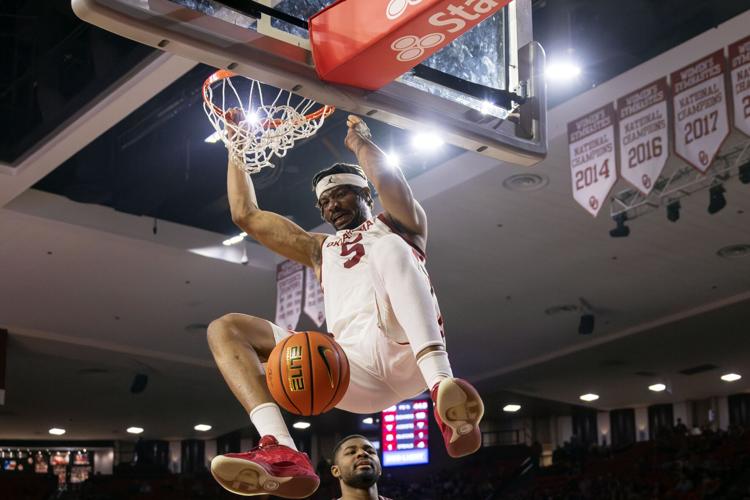
When OU senior forward/center Mohamed Wague breaks his fast at halftime or just before tipoff, everything slows down for a moment. The arena buzz, the TV timeouts, even the stakes of the late season fall behind the simple act of eating and drinking. Then, just as quickly, he’s back on the floor — a 6-foot-10 anchor trying to win games while his body adjusts to a completely different daily rhythm.
The holy month of Ramadan asks Muslims to abstain from food and drink from dawn to sunset, but for Wague, it also asks for something else: structure. His days start before sunrise with a large, carefully planned breakfast at 5:15 a.m., packed the night before by OU’s nutrition staff. He tries to take in enough calories and fluids to last through classes, practice and shootaround, all while managing the delicate balance between “enough” and “too much.” Too many fluids, and he feels heavy. Too little, and his energy dips before the ball ever goes up.
OU’s win at Texas (18-13, 9-9 SEC), a late-season overtime escape that pushed the Sooners to 17-14 and 7-11 in Southeastern Conference play, did more than add to their resume. It locked them into the SEC Tournament’s final tip slot, giving OU an approximate 8:30 p.m. start. That timing doesn’t show up on scouting reports, but it quietly tilts the floor for Wague. With sunset coming well before tip in Nashville, he can eat a more substantial pregame meal, complex carbs, protein and real hydration, instead of relying on fruit and quick sugars at halftime just to survive the second half.
“First half (against Louisiana State) he couldn't eat until halftime … at halftime he's full-blown eating," head coach Porter Moser noted ahead of senior night against Missouri. “His energy level in the second half … when Mo's playing well, look at how we're playing.”’
The numbers reflect that impact. When Wague is energized and out of foul trouble, his impact is obvious: the Sooners are 14-8 when he plays 20 minutes or more, 10-1 when he scores in double figures and 8-1 when he avoids picking up three or more fouls.
Since the start of Ramadan, OU is 4-2 with Wague averaging 9.8 points, 7.3 rebounds and two blocks per game, nearly three points better than his season scoring average of 7.1 points per game. Over his last five outings, he’s averaging 11.8 points, 8.6 boards and 2.2 blocks: the most consistent stretch of his OU career.
“I don't know if it's the time of year, but it sure seems like it,” Moser said on March 2. “This is the first time in his career he's had three straight double-figure games.”
His first night of this stretch looked nothing like that. In the Feb. 18 game at No. 25 Tennessee (21-10, 11-7 SEC), Wague fouled out in 10 minutes and did not score, as his body clearly still adjusted to the new demands of the month. Since then, though, he’s recorded four straight double-figure games for the first time in his career.
Wague’s Ramadan routine isn’t just a personal adjustment; it’s a shared experience. Since he arrived last season, Wague and OU’s performance staff have essentially built an entirely new routine on top of the regular season schedule. Last year, Ramadan began later, giving them one conference game before SEC Tournament play to adjust after former center Sam Godwin’s injury pushed Wague into the starting role. This year, the holy month began almost three weeks earlier, and the continuity of working with the same trainer and dietitian for a second year has changed everything.
"I had worked with Ramadan athletes before, but not that played basketball and are in like the biggest time of their careers,” OU men’s basketball dietitian Abbie Herkelman said. “We've been together now for two years … I think overall, we feel a little bit more confident in our approach, just with time and everything else.”
The staff’s planning comes down to the minute. On nights when Wague breaks his fast during the game rather than before it, Herkelman and assistant coach Ryan Humphrey constantly check the clock. If sunset hits at 6:55 p.m. and tipoff is just after, they’re tracking when they can afford to sub him out — not just for rest, but so he can finally take in fluids, electrolytes and a quick hit of sugar without feeling too full.
“I will tell Porter myself, like when we're at LSU, he was very aware that it was going to be around halftime when (Wague) was going to be able to eat,” Herkelman said. “I'm not saying that coach Moser necessarily makes plain decisions off of that, but it's just good awareness for him to have.”
The same coordination happens at home. If Wague’s fast is set to break in the middle of the first half, Humphrey will glance toward the bench, looking for Herkelman’s signal as they weigh game flow against Wague’s needs.
Even warmups are adjusted. On those days, OU reduces his pregame workload to conserve energy and limit excessive sweating before he’s allowed to refuel.
“We’re very, very strategic,” Herkelman said. “If it's possible that we can sub him out of the game so that we can get things in him as soon as possible, then we usually try to do that when it comes to, like his playing time and even when we're warming up … We're just monitoring that from like, a workload standpoint, you know, we also make accommodations to his sleep because he does have to get up early in the morning to pray and to eat, and so he gets a different timeframe of when he gets to come down for meals or different things like that, accommodations that we make for him just based on that.”
The routine bleeds into every part of his life. Because Wague has to be up before sunrise to pray and eat, his sleep schedule shifts as well. Late-night meals around 7:15 p.m. and again near 10 p.m. become normal on off-days, followed by a pre-dawn breakfast and planned naps throughout the day. Fans might hear an announcer mention that he’s fasting, but they rarely see the slow, intentional way his days are rebuilt during this month.
“People don't always realize that it's not like pulling up your weather app, and whenever your weather app says the sun's going to be up or down,” Herkelman said. “There's very specific timing involved in all of it … If his fast breaks in or around game time, pretty much every time he comes out of the game, he's got to eat something.”
Those internal changes have external results. On nights like OU’s overtime win at Texas, when Wague tips in a key miss and controls the glass late to put the Sooners up 83-82, his teammates see more than just physical presence — they see the payoff of staying committed when it would be easier to ease off.
“It's just been a difference. I don't know what it is. I know his faith is very strong,” Moser said. “When his minutes are low, like five fouls in 10 minutes against Tennessee … We struggle. When his minutes are up, it changes us.”
Inside the locker room, Wague is quiet by nature. He prefers, as Herkelman puts it, “to live in the shadows.” But Ramadan has pulled his routine into the spotlight, turning his private discipline into something the entire team can see and respond to.
“He is more than just a basketball player, and he's a very important part of our team. He's not only educated the staff, but also the players,” Herkelman said. “I think there's just something to be said about respecting someone's dedication to something, whatever that may be, like our guys don't have to practice the same faith or any of that, to just respect what Mo's doing. I think that can be contagious for a team to just be dedicated to the process and be dedicated to the wellness and well-being of themselves when this time of year is very exciting and also can be really hard.”
For Wague, it’s also his last run in college basketball. That urgency pairs with his faith, creating a version of himself that, people around him say, refuses to leave anything undone.
“It’s his last go,” Herkelman said. “He is the type of person that never wants to leave anything on the table. That's the way he plays every game, never wanting to feel like he left anything behind or have any regrets.”
As OU steps into its late-night SEC Tournament window, where the ball goes up after the sun goes down, the Sooners know their center will step onto the floor having already won a quieter challenge — one that starts in the dark, with a 5:15 a.m. meal and a commitment to keep going.
This story was edited by Laurie Jones.


