

Most law students were not interested in leading athletics operations 20 years ago, but now, many would not bat an eye.
Bob Lattinville, a former partner at Stinson LLP in St. Louis, had a unique conversation when Roger Denny spoke to him over lunch a couple decades ago about his interest in one day becoming an athletic director. Focusing on sports was not entirely uncommon at the time, but those who did often wanted to be agents. That rare ambition eventually took Denny to OU, where he is set to begin his first football season as an athletic director.
“I thought it was a really unique career aspiration because most people didn't (think that),” Lattinville said. “Most of the students that I had and some of the other young lawyers that I had spoken with that were interested in sports never really identified that as a career aspiration. They thought more about the kind of the traditional “Jerry Maguire” role; you're representing athletes. But when you think about it, how many different touches an athletic director has on the business of sports, Roger understood at a very young age he had a moonside view of everything.”
At the time of the meeting, Lattinville was a partner at Stinson and immediately saw a bright future for Denny. According to Lattinville, the firm managed a range of sports clients at the time, including the Kansas City Royals and Rawlings Sporting Goods.
“I thought, ‘This is great; I've got a young, smart guy that's interested in doing more than just representing athletes. He has a skill set that would be helpful across all of our individual and institutional clients,’” Lattinville said. “So after I met him for lunch, I'm like, man, we gotta hire this guy because he can help in a lot of different areas.”
Denny hit the ground running at Stinson. In Denny’s first week, Lattinville was working on a re-negotiation for the then-quarterback of the San Francisco 49ers, and Denny put together a detailed memo that impressed him.
“I didn't expect Roger to know the NFL Collective Bargaining Agreement other than what he might have read in the paper or something, …’” Lattinville said. “That document’s 300 pages. … He goes home that night, he reads it, cover to cover and he starts working on a memo that I would have expected somebody with 10 years of agency experience to work on. … It was excellent, and I used all of it when I responded to the 49ers.”
The work ethic and care that Denny demonstrated in his first week at Stinson demonstrated the level of diligence he brings to a task, one that sees it through and takes in every aspect, showing promise in law and as a leader.
‘Never shied away’

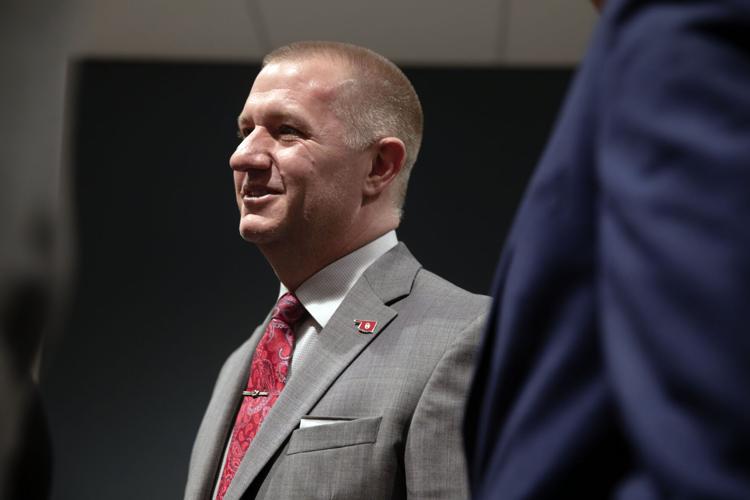
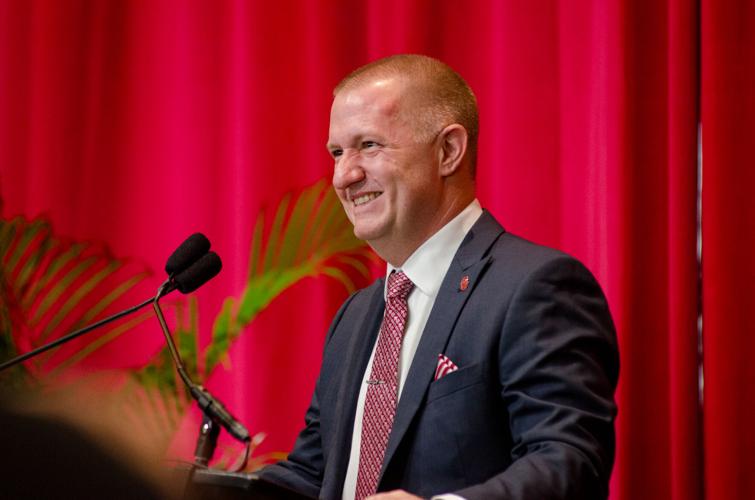
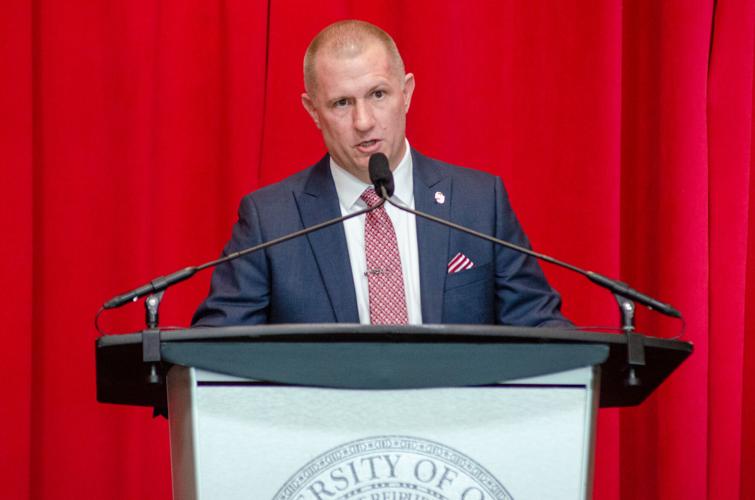
New athletic director Roger Denny after the OU Board of Regents meeting on Jan. 30, 2026.
Later on, Denny worked with Lattinville at Spencer Fane LLP, where he helped on mixed-use district plans around the ballpark of the MLB’s St. Louis Cardinals.
Lattinville said he worked under Denny in their later partnership, rather than over him, and he developed admiration for Denny’s steadiness. According to Lattinville, Denny kept the same attitude from athlete negotiations to city athletic projects.
“One of the things that I love about him the most is he is consistent,” Lattinville said. “He is authentic all day long. … Roger would always speak his mind, and he would do so in a very tactful way, very persuasive way. But he never shied away from disagreeing, and frankly, most of the time when he disagreed, he was right. … And quite often, even though he's 20 years younger than me, he would add a perspective to my representation that I thought really, really added value. … And I thought he was the best deal maker I ever worked for.”
While at Spencer Fane, Denny represented the bond issuers for Ballpark Village, the entertainment district in St. Louis. According to Denny, the Ballpark Village project took nearly seven years and required endurance, something he keeps in mind now when working on OU’s University North Park entertainment district.
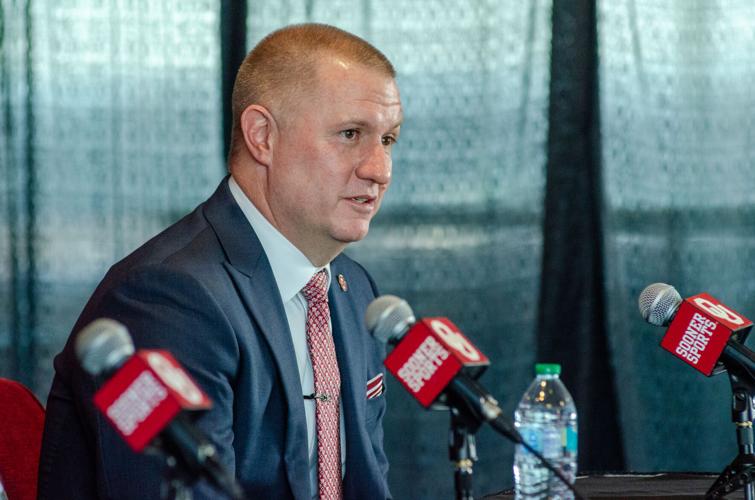
"You have to stay in it," Denny said at his introductory press conference on Jan. 28. "Big projects like that aren't easy, and a lot of them fall apart just because of the fatigue that comes with them. And the real work that goes into it is keeping the folks engaged, so that as that fatigue sets in, no one ever loses sight of all the reasons on the front end we said that (were) so important. … That's what we'll look to do (with the entertainment district)."
Lattinville was impressed with Denny’s work with Ballpark Village, and he sees it as a clear indicator that Denny will succeed as an athletic director. Denny handled the project knowing it was not simple for a lawyer.
“Most lawyers don't even mess with that kind of stuff, … because it's complicated, and the costs of having a false start and something like that are prohibitive,” Lattinville said. “He's a corporate transactional lawyer by education and experience, and 20 years ago, who would ever thought that that's like the ideal skill set to have as an athletic director? But if you ask me, that's exactly the kind of background that I think will do really, really well for Oklahoma.”
Denny stepped into athletics leadership at Illinois in 2021, serving as its deputy athletic director and chief operating officer after spending nearly 15 years practicing law. He joined the same year that name, image and likeness were introduced in college sports and felt he was a step ahead of other athletics leaders.
“I've been writing the words name, image, likeness in contracts for 20 years now,” Denny said. “I did a lot of work for professional athletes and sporting goods companies and media companies and things like that. A lot of those engagements were around licensed transactions that involve athlete and entertainer name, image and likeness.
“Even though that's a somewhat new concept now (and) almost five years old in college sports, that's not new in (the) sports and entertainment space, so I’ve got a lot of experience.”
As deputy athletic director, Denny worked alongside Illinois athletic director Josh Whitman, who also has prior experience in law. According to Lattinville, their understanding of the evolving landscape of college sports sets them apart.
“They both had a really, really unique understanding of the business,” Lattinville said. “So I think they had everything covered there, and their personalities complement each other just perfectly. … I really think that those guys were a super team at the University of Illinois.”
Whitman knew before Denny stepped into Illinois athletics that they would be a great fit, especially considering the direction of college sports.
“I thought that he had a really strong grasp of not only what was happening in college athletics, but what we thought was going to happen, and just felt like a nice fit from a personality perspective,” Whitman said. “It aligned well with my style and (I) thought that he could come in and be a tremendous asset for our program, which he was.”
Whitman helped Denny become a better communicator, according to Lattinville.
“Roger always had all the horsepower in terms of intellect, but what he learned from (Whitman) was ways to communicate that to a whole host of university stakeholders that learn or understand it from their perspective,” Lattinville said.
Whitman added that while at Illinois, Denny was able to gain a better knowledge of the operations of athletics that he was not able to grasp from an outside view working in law.
“He had always been on the outside looking into an athletics program, and so when we hired him, it gave him his first 24/7, 365 glimpse of the day-to-day operations of a college athletics program,” Whitman said. “And he was able to gain an understanding of not only the pace and the intensity but also some of the internal dynamics and how universities function.”
According to Whitman, the deeper knowledge of college athletics’ processes helped Denny succeed at Illinois and earn the athletic director role at OU.
‘Meet this moment in college athletics’

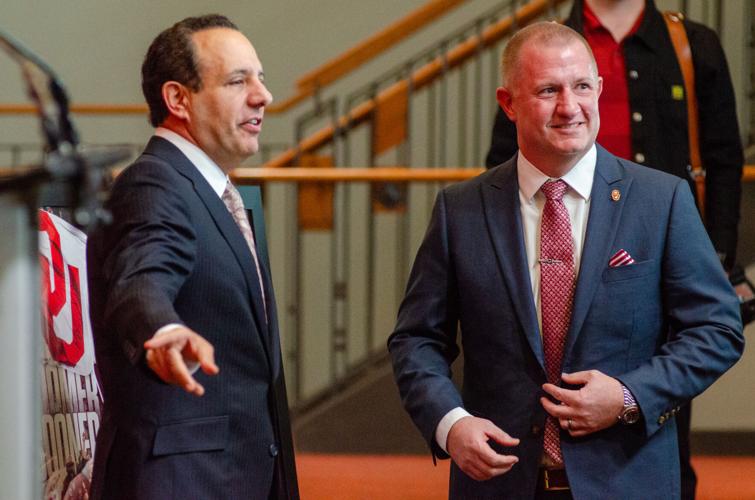
President Joseph Harroz Jr. and Roger Denny during the event announcing Denny as the new OU athletic director on Jan. 28.
OU President Joseph Harroz Jr. was clear about why he hired Denny during the athletic director’s introductory press conference.
Harroz believes Denny can thrive in the evolving, chaotic landscape of college football. As challenges unfold, OU wants to compete and build excellence.
“The question was, 'Can we be truly innovative to meet this moment in college athletics, understanding what the disruption is? ... ’" Harroz said. "The key is, 'How do you make sure you have the skill sets not just to compete in this new era, not just to maintain our historic competitiveness, but can we use this moment to increase dominance, build dynasties and help shape at the national level what a sustainable model for college athletics can be?'"
Since Denny officially started in the role on Feb. 15, he has been candid about how he looks to improve OU athletics, including better support for basketball programs, sustained success across the board and improved fan experience.
Denny has backed his plans up by hiring a general manager for each basketball program and overseeing national championships for women’s gymnastics and baseball. He is also pushing ahead with the Palace Project and plans for a new basketball and women’s gymnastics arena and secured a new contract for football head coach Brent Venables.
Denny still grapples with the challenge of prioritizing finances to sustain excellence while keeping fans engaged. As he moves forward with the Palace Project, which will decrease OU football stadium capacity by about 7,000 seats, Denny is listening to fans — but not slowing down.
“I understand the difficulty that's associated with a reseating in the stadium,” Denny said. “But at the same time, we have to make sure that we are staying economically viable because the one thing that we can't accept here is falling behind.”
Just like in his days working for law firms, Denny seeks to see issues from every side and understand priorities. Now, according to Lattinville, it is not surprising Denny was interested in athletics 20 years ago.
“Hindsight is 20/20 … if I was a law student now and I was thinking about doing something in sports, the opportunities are practically boundless, …” Lattinville said. “There's just so many issues out there that need to be addressed, and … that's something that a young Roger Denny recognized his first year at law school.”
Denny is set to begin his first football season as an athletic director Friday, and even with success in the past six months, some of the fanbase will not be satisfied without excellence on the gridiron. But according to Lattinville, Denny’s diligent attitude and law experience has prepared him to meet the moment.
“That's what I think really makes … his skill set so valuable in this era of college athletics,” Lattinville. “He understands the business, he understands the law and he understands the regulation. … He understands better than almost everyone where (athletics) is heading and how it needs to get there.”
This story was edited by Charlie DiVincenzo. Kylie Caldwell, Andrew Higgins, Larkin Bock and Tori Pham copy edited this story.


