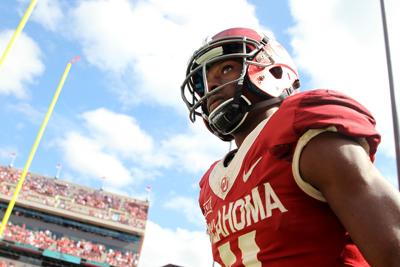
It was a routine play. Dede Westbrook was lined up at the safety position, poised to move at the quarterback’s word.
Down. Set. Hut!
Westbrook flew down the field, neck and neck with the opposing team’s receiver. In his peripheral vision, he saw the ball coming toward him and figured he had a shot at it. He jumped and reached for the ball at the same time as the receiver, and the two collided.
"I kind of landed on top of him and — me being draped over him — his knee went into my stomach and he ruptured my small intestine," Westbrook recalled.
He missed the rest of his senior high school season after playing in just seven games — but he avoided the original diagnosis: Westbrook might never play again.
“The doctor told me there was a huge possibility I would never play football again," Westbrook said. "But I overcame those odds, and here I am now."
Westbrook has come a long way since his high school days. From his high school injury to making it out of Cameron and finally to Oklahoma, Westbrook continues prove doubters wrong.
“I trained like crazy to pretty much prove everybody wrong,” he said. “And that’s what I did.”
Surprising success
Westbrook is fresh off one of the most prolific calendar months in college football history. He finished October with 881 yards and 11 touchdowns — both Oklahoma records — and has also taken over kick return duties.
He's started to pick up national praise, even landing some Heisman consideration. Quarterback Baker Mayfield knows how important Westbrook's emergence has been and has started deflecting Heisman talk toward his star receiver.
In the first quarter of Oklahoma’s track meet against Texas Tech in mid-October, Westbrook made his presence known.
On what looked like an overthrown pass, Westbrook scored from 49 yards out, chasing down a long, deep ball in the back of the end zone from Mayfield.
“I thought I missed him, but you cannot overthrow No. 11,” Mayfield said after the game.
That theory has proven true for Mayfield repeatedly this season. Westbrook got healthy over the Sooners’ bye week after playing injured through the first three games.
He now has 1,100 receiving yards in seven Big 12 games and leads all power five receivers with 1,254 yards on the season. He's also second among power five receivers with 14 touchdowns, just trailing behind Washington's John Ross, who has 15.
“Sterling was a workhorse. He was a guy that was pretty much the go-to guy, and I was just sitting back waiting until my number was called,” Westbrook said. “I don’t really care about the numbers. It’s exciting, but at the end of the day I just want to play football.”
But as valuable as Westbrook has been to the Sooners in 2016, he was even more necessary at Cameron Yoe High School.
Westbrook’s near-career-ending injury happened despite the use of special pads to protect his midsection. The injury happened when the receiver’s knee came in between the pads to rupture his intestine — but the fact he had pads in the first place meant he was a special player for the Yoemen.
“They run about $75 a pair,” Rick Rhoades, Westbrook’s high school coach, said. “We obviously could not afford to get every one of our players the EvoShields, so we were pretty selective in who we gave them to.”
Westbrook played multiple positions for Cameron Yoe. He primarily served as a receiver, but also as a running back and a safety; in the time he spent as a running back, he averaged 12.3 yards per carry.
OU coach Bob Stoops said that Westbrook is the fastest Sooner receiver since Mark Clayton — high praise from a coach who has seen several impact receivers come through Norman.
Small town, big dreams
Despite his success on the football and track fields, Westbrook had hurdles to clear elsewhere in life.
He didn’t receive any Division I offers out of high school because he struggled in the classroom. He attended Blinn College, a junior college in Brenham, Texas, for two years before coming to OU.
“He didn’t qualify to go to a Division I school, and Blinn gave him a chance to go and get his grades in order and get his associate degree and then move on to a Division I school or four-year school," Rhoades said.
He also had some assistance in getting out of Cameron, Texas — a place not many escape.
“His mom was a very stable force in his life,” Rhoades said. “She was pretty strict on the kids. She would do things like, at nine o’clock, she would make them put their cell phones away and things like that.”
He’s one of a handful of athletes Rhoades has seen come out of Cameron, which has a population of about 5,500.
“As far as (Westbrook’s) ability to catch the ball and do things in open space, he’s got to be near the top,” Rhoades said.
Westbrook has proven that time and time again in 2016.
“Coming from a small town, it’s really not possible for any of us to make it out,” Westbrook said. “The odds are very low for us. For me to beat the odds and come out and be good at the next level feels great.”


