

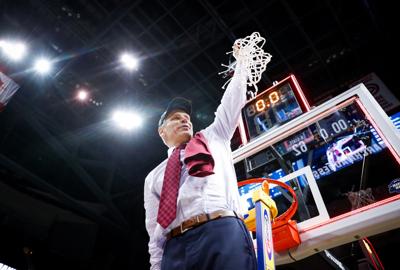
On the final morning of Loyola-Chicago men’s basketball’s 2017 preseason bootcamp, players entered an empty locker room.
The only item left behind was a note informing them they had 20 minutes to find their coaching staff.
Head coach Porter Moser had his players sprinting across campus, unearthing clues and searching for him and the other coaches. Finally, within a movie theater inside the Loyola student center, the players found their coaches and the music video for “One Shining Moment,” the song communal with March Madness, playing on the screen.
“This is your ‘why,'” Moser explained to the players. “This is why you went through bootcamp. This is your ‘why’ as we go into this season.”
That season, Loyola made it to the NCAA tournament for the first time in 37 years and made it to the Final Four as a No. 11 seed, which has happened only five times in history.
“It was inspiring for us,” former Loyola player and current OU assistant Clayton Custer said. “It was just a really cool idea that Coach Moser had to kick off the year and get us ready to go.”
Moser, a Chicago-area native from Naperville and a die-hard Cubs fan, coached his hometown Ramblers for 10 seasons before he was hired to be Oklahoma’s head coach on April 3, 2021. He became the school’s 14th head coach in its history after the legendary Lon Kruger retired, and will coach his first game for the Sooners on Nov. 9 in Norman vs. Northwestern State.
From his experiences at Loyola and beyond, Moser has learned to take his time, create a distinct culture and build a program that will last long after his tenure.

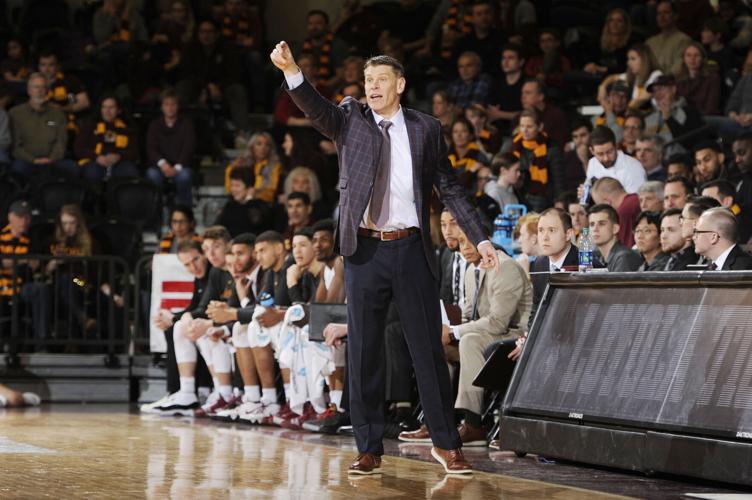
Coach Porter Moser during one of Loyola-Chicago's games against Bradley.
'He was a leader even at that young of age'
Eleven-year-old Brian Barone watched as his father, Creighton head coach Tony Barone Sr., and junior guard Porter Moser led their team to a Missouri Valley Conference Tournament Championship win over Southern Illinois on March 7, 1989.
Barone Jr., now the head coach at Southern Illinois Edwardsville, vividly remembers his father raving about the future Oklahoma head coach in his postgame press conference, calling him “the best shooter on the team,” and rebutting the claim that the team’s best players were walk-ons. While Moser did walk on to play at Creighton, he was more than a walk-on caliber player in Barone’s eyes.
The Blue Jays had just won their first of two conference tournament titles under Barone Sr. after going 20-11 in the regular season and previously beating Indiana State and Drake in the first two rounds of the tournament. Moser averaged 6.4 points per game on 40.4 percent shooting and 37.4 percent from 3-point range for the season.
Like most college basketball players, Moser was a star in high school. He scored 1,203 career points and grabbed 401 rebounds, earning all-state honors at Benet Academy in Illinois. He helped his team achieve a 102-game home winning streak and was inducted into the Illinois Basketball Coaches Association Hall of Fame as a player in 2017.
After high school, Moser decided to take his talents to Omaha and walked on at Creighton. However, things didn't begin as smoothly as he hoped.
“I go to Creighton and I’m like the 10th guard out of eight of us,” Moser joked at a leadership event in September. “Two managers were ahead of me on the depth chart.”
After appearing in only 12 games and starting zero games during his freshman season, Moser seriously contemplated quitting basketball or transferring to a different school where he could play more. His decision to stay with Barone Sr. instead of chasing a greener pasture changed his life forever.
Moser didn’t get immediate gratification, nevertheless, because at the beginning of his sophomore season he didn’t play either. It wasn’t until near the end of the season during a week off after a loss to Notre Dame that Barone Sr. said the five guys who worked the hardest during the week were going to start the next game.
Not only did Moser start that game, but he started all 27 games for the rest of his career.
“He was, in terms of a player, a guy that earned everything and every opportunity that he was given,” Barone Jr. said. “I remember my dad talking about that blue-collar willingness to give everything he could to the team.”
After winning the conference title and averaging 6.4 points per game during his junior season, Moser and the Blue Jays punched their ticket to the NCAA Tournament for the first time in eight years before losing to Missouri in the first round.
In 1989-90, Moser’s senior season at Creighton, he led the Missouri Valley Conference in 3-pointers with 55. He also averaged 6.2 points per game, two rebounds and nearly three assists a game. He finished with 469 career points at Creighton and graduated with a business degree.
Moser’s father, Jim, was the CEO of Moser Lumber back in Naperville. After college, Moser’s father asked him to come work for him in the lumber business like his siblings had upon finishing school. Moser turned down his father’s offer and told him he was going to work as a volunteer coach.
“He looked me in the eye and he said, ‘Is that what your passion is?’” Moser said. “I said, ‘Dad, absolutely,’ and he said, ‘My company was my passion, you’ve got to go with yours.’”
Barone Jr. can recall several instances where Moser volunteered to help run his father’s basketball camps or stayed late to proctor study hall.
Being present and involved in every aspect of a program is something Moser learned from his father during his time at the lumber business. He remembers workers, be it the janitor, chief financial officer, forklift driver or a salesman, telling him, “Jim Moser made me feel like the most valuable person here.” Ever since, he’s strived to have the same impact on people as his father at all levels of a program.
Matt Gordon has coached with Moser for nearly his entire 15-season career, his first impression coming at Illinois State.
“I remember him coming in with just a huge influx of energy,” Gordon said. “He’s an extremely energetic person and that’s never gone away in all the years that I’ve known him.”
Gordon, currently special assistant to the head coach and director of recruiting at OU, was later with Moser on Rick Majerus’ Saint Louis staff.
Majerus, who died in 2012, was a hall of famer and coached college and professional basketball for over 40 years. He served as head coach of Marquette, Ball State, Utah and Saint Louis. He led the Utes to a national championship appearance in 1998, but fell to Kentucky. He’s often referred to as Moser’s mentor.
After being fired from being the head coach of Illinois State in 2007, Moser went to Saint Louis to be an assistant again and to seek help from Majerus to save his career. At Illinois State, Moser tried to go too fast which resulted in only one winning season out of four with the Redbirds.
Majerus showed him how to build a culture that lasts in a program. After getting the Loyola job, Moser received a handwritten letter from Majerus that read: “Porter, be obsessed with the process of it, you’re trying to build a program, not a team. Don’t go too fast.”
“I can just tell the way he adapted from when we were at Illinois State,” Gordon said, “To then learn from (Majerus), and then when he got to Loyola he had such a clear vision of how he wanted to build it and build it the right way.”
Moser still keeps the letter Majerus wrote to him years ago and it has helped him endure early struggles and construct a program that will last.
Barone Jr. still jokes about a time during a basketball camp when Moser was making the rounds checking on dorm rooms after curfew. Barone and his friend were up late, talking and joking around when Moser busted open the door and realized it was the coach's son up past curfew.
“Hey, it is what it is,'' Moser said. “Wall sits.”
While Barone Jr. laughs about the occurrence today, he realizes just how important it was to Moser to be a leader even if it was small things like that.
“As I look at it as I'm older, he was a leader even at that young of age,” Barone Jr. said. “Not necessarily the best player on the team, but he was definitely a leader. Now at the time, I just knew that when Porter was in the room, he was a heck of a lot of fun to be around."

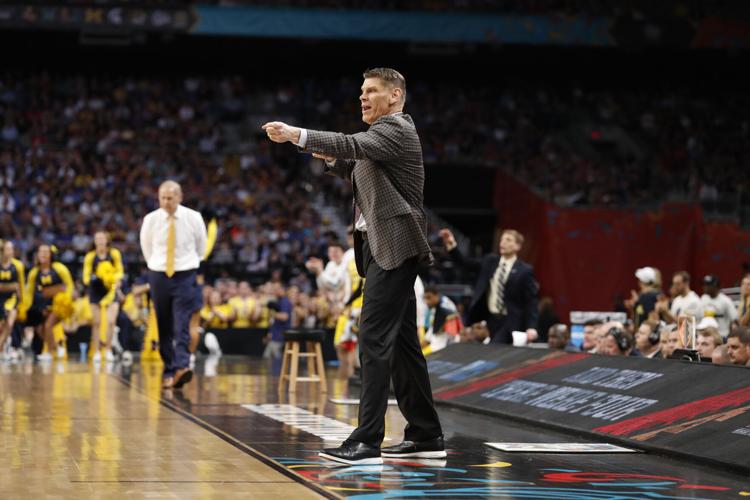
Coach Porter Moser during Loyola-Chicago's NCAA Tournament Final Four game against Michigan on March 31, 2018.
'All that stuff was all part of the winning culture'
A curious 42-year-old Moser was going through his new belongings in his new office when he spotted an old photo in a closet. It was of the 1963 Loyola-Chicago national championship team sitting on a convertible stuck on Sheridan Avenue in Chicago amid crowds of people at their championship parade.
In 2011, after 27 losing seasons in the previous 30 years, Loyola athletics director M. Grace Calhoun figured it was time for a change in leadership.
Enter Porter Moser.
Since the Ramblers’ national championship in ’63, the season of the Game of Change, a game in which Loyola had four Black starters in its second round game against the all-white Mississippi State during the era of segregation and the subject for the upcoming film, “The Loyola Project,” the Ramblers had struggled to stay relevant for almost five decades.
“This is the excitement I want surrounding the Loyola program,” Moser said as he hung the picture up.
Not long after arriving at Loyola, Moser heard from anyone and everyone that winning just can’t happen in Chicago because it’s a pro town engulfed by the Bears, Bulls, Blackhawks, Cubs and White Sox. Nobody went to Loyola’s games.
“I could’ve taken my driver at the first media timeout at half-court and swung,” Moser said. “It would’ve been like one of those putt-putt things and bounced around the stands.”
Moser wasn’t going to have that. He was going to do his best to get students in the stands.
“(Moser) would go knocking on doors,” said Joe Crisman, who played at Loyola under Moser from 2011-15. “He would hand out hotdogs to students asking them to come to the games, inviting them to come to practice, all that stuff was all part of the winning culture, and that was his vision.”
It worked. More and more crowds started showing up to the games until finally a ticket to a Loyola basketball game became one of the hottest commodities in the city. Gordon can remember the last regular season game of the 2017-18 season against Illinois State where the crowd was especially large.
“It was No. 1 vs. No. 2 in the league,” Gordon said. “If you went on StubHub, we actually had a graphic of it. Our ticket for our game was more than double the price of what it was to go to the Blackhawks hockey game, Bulls basketball game and Fire soccer game that night.”
After the regular season, the Ramblers went on to win the Missouri Valley Tournament championship, punching their ticket to the NCAA Tournament. They beat Miami (FL), Tennessee and Nevada in close contests before blowing out Kansas State in the Elite Eight.
After beating the Wildcats to advance to the Final Four, Loyola arrived back in Chicago to a sea of fans celebrating the achievement. As the team bus rolled down Sheridan Avenue, people started running out of bars, pulling out their phones, honking their horns and the bus became trapped on the street. Moser couldn’t help but think about the photo taken 48 years earlier and how far the program had come since his arrival.
Gordon remembers the Chicago skyline being lit up with Loyola colors and the Blue Cross Blue Shield Tower reading “Go Loyola.”
“That was a Chicago moment,” Gordon said. “We’ve seen that building a million times growing up as kids that said nothing but pro sports franchises, not us.”
Fast forward to 2021 and the 43-year-old Barone watched Moser’s Loyola team practice ahead of the Missouri Valley Conference Tournament.
The Ramblers were the No. 1 seed in the tournament and were led by standout center Cameron Krutwig. They were fast, skilled and physical in everything they did. They were coached and played with energy using the now legendary Culture Wall.
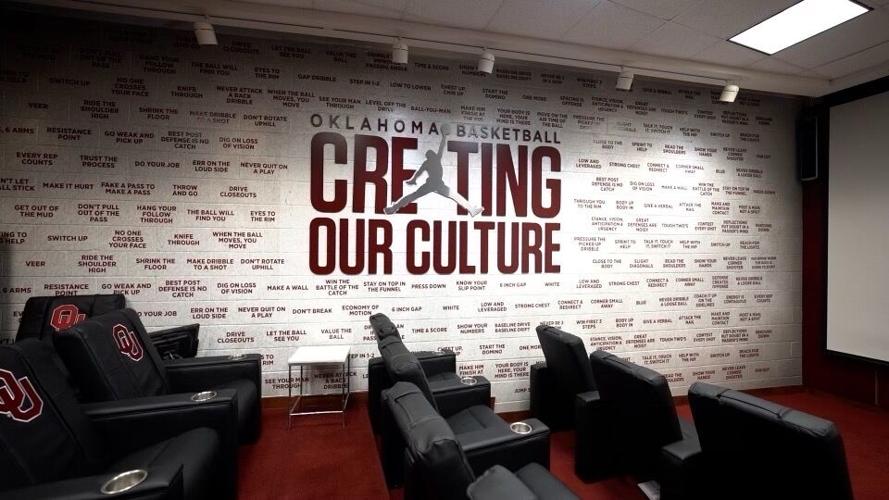
Players and assistants have spoken about the wall being an integral part of Moser’s success as a coach, as it contains important rules and catchphrases related to the program’s vision and goals such as: “When the ball moves, you move,” “Do your job,” “Fake a pass to make a pass,” and “Err on the loud side.”
“We really took it to heart,” said Krutwig, who now plays for the Antwerp Giants in Belgium. “It’s proven that it can work, sometimes it gets repetitive and you know what you have to do because you’ve seen it so many times and heard it so many times.”
“I still know them all. There’s probably not one thing if I got on a call with (Moser) right now that he could stump me with.”
Barone Jr. watched as the machine of a team rolled on through its different sets and he observed the focus instilled by the young player he used to watch as a kid, now turned all-star coach.
“I was always able to see (Moser) as a mentor, part of the family,” Barone Jr. said. “I always viewed him as a coach, but in that practice I viewed him as an elite coach."

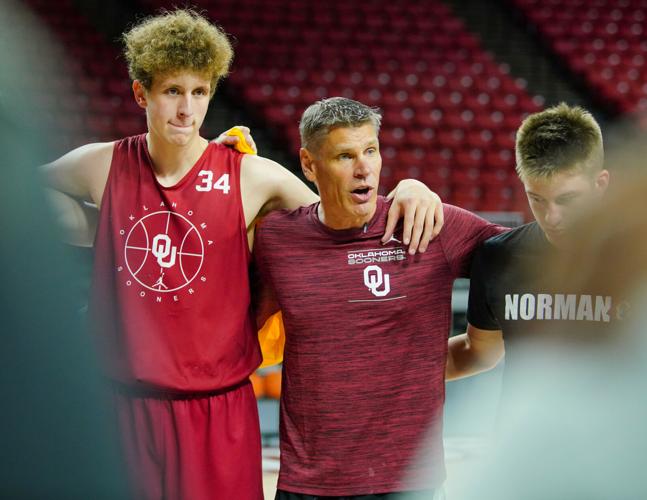
Head coach Porter Moser (middle) puts his arms around junior forward Jacob Groves (left) and an assistant (right) during a practice at the Lloyd Noble Center.
'A believe-in is way better than a buy-in'
Moser has a specific vision for Oklahoma basketball.
He’s not trying to reinvent the wheel. He’s trying to enhance it with his own leadership style. He saw how Billy Tubbs, Kelvin Sampson and Kruger went about things and sustained success. That’s what drove him to Norman.
The end of the 2020-21 college basketball season brought one of the craziest coaching carousels ever. Jobs were opening up everywhere and Moser was seemingly at the top of every program’s list. Schools in the Midwest like DePaul, Indiana, Marquette and Minnesota were all looking for a new head coach and Moser seemed like a fit at any one.
However, all speculation stopped shortly after Moser got a call from OU athletic director Joe Castiglione. Kruger had just announced his retirement and Moser and Loyola had just been knocked out of the NCAA Tournament by Oregon State in the Sweet Sixteen.
“When (Castiglione) called me and we sat down and started talking about OU,” Moser said, “... the brand, the spirit here … that’s what I love and why I’m so blessed to be the head coach here.
“There’s a collective spirit on this campus, I’m glad to be a part of it and I’m glad to enhance it.”
While Moser didn’t need to make drastic changes, he did have to reinvent the roster. Four-year starting forward Brady Manek transferred to North Carolina, two-year starting guard De’Vion Harmon transferred to Oregon and two-year starting guard Austin Reaves is now with the Los Angeles Lakers.
Undeterred, Moser and OU went fishing in the transfer portal and landed experienced assets to help an otherwise young team.
Fifth-year senior forward Ethan Chargois transferred from SMU, fifth-year senior guard Jordan Goldwire came from Duke, redshirt senior guard Marvin Johnson arrived from Eastern Illinois and redshirt senior forward Tanner Groves and junior forward Jacob Groves came to Norman from Eastern Washington.
“I really like our group,” Moser said. “They’re playing hard, they’re listening and I’m excited about where we’re going with this.”
The Sooners looked dominant in their lone exhibition contest on Nov. 1 against Division II Rogers State, defeating the Hillcats 106-57.
Much like Loyola before Moser arrived, the Sooners have an attendance crisis, especially with students. Attendance at basketball games has been an issue for years and has baffled OU’s athletic department.
The Lloyd Noble Center’s capacity is 10,967, which ranks eighth in the Big 12. The Sooners don’t get close to that during most seasons. For example, in 2019, the LNC’s estimated attendance never passed 10,500 and only surpassed 10,400 once when perennial powerhouse Kansas came to town on Jan. 14.
Obviously, winning will put butts in seats, but Moser is looking to use some of the same tactics he used at Loyola to drive attendance. The Sooners have even added new seats near the floor to get fans closer to the action.
“I love to see the students here,” Moser said. “The people that don’t know me on this campus soon will. I’m going to be out everywhere.”
Moser has attended almost every home OU football game this fall plus OU-Texas in Dallas and has appeared at a handful of campus events including Rah Rally. He also made a speech at a chapter meeting of the Brothers Under Christ fraternity and visited several others.
Great time meeting our OU fraternities tonight 👊Can’t wait to have them in the LNC as part of the @OUBoomSquad 💥 pic.twitter.com/EM0SKNWCgK
— Oklahoma Basketball (@OU_MBBall) October 25, 2021
In his introductory press conference on April 7, Moser recalled, while at Loyola, paying for three buses to ferry students to a game at Valparaiso. He said he’s looking forward to making similar investments in Norman.
It’s about culture for Moser. It’s about the standards and the way he likes to do things. That’s why he’s brought his famous Culture Wall from Loyola to Norman; to infuse the spirit he created at Loyola into his new opportunity at Oklahoma.
“I hate the term ‘buy-in.’ You’re really successful when you’re leading people that believe in what you’re doing,” Moser said. “A ‘believe-in’ is way better than a buy-in.
“I think when teams get a collective spirit, that’s when things really go and that’s my vision for Oklahoma men’s basketball."

Head coach Porter Moser's Culture Wall inside the Lloyd Noble Center


