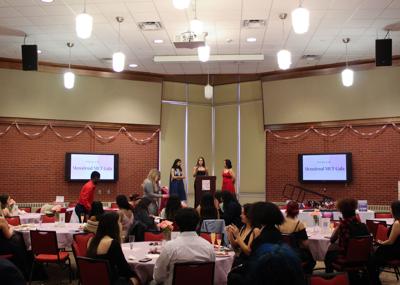
OU Women’s Health Advocacy and the OU International Advisory Committee held the first ever Menstrual Met Gala on campus Friday.
The gala was held to spread awareness about period poverty and stigma regarding menstruation around the world, according to Kylie Hutchison, president of the Women’s Health Advocacy.
Period poverty is the inability to afford or access period supplies. A 2021 study found that 10 percent of all female college students are unable to afford menstrual products each month.
The gala was held at the Jim Thorpe Multicultural Center where guests ate and browsed tables with information about international student organizations.
The event featured several guest speakers, including Neira Kadic, scholarship advisor and international admissions counselor for the United Worlds Colleges Scholarship program at OU, who talked about her experience as someone who was born outside of the US.
Originally from Bosnia and Herzegovina, Kadic said people in some countries avoid talking about periods and the use of the word “menstruation” can be seen as a “dirty word.”
“A lot of that exists at this intersection of culture and religion, and we don't want to blame one or the other,” Kadic said. “We are shamed for having menstruation. We cannot discuss policy about things that we don't talk about.”
Although funding for period products could help many people, Kadic said some people question that it is not a priority for government funding
On March 22, Idaho House members rejected a bill that would’ve funded free period products in public school bathrooms.
Cindy Belardo, OU alumna and CEO and co-founder of Sunny, talked about her self-care brand during the event.
Sunny is a self-care brand that offers a menstrual cup that inserts similarly to a tampon, according to the business’ website. It also delivers eco-friendly healthcare products and inclusive education about period poverty and stigmas.
Belardo graduated from OU in 2019 with a bachelor’s degree in environmental studies. The year before graduating, she said she started a project alongside OU Housing and Food about period education.
“(At OU), I found my niche, which is in this centerpiece where sustainability meets human health, and that's what I found through sustainable period gear,” Belardo said.
Belardo said she was inspired to start her business to educate others about stigmas regarding menstruation after a trip to India, where she learned about period poverty and the taboos surrounding it.
“Every region and every family has their own set of circumstances and taboos that they're fighting against,” Belardo said. “We're just not talking about periods openly as a society on a global scale. ”
Siddhi Patel and Asmi Yadav, president and Sub-C Chair of the India Student Association, respectively, talked about menstruation in India.
Patel said there are not enough period resources for people in India, and some can be embarrassed by going out to buy period products for themselves.
The shame towards people with their periods can also be found in their own households, Yadav said. She said some women are not allowed to touch others or to be in the kitchen while on their periods.
Patel said it is important for people to be educated about periods, especially for people in India who don’t receive the “period talk” at their schools like many do in American schools.
“I think it's just having that awareness of your own body so that you can avoid all these illnesses that might be caused by not having the proper hygiene or using the wrong products,” Yarev said.
Orissa Molina, a senior registered pharmacist at the San Ignacio Community Hospital in Belize, said 67 percent of females in Belize are menstruators, and yet they don’t know what is happening to their bodies.
Molina said it is not normal for mothers in Belize to talk about periods to their children.
“A lot of people don't talk about it. They hide it. They will not want to go out or they will not want to go to school. They will not tell you anything,” Molina said.
Molina also said many people struggle to afford period products and pain medication, which can affect their attendance at school or work.
“We will continue our efforts to help these young women,” Molina said. “Our job is just a guide. We need to reach out more, we need to educate more. We have a lot to do yet and our educational campaigns are just really starting.”
This story was edited by Alexia Aston and Jazz Wolfe.


