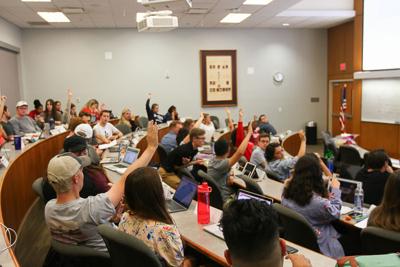

In 2022, OU admitted its most diverse freshmen class, with 39 percent identifying as an ethnic or racial minority and 80 international students.
OU SGA’s leadership has pushed for further diversity and inclusivity outreach among students of color and international students in its four branches.
According to a statement from Student Government Association President Zack Lissau, around 38 percent of the current executive cabinet identifies as a person of color.
Lissau wrote he had asked members of his cabinet to identify themselves with a survey if they felt comfortable, and based on the results, he believes the cabinet adequately represents OU’s community based on the fall 2022 enrollment analysis.
“(Vice President Denzel Akuffo) and I are fortunate to be surrounded by a cabinet from different backgrounds, such as, socioeconomic status, ideologies, religions, and sexual orientations and gender identity,” Lissau wrote.
Manuvel Sibichan, Crimson Leadership Association co-chair and a South Asian American man, said he hopes to encourage the current Crimson Leadership Association group, particularly the students of color, to pursue their interests and hobbies while at OU.
Sibichan said, from his experience, many students of color feel discouraged when looking for organizations to join because they don’t see people who look like them in these groups.
“If people see an organization being very, very white, it’s going to turn them away. … I know because I felt like that all my life,” Sibichan said. “Some of it’s a mentality, like if the one person of color isn’t going to be you, then it’s someone else. It’s just going to keep getting passed around like a self-fulfilling cycle.”
He said mentors, specifically those of color, helped him get his footing and helped him feel comfortable in his skin. Sibichan also said starting small is ideal, but self-motivation and self-confidence to apply for leadership positions is how he believes people of color make room for themselves in a predominantly white institution like OU.
The university admitted its first Black student, George McLaurin, in 1948 and ended institutionalized segregation after McLaurin v. Oklahoma State Regents in 1950.
Sibichan said the downside is that performative diversity also occurs if an organization feels compelled to admit any student of color as a member, which he said is counterintuitive to actual diversity and inclusivity.
“Having a person of color who wants to be there and wants to create change is more important than having diversity for diversity’s sake,” Sibichan said.
Carolyn Berggren, the OU Undergraduate Student Congress Human Diversity committee chair who is white, said she aims to create a welcoming and communicative space for all her constituents to feel at home while they’re on campus.
She said her focus has been on culture and general education over various ethnic, religious and sexual identities. Berggren said she believes knowledge will lead to the destigmatization of various topics, which will allow her to discuss diversity more in-depth than before.
“It’s so important we normalize conversations because our campus reflects so many different cultures and backgrounds,” Berggren said. “People should feel open to be present in the SGA body and not have to feel ashamed for being themselves.”
Berggren said she knows there will be some perspectives and experiences she will never have as a white woman. However, she said she hopes to create an environment where people from all identities can express their concerns with her.
“I come from a position of privilege, and I hope to use that privilege in a way to help uplift the people around me, rather than speak for them,” Berggren said. “I don’t know how they feel, but I want to make sure they have a welcoming space and the comfort to be able to talk to me about it.”
She said she wishes to follow the example of her predecessor, current OU Law student Caitlyn Harman, who made her feel welcomed and similarly created a safe environment.
Harman helped Rep. Nathanael Reese, who is Jewish, write a bill defining antisemitism and have the university recognize the antisemitic experiences Jewish students have on campus, such as the antisemitic graffiti sprayed around Norman in 2019.
The bill passed through Congress and the OU Graduate Student Senate, only receiving two dissenting votes and one absence. Berggren said, despite this, the amount of clarifying questions Reese and Harman were asked by Congress and GSS members surprised her.
Sen. David Long asked Reese if his bill fell under the university’s code of conduct and was rendered redundant in some areas because of that. Reese also clarified that he was talking to 2SLGBTQ+ and Muslim OU community members on campus, but wanted to focus on the Jewish community for this piece.
Berggren said she doesn’t believe there was any ill intent behind the questioning, but the questions themselves showed her there’s a need for education, specifically on religious diversity, in Congress.
“What happened during Reese’s presentation of the bill leads me to believe there isn’t enough religious knowledge going around the body,” Berggren said. “He had brought in all these viewpoints and examples of antisemitism in Norman within the last five years, and people still were like, ‘What would this really do? What’s the point of this?’ They didn’t recognize this as a prevalent issue because it doesn’t affect them.”
Berggren said she’s also trying to keep international students involved in her inclusivity outreach during her time as chair, which included hosting a "Friendsgiving" potluck for international students who weren’t able to go home to see their families.
Congress, unlike GSS, does not have a committee dedicated to representing or talking to the international student population among undergraduates. Before SGA’s fall 2022 general election filing closed, the OU International Advisory Committee posted on their Instagram story imploring international students to apply for representative seats.
According to OU’s 2022 enrollment analysis, there are 1,627 international students on the Norman campus, making up 5.7 percent of the total student population.
Feyi Babayemi, the GSS International Student Affairs Committee chair, said undergraduate international students would benefit from representation in organizations that generally cater to traditional students, like student government.
“The United World College students have their own community here, but it doesn’t hurt to have a voice in congress,” Babayemi said. “We have to consider we’re not serving just domestic students, and it’s not smart to decide what is good for students without listening to what they have to say or asking their feedback.”
Babayemi, who is from Nigeria, said there’s a lot of diversity among international students and, due to their different experiences and backgrounds, having a group on campus care about what they think would make the transition to the U.S. more accommodating.
“I’ve had classes with people from literally all over the world, so in terms of diversity, OU is definitely not lagging behind,” Babayemi said. “At the same time, they should pay more attention so international students can have the best experience possible and (be able to) say (they’re) glad (they) came to OU … and it’s a place where diversity isn’t seen as a problem. It’s another strength.”


