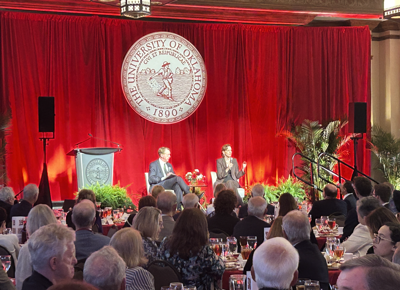

Pulitzer Prize-winning historian and journalist Anne Applebaum spoke at OU’s Spring 2026 Presidential Speakers Series Dinner at the Oklahoma Memorial Union Wednesday.
Around 600 people, including OU students and faculty, as well as university President Joseph Harroz Jr. and Oklahoma Supreme Court Justice Dustin Rowe, attended the event.
Applebaum’s talk “Geopolitical Risk: Regionally and Globally,” addressed the revitalization of historically controversial political views, the struggle for democracy under autocratic regimes and the challenges faced by intergovernmental organizations.
A Yale University and London School of Economics graduate, Applebaum is a staff writer for The Atlantic, covering Eastern Europe and American foreign policy. She has previously written for The Economist and served on the Washington Post's editorial board from 2002 to 2006. She has published several books, including “Autocracy, Inc.” in 2024, and “Gulag: A History” in 2003, which received a Pulitzer Prize in general nonfiction.
The night began with Harroz’s opening remarks, which focused on OU’s rapid growth and featured the unveiling of the university’s “What One Can Do” marketing campaign, and an opera performance by OU graduate student Gabrielle Salomon.
Following a brief interlude for dinner, Applebaum took to the stage with moderator Mike Boettcher, a former broadcast journalist and current professor at the Gaylord College of Journalism and Mass Communication.
A “swerve”
At the beginning of the interview, Applebaum argued that modern discourse is refocusing on political ideas that had previously fallen out of favor, including many from the 20th century or earlier.
“We're rediscovering philosophers like Carl Schmitt, who was a philosopher in the 1920s and 30s, who wrote about how all politics is a form of warfare, …” Applebaum said. “We're rediscovering the idea that big nations can bully small ones and get away with it.”
According to Applebaum, these reemerging beliefs pose a challenge to the stability of international organizations such as the United Nations and NATO.
“A whole series of institutions are starting to fail. Some of them are failing because the institutions weren't working,” Applebaum said, while others “are failing because some international leaders have decided we don’t need them anymore.”
Applebaum compared the present moment to the fall of communism in Eastern Europe during the 1990s and the emergence of the Northern Renaissance in the 15th century.
“I spent some time thinking about what's the right word for this moment. Is it a rupture? Is it a transition? What's the right word? …” Applebaum said. “I feel like what we’re living through right now is a swerve.”
Future of democracy
Applebaum pointed to democratic backsliding around the globe as a defining characteristic of this “swerve,” pointing to the rise of authoritarianism in Hungary and declining respect for the rule of law. She went on to say that America and its allies have treated democracy like tap water for decades.
“You don’t have to worry about where the water came from or how it got there, you just turn it on, and it’s part of the background of your life,” Applebaum said.
Applebaum said Americans cannot continue treating democracy as the job of a select few professional politicians. However, when reflecting on her experiences with Generation Z, she said, “I hear this idealism returning that I feel is an adequate response.”
Applebaum also criticized recent American action in Iran and Venezuela, arguing that the U.S. cannot spread democracy to autocratic nations without the support of everyday citizens.
“If we want regime change, then we need to know … how are we inspiring people in (these nations), …” Applebaum said. “I don’t think anyone’s ever bombed their way to democracy.”
Applebaum said there is no way of knowing exactly where the present “swerve” will take us, with the future depending largely on present-day decisions.
“The truth is that things will happen tomorrow, depending on what we do today. There is no arc of history that automatically bends one direction or another. The arc of history bends if people bend it,” Applebaum said.
This story was edited by Macey Thaxton and Madisson Cameron. Sophie Hemker copy edited this story.


