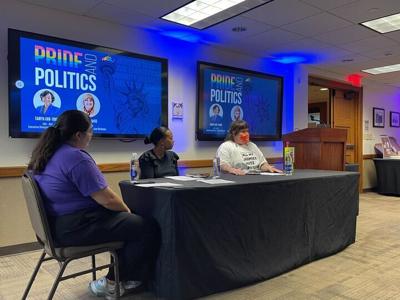

OU Queer Student Association hosted its Pride and Politics panel on Thursday, featuring speakers from the American Civil Liberties Union of Oklahoma and Freedom Oklahoma to discuss Project 2025, 2SLGBTQ+ rights and the voting process.
Speakers included Tamya Cox-Touré, executive director of the ACLU of Oklahoma, and Nicole McAfee, executive director of Freedom Oklahoma, a nonprofit designed to educate and advocate for 2SLGBTQ+ Oklahomans.
Around 40 people attended the meeting in the Oklahoma Memorial Union’s Frontier Room – a record attendance, according to an event coordinator. Oklahoma Votes offered registration and absentee ballot forms for the audience.
During the panel, McAfee said over the past three years, Oklahoma has had the worst anti-2SLGBTQ+ legislation in the country, citing single-sex bathroom enforcements, forced outing policies in school and book bannings and censorships.
“Beyond that, we are seeing a lot of new attempts to criminalize our community, not always in explicit ways, but in ways that we know disproportionately target queer (and) trans folks,” McAfee said. “Oklahoma still has two statutes that criminalize someone for their HIV status. Both are still regularly used to charge people.”
According to the Oklahoma statutes, it is a felony for HIV carriers to engage in activities “reasonably likely” to transmit the virus, or to prostitute with HIV.
Cox-Touré said 2SLGBTQ+ rights have always been a priority for the ACLU of Oklahoma.
“LGBTQ work has been a tenant of the ACLU of Oklahoma,” Cox-Touré said. “ACLU of Oklahoma was founded in 1964 and to us, LGBTQ rights have been a part of that work.”
Cox-Touré said Project 2025, a conservative policy document created by the Heritage Foundation for a potential Republican presidency, is a large concern because it intends to abolish 2SLGBTQ+ rights and eliminate diversity, equity and inclusion efforts across the nation. She said even if former President Donald Trump does not win in the November presidential election, Project 2025 could inspire similar legislation on a local and state level, citing Oklahoma as the GOP’s model for the rest of the United States.
“Oklahoma is the testing ground for a lot of bad policy,” Cox-Touré said. “They will try places like Oklahoma first to see how it plays out, to see if it can get passed, and then they have a strategy. We are pushing back for some of the most extreme bills because of the impact or the domino effect it will have in other states.”
While citing the dissolution of DEI at OU, Cox-Touré said the university went beyond Gov. Kevin Stitt’s executive order when it closed the Gender + Equality Center. She encouraged continued political discourse among students.
“OU’s president turns around and starts eliminating programs that have been in existence for a while,” Cox-Touré said. “Those (policies) are directly targeting 2SLGBTQIA+ students … it’s happening here on your own campus.”
Cox-Touré said students should be aware of anti-2SLGBTQ+ policies in Oklahoma and advised students on campus to create strategies to counteract them. She said students can reach out to their representatives and work with the ACLU of Oklahoma.
“Doing deep listening is the best strategy that I can do, to take back to the experts and my staff,” Cox-Touré said. “There is some value in if you want to impact local elections and if you want to impact the representatives.”
McAfee said the 2SLGBTQ+ community must encourage their local representatives and university leaders to fight for the issues important to them.
“There's more space to move the OU administration than there might be to move the state legislature,” McAfee said. “Together, you’ve got some power.”
In response to a recent state report that 453,000 voters purged from the Oklahoma voter registry, Cox-Touré said voting will not ensure progress, but advocated for students to vote regardless. She acknowledged students experience barriers to voting due to a lack of time and transportation.
“Voter suppression is extremely real here in Oklahoma,” Cox-Touré said. “We have to be registered by October 11. I don't understand why I can't go the day that I want to vote and register. To me, that's all voter suppression.”
Cox-Touré said students should be aware of their right to provisional ballots, which allow voters to vote if they believe they are registered in the event their name does not appear on the registry. McAfee said poll workers can have limited training, which requires voters to be aware of provisional ballots.
According to McAfee, voters can use absentee ballots to bypass crowds and become aware of the ballot’s details early. They emphasized voters should request an absentee ballot as soon as possible due to possible denial.
As a non-binary person, McAfee said voting with other 2SLGBTQ+ individuals makes the process more comfortable for them.
Cox-Touré asked the audience what they were afraid of regarding the election. As Cox-Touré questioned the audience, she wrote down the answers students gave her.
Two education students in the audience said they were afraid of losing job prospects as a result of Project 2025.
Another student said they were afraid of the 2SLGBTQ+ community becoming criminalized and harmed by both the law and individuals who might abuse it. They added they currently do not feel safe advertising their identity in Oklahoma. Cox-Touré asked if there was ever a time they felt safe advertising their identity.
“When the GEC was open,” the respondent said.
McAfee said the students’ fears were valid considering recent issues, such as the death of Nex Benedict and the end of gender-affirming care in the state.
“Over the last four years, so many of my worst fears have become reality,” McAfee said. “People's worst fears about what is going to happen nationally … those things are happening here in Oklahoma.”
Cox-Touré said the ACLU of Oklahoma knows it will lose in terms of future anti-2SLGBTQ+ legislation, but added she’ll go to court to combat it regardless.
McAfee said Freedom Oklahoma attempts to create a sense of community as a protective strategy due to a lack of institutional support systems. They said there are members of the queer community who are willing to accept the status quo of marriage equality without advocating for transgender causes. McAfee said it is important for 2SLGBTQ+ individuals to work together in creating a unified movement.
“We are not anywhere close to that safety coming to us from these systems that are set up to work against us,” McAfee said. “In order to create liberation, we have to do that together.”
This story was edited by Anusha Fathepure and Ana Barboza. Gretchen Schultz and Sophie Hemker copy edited this story.


