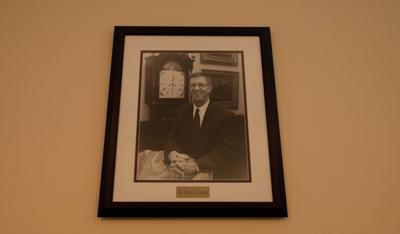

David Schrage was a hero to his students, giving his career and his passion to uplift them.
During his time with OU from 1970 to 2011, Schrage founded multiple organizations and groups that would last for years, including the Housing Center Student Association. According to his wife, Barb Schrage, he would lend his mentorship to new leaders even after retiring from his position as associate vice president for Student Affairs in 2001. Barb said Schrage continued to unofficially advise his former students before fully stepping away from his career in 2011.
“His number one role in life was mentoring people to become mentors later on,” Barb said. “One of (his) things was his kindness and care to others. He was ‘pro-student’ from the word go.”
On Oct. 5, Schrage died at 82. A celebration of life will be held in the David F. Schrage room in the Oklahoma Memorial Union on Jan. 11.
In addition to his work with Student Affairs, Schrage was the director of OU Housing and Food Services for nearly two decades. Known by his students as “Dr. Dave,” his thoughtfulness gave him a reputation beyond his job titles even after his retirement.
Anu Pugalia, former president of the OU Housing Center Student Association, wrote in an email to OU Daily that Schrage’s support for student leaders was key to the successes while he was there.
Pugalia, who was mentored by Schrage, wrote that the final five years of his tenure at the university were “the golden age of OU Housing.” During this period, the program hosted national conventions and received several awards, including second place for national program of the year in 1999.
“None of these successes could have been accomplished without his unwavering support and the trust he placed in student leaders,” Pugalia wrote.
Pugalia wrote that Schrage’s work gave the housing program a foundation of ideals to build on for the future. Schrage would often invite student leaders for dinner to build team morale and create relationships outside of school.
“Dr. Dave’s diligence and hard work built an award-winning residence hall system that was well-known around the region and nation,” Pugalia wrote. “I was just one of the many students he mentored to be effective, confident leaders both during our student days and in our future careers.”
Barb said Schrage’s ability to lead was something that extended across his professional and personal life.
“He uplifted others all the time. He never wanted credit and gave it all to others. … He was such a wonderful listener. We would have different people come over and Dave would give advice on their careers and lives wherever they asked,” Barb said. “His number one role was mentoring people to become mentors later on.”
Amy Davenport, director for OU Fitness and Recreation, was inspired by Schrage's leadership in her life. Schrage's mentorship and dedication to the campus community impacted Davenport’s values and approach to supporting students and building community.
“He’s influenced how I work with students in a positive way and how we can all be this bridge to students,” Davenport said. “He was really big on the campus network of full-time employees and professionals to help get students to the resources, and I have taken that with me in my career.”
Davenport first met Schrage through the President’s Leadership Class, an OU freshman leadership program. Her experiences with Schrage in college led her to take over his role as director of Housing and Food Services in 2000.
“When I was a first-year student, he took me under his wing and helped take care of me, helped make me successful and kind of moved through those times with my family,” Davenport said. “He had a big heart, and he really helped me see how to work with people and how to get to know other people.”
James Brown, who met Schrage in 1994 as the Housing Center Student Association’s Walker Center vice president, was close to Schrage throughout college and after he graduated. Brown said Schrage was a mentor, supporter and advocate who positively shaped his personal growth in college.
“He didn't talk to us like he was superior. For somebody who was the director of the (Housing and Food Services), it was definitely a little bit of a surprise that he was just very easy to talk to,” Brown said.
Brown said he felt supported by Schrage’s willingness to share knowledge and for making his voice feel valued even as a young college student.
“He always seemed like somebody who was very practical in his engagement with student leaders. It wasn’t unprofessional in any way; he was treating everybody like people,” Brown said.
Schrage’s support, while Brown was Housing Center Student Association vice president and later president, helped push him to strive for higher goals.
“It was that genuine sense that he knew that you were a valuable human being. That really helped me and some of my other fellow students at the time believe that we could do a lot of things that we hoped we could do,” Brown said.
Brown said Schrage went above and beyond in his engagement with the student leaders.
"He would come to our meetings on Sunday evening on campus, which is obviously not business hours, but he would be there. Dr. Schrage would say, ‘Hey, anything else you guys need?’” Brown said. “That was encouragement that I don't think is common in the world. His level of (encouragement) was incredibly admirable and much appreciated."
Davenport said Schrage was naturally selfless when it came to doing all he could for his students.
“He cared so much about building the future for everybody, and I think that that is paramount for his objectives and how he taught people to live,” Davenport said. “The core (of his mindset) was ‘for success, for students’ and whatever it took to get there.”
Brown said Schrage would offer a support system for him and others around his life which created a “balance between friendship and professionalism.”
“He was like your favorite uncle. He was the guy who would help you study all night for the big test that was coming up. That was the kind of vibe he had,” Brown said. “He was incredibly supportive, friendly and professional. With a sense of humor, too.”
Davenport said Schrage gave his students a secure place to find support in college and beyond.
“I felt like when I was with him, I was special, but I also know that he had so many other people that he had that relationship with, so I wasn't alone in how he treated me. He made everybody feel special,” Davenport said.
Pugalia remembers Schrage for his character and commitment.
“He was humble, soft-spoken, genuine, caring, reliable, and a man of unquestionable character,” Pugalia wrote. “He made sure that student leaders were part of the dialogue and an equal partner in decisions impacting Housing (from rate increases to meal plan changes), and then he kept his promises.”
Brown said he could not define Schrage’s impact and legacy in one sentence.
“He was so much more than any one particular adjective would convey. You can't just say he was nice because he was nicer than that. You can't say he was supportive because he went beyond what a supporter was. He was just so much more than any one word you could think of,” Brown said. “Being supportive, being nice, going the extra mile. He would go beyond what you would really expect to encounter.”
Davenport said she hopes to uphold Schrage’s legacy.
“I want to honor Dr. Dave's legacy by keeping an open mind,” Davenport said. “Be kind. Treat each other with kindness, and keep an open mind to everyone.”
Schrage is survived by his wife Barb, his daughter Kimberly and his stepson Eric Gant.
This story was edited by Ismael Lele, Ana Barboza and Anusha Fathepure. Natalie Armour, Avery Avery and Mary Ann Livingood copy edited this story.