
OU Daily first reported the dissolution of the Crimson Callers, an organization under the OU Foundation that facilitates financial gifts from OU alums, last May, with the organization officially disbanded June 21.

Now, former Crimson Caller employees — as many as 30 to 40 students who were originally displaced from their jobs — are speaking out on the challenges and changes they have faced nearly one year since the call center’s dissolution.
‘Under a lot more stress now’
Former employees told the Daily last May that the call center provided a steady income that paid for daily essentials and housing costs. Alex Richardson, a biology and linguistics senior and former Crimson Caller, said he has struggled to find the balance since the call center’s dissolution.
“The job at the call center paid almost twice what minimum wage does, and so I could basically spend maybe eight to 12 hours a week working, and I would make as much as I do now working … probably 16 hours on a good week,” Richardson said.
Richardson added that the extra time he spends working has affected his academics. Richardson said he often deals with burnout and has difficulty managing his energy.
“It’s just taken a lot more time and energy to get what I do now out of what I did,” Richardson said.
Richardson also noted the social impact the call center’s closure had on his time at OU.
“Hanging out with my coworkers was the best part of the job, …” Richardson said. “I feel similar ways about all of my new coworkers, but it’s definitely pretty sad.”
‘What am I getting out of it?’
The Crimson Callers’ dissolution in June 2025 came amid the implementation of an AI chatbot called “Rose.” Rose was designed to conduct the roles of former Crimson Callers and is listed on the OU Foundation’s staff directory as a “Virtual Engagement Officer.”
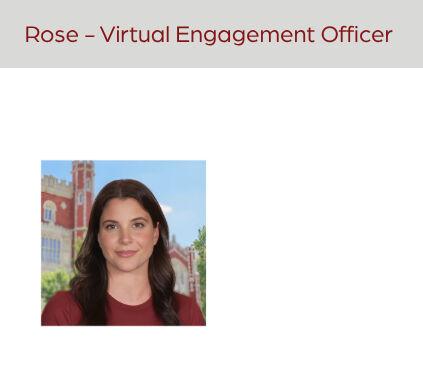
Crimson Callers' AI Chatbot, Rose.
Richardson said he, in May 2025 and now, struggles to support the chatbot’s role in facilitating gifts for OU, citing “unhealthy attachments” to chatbots and the need for human connection.
“The whole thing is really built around this very human dynamic between the students who are calling alumni, and I think that if you’re doing that, and the person who’s calling the alumni isn’t a person, they’re just not going to want to form that relationship,” Richardson said.
In an April 2025 statement to the Daily, Guy Patton, president and CEO of OU Foundation, wrote that Rose’s implementation — and the caller center’s dissolution — was in an effort to align OU with other universities’ gift facilitation models.
“Like many universities and foundations across the country, we are shifting away from traditional fundraising tactics toward more relationship-based, donor-centered approaches that reflect the changing expectations of alumni and supporters,” Patton wrote.
The Daily reached out to Patton three times over email for comment on both the original dissolution and students’ comments on the lasting impacts the call center’s closure has had on them and their college experiences.
The Daily did not hear back by time of publication.
The OU Foundation also justified the call center’s dissolution by citing the yearly turnover of student callers who either graduate or leave the call center.
Richardson described the “exhaustive” interviewing, training and onboarding process that, in his opinion, did not outweigh the caller’s intrinsic value.
“I definitely disagree with that, …” Richardson said. “I just saw the opposite of that. (There was) a very, very large retention of the callers, and people were definitely receiving more gifts than they were getting paid.”
Caleb Pennington, a voice and meteorology senior, echoed Richardson’s sentiment, saying that during his time as a Crimson Caller, the call center tended to onboard as many as they would release or lose.
“I think it’s ridiculous that (OU Foundation) said that it’s a lot of work to train the new people, considering our direct manager had no problem with it (and) the supervisors had no problem with it,” Pennington said. “So to say that it’s a pretty harsh turnaround to train all these new people, I think is total crap, to be honest.”
Pennington said that he does not believe the chatbot will be successful in facilitating gifts in the long term.
“Maybe it’s working out for them now, but I 100% do not see it working out in the long run,” Pennington said. “If it is already not working out for them now, I can’t see it working out for (them) in the long run.”
Pennington also noted the relationship between AI and humans. He said that the use of AI in gift facilitation could be unsuccessful among younger generations who are entering the workforce and becoming alums.
“Especially if you're calling a younger person who’s my age, I know how to detect something’s AI pretty quickly. I'm going to already be turned off to talking to a robot, because what am I getting out of it? …” Pennington said. “This is one of those things that AI is not good for.”
‘In a way, it kind of benefited me’
Pennington noted the support of Bob Amico, the former executive director of annual giving, who often defended the work of the Crimson Callers and made the call center feel like a “safe space” before his March 2025 resignation.
“When he resigned, I feel like that should have been the first red flag that something (was) going to happen,” Pennington said. “Sure enough, I think it was two weeks after he resigned, is when we got the official announcement that the call center was discontinued.”
The Daily reported in May 2025 that after Amico’s resignation, and according to Crimson Caller employees at the time, the call center was dissolved after a “strategic analysis” was conducted.
According to reporting at the time, the analysis was conducted by Marty Wold, OU Foundation assistant vice president for annual giving and alumni engagement. Wold was Amico’s direct supervisor, according to employee testimony to the Daily in 2025.
The Daily reached out to Wold three times over email and twice over the phone for comment, but did not hear back by time of publication.
Patton wrote in his April 2025 statement to the Daily that all callers would be given advance notice and assistance in finding new jobs.
“Recognizing their important role, we provided current student callers with advance notice and support as they transitioned from the program,” Patton wrote.
Pennington said he had to find a new job after the call center’s dissolution, and that his rent payment was made from the call center.
Pennington said despite the call center’s closure, there have been bright spots.
“I was able to meet new people after I got laid off,” Pennington said. “I was able to join OU Nightly, so it did lead to that, (and) in a way, it kind of benefited me.”
Pennington added that the communication skills he learned at the call center were beneficial to him and his career.
Richardson, reflecting on his time as a caller, said there are pros and cons to the organization’s closure.
“It's been mostly negative change for me, (but) I do think there is some validation,” Richardson said. “If I did find a job, potentially, where I was doing something more related to my major and more fulfilling towards the things I really want to do, then I wouldn't feel obligated to continue with the call center. It's been a good job, and I like the people there, but that's all hypothetical.”
This story was edited by Reagan Rozzi. Tori Pham copy edited this story.


