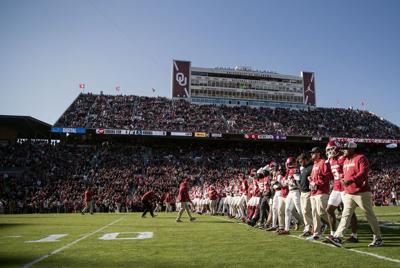

After over 100 years of football, almost 30 years of sold-out regular season home games and seven national championships, OU is undertaking The Palace Project, a two-year, $450 million renovation plan for Gaylord Family-Oklahoma Memorial Stadium that will decrease capacity and upgrade luxury spaces.
Announced in November, the project will see the stadium’s capacity decrease by 7,000 seats. The project is primarily focused on the stadium’s west side and plans for the construction of 47 suites, 64 semi-private boxes with seating for roughly 280 guests, around 4,000 new club seats and six premium club and lounge spaces.
Cody Havard, University of Memphis sport commerce professor, said from a financial perspective it’s inherent that a customer who brings in more money per game is more important to an organization, but emphasizing those customers can neglect younger fans meant to bring in that higher revenue down the line.
Havard said the people who are buying luxury boxes and suites have a strong bond with the team, which is a vulnerable relationship when fans don’t have as many accessible entry points to fandom.
“If you start to focus more on those fans, those customers, and organizations start to neglect the regular customer, then you could run into an issue of supply and demand later on, …” Havard said. “You have to have a plan in place … to foster the engagement for new fans and for younger fans.”
According to the November release, significant funding for the project has been provided by private donors, and fundraising efforts will continue in the following months. No state-appropriated funds or student tuition or fees will be used to finance the project.
Havard said he takes his kids to baseball games but that the experience feels different from what he remembers growing up, when kids’ tickets cost just a dollar. Havard compared this relationship to the bond formed between die-hard Sooner fans and OU football games.
Harvard said as sports become less accessible, the everyday fan struggles to maintain hype and loyalty.
“If organizations truly want to build, if they truly want to better engage their consumers, those are the types of things that I’m worried are missing,” Harvard said.
In 2024, OU President Joseph Harroz Jr. wrote in a release that the goal of OU’s conference move to the Southeastern Conference was to increase national visibility and improve the fan experience.
OU’s stadium has a current capacity of 80,126, nearly double that of Vanderbilt’s 35,000-seat FirstBank Stadium — the SEC stadium with the lowest capacity — but below several major competitors, including the University of Texas at 100,119 seats.
According to an email from OU athletics to OU Daily, the university evaluated a combination of historical seating trends, ticket use rates, fan surveys, SEC and national peer benchmarks and broader live-entertainment industry standards.
“Across each of those data sets, the findings were consistent: today’s fans prioritize accessibility, comfort, efficiency, and quality experiences,” OU athletics wrote.
Havard said when Texas upgraded its south end zone seating at Darrell K Royal-Texas Memorial Stadium in 2009, it was like an “arms race” with Texas A&M to see who would have the bigger stadium.
“The (pressure) used to be: ‘Let's increase and let's have better facilities and grander facilities — larger facilities that people can see and (universities) are known for,’” Havard said.
Havard said he expected OU to increase capacity in response and was surprised to hear about the decrease caused by the Palace Project renovations.
Havard said it’s interesting to hear that OU plans to decrease capacity, but it follows what he sees as the professional model. Havard said that capacity has been decreased at some professional venues for the sake of more amenities but that attendance at the collegiate level is a bigger driver than it is at the professional level.
“With the collegiate level, it’s typically been, ‘Let's get as many people into the stadiums as we can, so that we show our capacity,’” Havard said.
The university is partnering with architectural firms Populous and Manhattan Construction Group for the project. Renovations to the west side include:
• New gates on the west side, leading to ground-level and second-level concourses connecting to the north and south end zones.
• New elevators, improved access points, expanded restrooms and new concession stands for the west concourse and upper deck.
• Replacing all chairback and bench seating.
• Additional Americans with Disabilities Act-approved seating options.
• A new fan area on the west upper deck with a “unique common space.”
• A new press box.
The university is also widening aisles and seats, increasing row spacing, installing additional chairbacks and expanding concourses, according to the email from OU athletics. These changes, it wrote, are meant to improve flow and reduce congestion.
“These enhancements are not cosmetic; they are strategic responses to the insights we gained from how fans engage with live events today,” OU athletics wrote.
Havard expects more organizations to follow the model OU is using for the stadium. He said television-rights revenue could enable more organizations to decrease capacity for luxury boxes, club seating and more amenities for people who can be charged more. In another sense, Havard said he sees a shift toward looking at “revenue per customer” in live sports entertainment.
“Another thing that I think we’ve seen organizations do for a really long time, and I could see there being more emphasis on this, is the idea that people really start to pay more attention to what is offered to the fans,” Havard said.
OU athletics wrote it intends to align with national trends.
“Across college football, leading programs are prioritizing enhanced amenities and modern infrastructure over raw capacity numbers,” OU athletics wrote. “This trend also holds true for live entertainment venues generally.”
Havard said that some customers are considering what the university offers to facilitate business.
“‘Are they bringing clients to the contest? Is that a form of entertainment so they can get business deals done?’ …” Havard said universities like OU may be asking. “‘Well, if that's the case, then how can we make that easier for those customers? How can we make it easier for the business owner to do that so they want to keep coming back?’”
Havard said it is upsetting that this trend starts to “put a price tag” on a customer’s importance. Some OU fans have already voiced their disappointment over the university’s planned changes.
In a Nov. 23 Instagram post, social media influencer and long-time Sooner fan Kasey McComas shared that she met and has sat next to David Talley during every regular season home game since 1998. After hearing about the stadium renovations, she fears the tradition may come to an end.
“We’ve sat together through 4 head coaches, suffered losing seasons, witnessed a national championship season, and everything in between - together,” McComas wrote. “But now a new stadium renovation was announced … Leaving people like David and I, who scream at every game, were there when we were consistently losing in the 90s, to most likely lose our seat location to either elimination, or to be priced out of it.”
In an interview with the Daily last December, McComas said over the years, through high-fiving and hugging during touchdowns, season ticket neighbors have become “gameday family.”
McComas also said that the reduction will give OU less of a competitive advantage. The stadium’s current capacity is about 20,000 less than universities like Alabama and Tennessee, which hold 101,821 and 101,915 people, respectively. McComas feels that OU should be closing the gap rather than expanding it.
“It’d be great if they could keep the seats where they are and just build up, but I understand that that's not possible. I think that 7,000 is too many people to move, …” McComas said. “I think it’s embarrassing that we are going to go below 80,000 capacity.”
The email from athletics noted that the decrease in capacity will not limit any season ticket holder’s access to seating in the stadium and its goals are to maximize attendance, enhance the overall gameday experience and maintain accessible price points throughout the stadium.
“We recognize that seats at Gaylord Family –Oklahoma Memorial Stadium represent more than a location,” OU athletics wrote. “They represent tradition, relationships, and generations of memories.”
Construction is set to begin after the 2027 season and be completed before the 2029 season. A “stadium-wide reseating process” will begin ahead of the 2028 season, which will be further defined for fans via email and direct mail, according to the press release.
“For those who have sat alongside friends, family, or longtime neighbors, there will be a structured opportunity to select seats together,” the OU athletics wrote. “The reseating process will utilize an online selection platform similar to the annual Red River Rivalry seat-selection process, allowing groups to coordinate and secure seats collectively based on priority points and availability.”
OU athletics said that as pricing structures are finalized, it is committed to offering a range of options for fans at every level.
“Students are an essential part of our home-field advantage, and their presence and energy are invaluable,” OU athletics wrote. “We are actively reviewing our allocated inventory to ensure students continue to have meaningful access and a first-class game day experience.”
Havard said fans are a major part of the live sports entertainment experience in general, and losing them can be damaging.
“Seeing these people up and screaming and playing drums and playing instruments — like that's part of the experience,” Havard said. “Those are the people that if you price those fans out, you don't have that excitement.”
Havard said a secondary detriment of reducing that fan base is the effect it has on advertising revenue. Television rights, he said, are where collegiate sport organizations make a lot of their money and sports are more fun to watch when audiences see dense crowds going wild for their team on TV.
“I'm not against organizations facing the reality of what they have to do today, and I'm not envious of them either because it’s very difficult,” Havard said. “You have to be making the decisions for what is going to be best for your bottom line right now and you also have to be aware of what’s going to happen in the future.”
Havard said would-be audience members undergo cost-benefit analysis in choosing how they watch their sports. When attending a game, Havard said, you have to think about time spent getting to the venue or money spent parking, whereas watching college football on television can be much more accessible. Havard said organizations have to persuade people more now to consume their products.
“A lot of organizations are trying to provide a more entertaining or engaging environment,” Harvard said. “When you’re having to compete with all these other forms of entertainment and direct-to-consumer streaming and all of these different mediums of watching a game — you really have to increase what you give fans to attend a live game.”
The November press release states no timeline is currently in place, but a future north end zone phase will offer another opportunity to evaluate the stadium’s capacity and make necessary adjustments.
“Regardless of the capacity figure, OU’s commitment remains clear: every season ticket holder will retain access to the stadium and benefit from an enhanced experience,” the release reads. “The reimagined stadium will offer a range of seating options, strengthen long-term economic impact and ensure the tradition of Oklahoma Football endures for generations.”
This story was edited by Macey Thaxton, Josh McDaniel and Anusha Fathepure. Andrew Higgins, Sophie Hemker and Gretchen Schultz copy edited this story.


