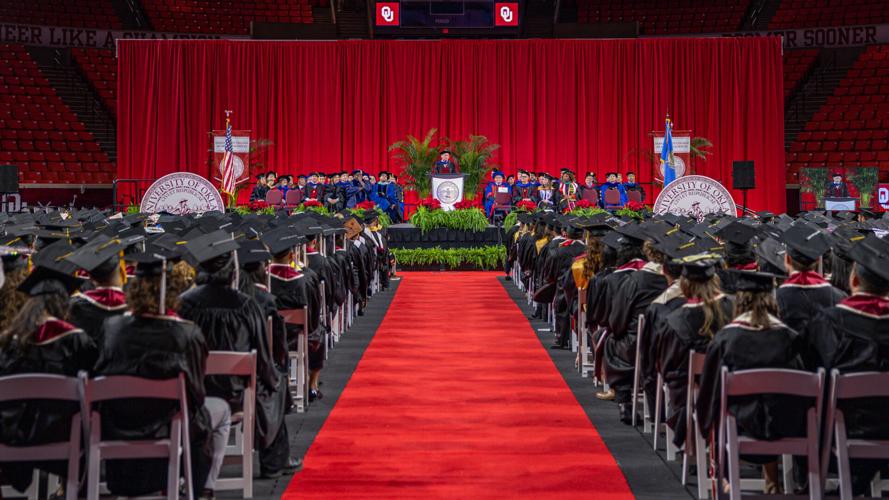



College of Arts and Sciences Graduation Commencement on Dec. 15.
Update: OU's Division of Student Affairs announced broader changes to the division, including alterations to its Multicultural Programs and Services and the Gender + Equality Center on Wednesday afternoon, after this story was published in OU's summer magazine.
This story is part of OU Daily’s summer magazine. This publication will be available in mid-April on racks around campus and online at oudaily.com.
Following Gov. Kevin Stitt’s December executive order calling for a review of diversity, equity and inclusion in higher education, OU multicultural organizations were left wondering where they stand at the university.
According to the website OU created to clarify the university’s guidelines for the implementation of the executive order, offices focused on “African American, Hispanic, or LGBTQ+ students likely violate the Executive Order” as they are departments and programs that are not protected under it.
The website goes on to state offices solely dedicated to these students will need to be restructured and programs supporting these communities may be incorporated into a framework that will broadly support more student success.
Amelia Torrevillas-Brown, president of the OU Asian American Student Association, told OU Daily she has been reassured that AASA and other Student Life multicultural programs are protected as they are departmental student organizations.
However, she said the future for these organizations is still unclear.
“(The Student Life organizations) may not directly be impacted in (that) we don’t have to rename, but the way we might get funding could drastically change and we don’t know what that's going to look like in the future,” Torrevillas-Brown said.
She said despite AASA’s protection, she’s seen a lack of clarity from the university, creating anxiety among members.
“We keep asking, ‘When’s everything going to be mapped out? Where is it going to change?’ And we don’t have that map yet,” Torrevillas-Brown said. “I remember thinking, ‘Shoot, where and how do we go from here?’ … This lack of clarity … creates fear and creates uncertainty, and the way the university reacts could truly be better.”
Initial and continued frustrations
Torrevillas-Brown said she has sensed frustration among leadership of other multicultural organizations, which includes the Black Student Association, Hispanic American Student Association and American Indian Student Association, at the lack of transparency from the university’s administration.
In January, a meeting with student leaders at the Vice President’s Advisory Council shed some light on the situation from top OU leadership, including Vice President for Student Affairs and Dean of Students David Surratt and OU President Joseph Harroz Jr.
At the meeting, which was meant to brief student leaders on the executive order, Harroz told the group that nobody would lose their jobs and students would be protected. Even still, the meeting’s remarks were vague in terms of protections for scholarships, funding for registered student organizations and various programming at the university.
Torrevillas-Brown said she wants to be the kind of leader people can depend on but felt more scared at her inability to assure herself and others because of the lack of answers from administration.
“In general, when the executive order was passed last semester, there was just a swarm of mixed emotions,” Torrevillas-Brown said. “Being in a position that has the reputation that you know everything in a moment where you also personally feel scared as a person of color on campus, … it was tremendously scary to not have answers for other people.”
She said she more than understands the concern surrounding the uncertainty of DEI programs and organizations, but said this uncertainty is something that has been consistently repeated to her and the other multicultural leaders by administration.
Torrevillas-Brown said she believes a lot of trust between the university and students of color has been lost in this situation surrounding the executive order.
She said the least the university could do is provide what she describes as the bare minimum, such as resources for students of color, like the website with the university’s executive order guidelines, which she felt wasn’t broadcasted well.
The university, she said, needs to continue to provide a safe space for students of color, which she feels the state is potentially putting in jeopardy.
“(OU) needs to provide the bare minimum and sometimes it feels like it’s not even there and it feels extremely lonely,” Torrevillas-Brown said. “Wondering what’s going to happen and not having those answers which directly provide it leaves a lot of students hanging, wondering how their identity is going to stand being at a university in a predominantly white state.”
Following the initial release of the executive order, Harroz reassured the OU community that the university would remain a place of belonging and opportunity and that individuals who are currently employed in the then-Division of DEI would not lose their jobs.
“We're going to find out what (the executive order) says and what it means,” Harroz told student leaders at the Vice President’s Advisory Council meeting. “And then we’re going to find out what we’re going to do to make sure we maintain ourselves as a place of true belonging. That’s what we do.”
Harroz restated this intention in a recent sit-down with OU Daily on April 2.
In August, OU welcomed its most diverse first-year class with an increased number of students from minority groups and first-generation students. Of 5,212 students in the class of 2027, 39.4% are from underrepresented communities and 26% are first-generation students.
Torrevillas-Brown said while looking at student demographics like enrollment, it’s important for OU to not forget these statistics as DEI programs and services continue to consolidate or disappear, causing an integral part of students’ university experience to be uprooted from underneath them.
“Where’s the Band-Aid for it? The antibody? The ointment?” Torrevillas-Brown asked.
Harroz wrote in a December statement OU is unwavering in its values and principles and is disappointed in the governor’s executive order. However, despite this disappointment, the statement read the university is still obligated to comply.
Regarding the university’s compliance with the executive order, Harroz said figuring out OU’s next step forward is a larger lens before administration can focus on any specific program.
“For all the discussion and emotion around this, one of the things we try to do and say, ‘What are those things that are immovable for us? What are those values that we hold?’” Harroz said in the sit-down interview with OU Daily.
Torrevillas-Brown said she’s aware of and grateful for the conversations happening in administration but continues to wish for more transparency between OU and the greater student population.
“That’s where a lot of students of color feel very lost and alone and unsupported. … That’s something I think (OU) can extremely improve on,” Torrevillas-Brown said. “Things would be better by simply having these conversations and simply being communicated in a way that is very accessible, even if they don’t have all the answers, instead of having this executive order pass and for us to not know what’s going on (for) them to be silent for three months.”
OU Daily has also reached out to representatives of the Hispanic American Student Association, Black Student Association and American Indian Student Association.
Ryan Lee, AISA adviser and American Indian Programs and Services coordinator, wrote in an email to OU Daily that the association would have to “decline the opportunity” to speak, citing a busy schedule. The other two have not responded by the time of publication.

Asian American Student Association at Lunar New Year on Feb. 8.
Multicultural events and ceremonies
Torrevillas-Brown said multicultural welcoming events, such as AAPI Student Welcome Week and Welcome Black Weekend, are still up in the air as far as she was aware and was unsure if they would take place in fall.
She said although these events are held with the respective multicultural students they are designated for in mind, they are open for all and don’t bar anyone from participating. However, she can see how these events could be seen or argued as “not necessary for compliance and accreditation and do not broadly support student and employee success,” which would violate the executive order.
Torrevillas-Brown said she remembers a time when many students were afraid the university would eliminate The APIDA Leadership Conference, which is a conference for high schoolers of Asian descent in Oklahoma hosted by AASA.
Oklahoma students are not the only ones concerned about their state’s review of DEI programs within higher education. Other flagship universities in states such as Tennessee, Florida and Texas where anti-DEI legislation has also been passed have taken steps towards renaming and rebranding, reorganizing or dispersing their DEI divisions in response.
The University of Florida eliminated all DEI-related programs and terminated all positions within, and the University of Tennessee renamed its Division of Diversity and Engagement to the Division of Access and Engagement in November, according to an article by The Daily Beacon, the university’s student newspaper.
The University of Texas at Austin has discontinued programs for “undocumented students,” and closed the doors to its Multicultural Engagement Center and its Division of Campus and Community Engagement, according to The Daily Texan, the university newspaper.
The University of Texas at Austin also pulled funding for its multicultural graduations, end-of-year events that celebrate graduating students of specific cultural backgrounds, a tradition it shared with OU. The American Civil Liberties Union of Texas released a statement on X, formerly known as Twitter, telling Texas students their “identity is valued and you belong in our schools” after students expressed dismay over the loss of the celebrations on social media.
The alumni association of the University of Texas, or Texas Exes, will be hosting the multicultural graduations to keep the tradition alive despite pushback against DEI programs, according to an article by The Daily Texan.
In an email sent to OU Daily, Texas Exes Vice President of Communications Dorothy Guerrero confirmed the alumni association will be hosting four cultural graduation celebrations for Latino, Black, Asian and 2SLGBTQ+ students.
The University of Texas at Austin did not previously host a multicultural graduation celebration for Indigenous students, and Pacific Islander and South Asian American students are part of the Asian celebration.
“The Texas Exes looks forward to celebrating our 2024 graduates and welcoming them to the Alumni Center and the next chapter of their lives,” the statement read.
OU still currently plans to host these events in May, according to an email sent by Director of Strategic Initiatives Kesha Keith.
“One highlight of our programming is academic achievement celebrations, which provides a unique opportunity for students to honor their accomplishments personally, professionally, and academically,” Keith wrote. “These events are open to anyone interested in attending, regardless of background.”
In these celebrations, students receive verbal recognition, a certificate and a cultural stole which symbolizes their connection to their cultural heritage and their achievements at OU. She wrote that the celebrations provide a space for community celebration and recognition, which complement OU’s formal ceremonies.
“We remain committed to fostering an inclusive and supportive environment for all students and are proud to continue offering these important opportunities for our community,” Keith wrote.
She also wrote it’s important to remember that official graduation ceremonies at OU are celebrated in only two formats, commencement and convocations, and that these multicultural events are not and should not be considered graduations as academic degrees are not presented.
The first two celebrations this semester will be the Black Excellence Ceremony and the Lavender Celebration, held on April 27 and 28 respectively.
The Lavender Celebration is a way for 2SLGBTQ+ students to acknowledge their achievements and contributions to their university, according to the Human Rights Campaign. It has historically been named the Lavender Graduation as per a tradition started by the University of Michigan in 1995.
Torrevillas-Brown said she doesn’t remember any AASA members being concerned about the fate of the multicultural graduations outright, but she can see where that kind of anxiety could easily grow.
“I can see how concern over DEI can be very much mirrored with our multicultural graduation stoles,” Torrevillas-Brown said.

Graduate during the College of Arts and Sciences commencement on Dec. 15.
Moving forward
On Feb. 20, Harroz sent an email to the OU community announcing the university’s initial steps into complying with Stitt’s December executive order.
The initial changes included reworking the function of OU’s Division of Diversity, Equity and Inclusion and renaming it to the Division of Access and Opportunity. The sign above the division’s door was officially changed over spring break. On April 4, a sign was posted on the front doors to the Division of Access and Opportunity stating that they were closed to the public.
Torrevillas-Brown said she believes a person’s cultural and ethnic heritage are integral to their being, and that for people of color, realizing their experience and the evolution of it is vital. She said it is how many recognize their culture and it isn’t at all a way to “force it” onto anybody else like some seem to believe.
People of color, she said, should be allowed to be proud of their accomplishments through the lens of their culture and what that represents.
“I don’t want to say insane, but it honestly is a little insane to think that (we’re forcing our culture onto people),” Torrevillas-Brown said. “It’s more of just a celebration of who you are and … what you’ve done for yourself and how you feel about that culturally, because culture encompasses a lot more than the color of your skin.”
Torrevillas-Brown said she wants it to be known that AASA, as well as the other Student Life organizations from her understanding, are built on advocacy and they’re hoping to create new safe spaces in a way that won’t negatively impact the safe spaces they’ve established in their associations.
“It’s kind of at a standstill,” Torrevillas-Brown said. “I think that’s a concern a lot of us have: ‘How are we going to help support (other organizations) without getting a target on our back?’”
She said the Student Life multicultural associations are in constant conversation about how they can protect the other places on campus that advocate for their respective communities, but the path forward remains foggy.
“What our biggest fear is, ‘We’re protected, but how do we protect these (organizations) that provide a lot of advocacy for our people in our communities?’” Torrevillas-Brown said. “We don’t know what that looks like, and I’ve asked so many questions to the administration and, like I said, they don’t have answers for me.”
Read more:

This story was edited by Anusha Fathepure, Peggy Dodd, Ismael Lele and Karoline Leonard. Ryan Little, Mary Ann Livingood and Nikkie Aisha copy edited this story.


