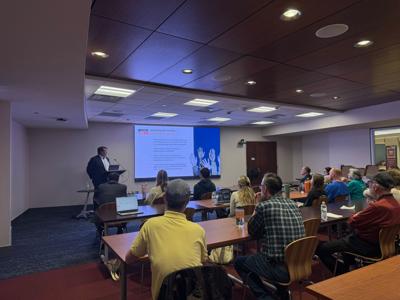

On Thursday, April 24, the Carl Albert Center hosted a "Lunch and Learn" event with Republican political strategist and pollster Pat McFerron to discuss open primaries and State Question 836.
The presentation began with an introduction by Michael Crespin, OU political science professor and director of the Carl Albert Center, who highlighted McFerron’s background and credentials.
“He's a founding partner at CMA Strategy, which is a leading public affairs firm,” Crespin said. “His career includes working with multiple presidential campaigns, plus successful U.S. Senate, gubernatorial, congressional races and over 20 victorious state ballot questions.”
The first half of McFerron's presentation focused on Oklahoma, in which he explained that the state primarily has a closed primary system and that there are only three recognized political parties: Republican, Democrat and Libertarian.
According to the Oklahoma State Election Board, Oklahoma operates under a closed primary system, which means that, in most cases, only voters registered with a specific political party can vote in that party’s primary election. The Republican and Libertarian parties in Oklahoma have chosen to keep their primaries closed. However, the Democratic Party has opted to allow Independents to participate in their primaries. This means that while Independents are excluded from Republican and Libertarian primary ballots, they are permitted to vote in the Democratic primaries.
State Question 836 would allow registered voters in Oklahoma to vote in any primary election, even if they’re not affiliated with the party hosting that primary.
McFerron argues that this change would ensure that every voter has a voice in every election, and it would also shift control from the political parties back to the voters.
“The party really controls things … not for the private organizations from the political parties,” McFerron said. “Political parties are not government entities. They are private organizations, but they control the process at this point.”
McFerron said primary elections often determine more important decisions than general elections. McFerron said this is a problem everywhere, but it is particularly severe in Oklahoma where there is a Republican majority.
“I am conflicted all the time,” McFerron said. “My vote is less than somebody that lives in a cohesive area where you're just one party or the other, where you could pick and choose, because my vote is not going to count.”
According to McFerron, the notion that general elections are meaningless has led to a rapid decline in voter turnout.
“People are conditioned to vote in November. This is where Oklahoma's voting age population turned out right,” McFerron said. “Why do you think more people don't vote? It's because they don't think their vote matters.”
McFerron attributed this to the primary system, which he said typically allows only two extreme candidates to advance, leaving moderate voters with little choice.
In House District 20, south of Norman, a Republican primary was won by just five votes which meant fewer than 3,500 votes determined the representation for nearly 39,000 constituents.
McFerron argued that the current electoral system rewards division over consensus. McFerron said candidates are often incentivized to focus on energizing a narrow base of voters rather than appealing to a broad coalition.
“There's no incentive for consensus building, there's no incentive to find solutions,” McFerron said.
McFerron argued that Oklahoma’s current primary election system encourages candidates to appeal to small, passionate voter blocs instead of the broader public. With voter turnout often hovering around just a few thousand votes in districts with tens of thousands of eligible adults, winning requires mobilizing a committed minority, sometimes as little as 53% of the eligible population, McFerron said.
McFerron said this dynamic plays out across party lines. One example he cited is the polarized debate over education policy in the state.
“Over the last year and a half, we've had folks on one side of the political aisle that want to put Bibles in classrooms, they want to make sure that every kid has access to a Bible in a classroom, and teachers are teaching the Bible,” McFerron said. “We have another group that wants to make sure that every child has access to the New York Public Library so they can explore their sexuality on their own.”
McFerron said the result is a system that limits meaningful choice, discourages consensus and makes many voters feel stuck between “the lesser of two evils.” He said opening up primaries could engage more voters and provide more representative options. Though even that, he acknowledges, may not be a quick fix for profound voter disillusionment.
McFerron noted that while State Question 836 does not officially eliminate straight-party voting, it would render it ineffective in races where two candidates from the same party move forward.
Critics of the proposal have raised concerns about scenarios where voters may be left with only candidates from a single party in November. McFerron acknowledged these outcomes are possible but argued they already occur under existing systems.
McFerron also suggested the reform could revitalize party engagement.
“I actually think that this can also lead to a resurgence of the political parties on a grassroots level,” McFerron said. “Right now, they really don’t have much of a role, … but if we do away with this (closed system), I think you’ll see the parties start saying, ‘This is the one we want you to vote for.’”
McFerron also spoke on the ongoing debate in Oklahoma over tax cuts and public investment, particularly regarding education, mental health and infrastructure. While there is strong support for tax cuts among Oklahomans, especially Republicans, McFerron pointed out that when asked about specific priorities, many people prefer investing in public services over tax reductions.
"Yes, people want tax cuts, but if we ask them, 'Do you want taxes, or do you want to fund education?' there is a preference for an investment in education," McFerron said. "If you ask them about taxes or funding for mental health, they prefer mental health. Taxes or infrastructure, roads and bridges — they want infrastructure."
Despite this, McFerron acknowledged that the governor's proposal to phase out the state income tax has strong support from Republicans, with a 2-1 favorability ratio. However, when polling questions linked tax cuts to potential cuts in public services, such as infrastructure funding, opposition grew, particularly among the general electorate.
McFerron also noted that Republican primary voters are a key audience for politicians and that this can sometimes put politicians at odds with the broader electorate.
"Republicans are at odds with the general electorate, but they’re going to be successful in what they’re doing here," McFerron said.
In an interview with OU Daily following the event, McFerron said it’s important for younger voters to be knowledgeable about the benefits of open primaries.
This story was edited by Anusha Fathepure and Ismael Lele. Tori Pham and Avery Avery copy edited this story.


