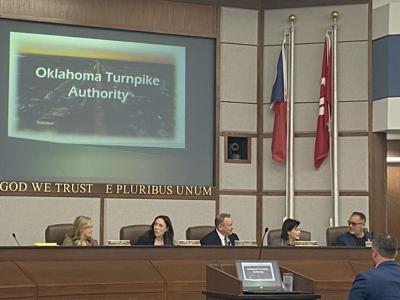

A representative from the Oklahoma Turnpike Authority said the agency did not know the number of homes that would be affected by the proposed ACCESS Oklahoma Turnpike during a Tuesday study session with the Norman City Council.
The study session included a three-hour-long questioning from council members regarding the turnpike. Joe Echelle, deputy director of OTA, presented the turnpike route through Norman along with the organization's sources of revenue to the council.
Echelle said that OTA receives no state appropriations, with most of its revenue stemming from toll roads. In 2022, OTA's revenue is projected to be over $451 million, including carryover from previous years.
Echelle said Oklahoma's toll rates are 60 percent lower than the national average for passenger vehicles and 64 percent lower for heavy trucks.
The ACCESS Oklahoma Program proposes an alternate route for Interstate 35 and Interstate 45 traffic congestion south of OKC, reviews older parts of the turnpike network for new access locations and widens portions of Interstate 44 and the John Kilpatrick Turnpike. The path of the proposed turnpike was decided using area population, traffic growth, accident data and travel times.
Echelle led the council through the project map, which is available on the ACCESS Oklahoma website. The route is shown in blue that follows the direct path of the turnpike, surrounded by a 1,200 feet wide orange line highlighting the surrounding area. Echelle said that the orange line might change in size throughout the development process.
"Even if they aren't in the orange, they'll still have a turnpike in their front yard, correct?" Norman Mayor Breea Clark asked.
Echelle said it would depend on the impact on the property and that because they aren't exactly sure of the alignment of the turnpike, they cannot determine the exact number of homes.
"Every single family member is unique, it's the most serious thing we do," Echelle said. "We go out and purchase property from people who did not have a for sale sign … there will be people today who don't have a turnpike as a neighbor who will have a turnpike as a neighbor."
Clark responded to Echelle by saying the turnpike would completely change "the character" of Norman.
Echelle said that when OTA was discussing how to introduce the plan to the public, one of its priorities was to introduce it in a "less impactful" and "less anxiety-inducing" way than the Kickapoo Turnpike announcement did.
One goal Echelle has for the project is to work with the city manager's office and the council to "address concerns in real-time" and provide a "long range look" into relieving traffic.
Ward 3 Councilmember Kelly Lynn asked if board members, family members or LLCs owned by OTA board members were prohibited from buying land that could be used for commercial development around the proposed turnpike. Todd Gore, property acquisition specialist for the OTA, responded that there wasn't a ban.
Lynn compared this to insider trading, calling it "almost criminal."
Echelle said that he was "unaware" of any kind of transaction but said that property had been purchased from OTA employees before. That was done through the process of condemnation, where a court determines the value of a property to avoid any favoritism.
"Somebody is making money on (the turnpike). The whole process just seems gross, especially when you're going to change the whole landscape of our city," Lynn said.
Clark asked if any mayors or city managers of other impacted cities were notified before the introduction of the plan. Clark has said previously that OTA did not notify her or another one of Norman's elected officials prior to the announcement.
Echelle said that others were contacted and OTA held meetings with a few of those officials. Clark asked why OTA was not more "proactive" in reaching out to Norman, especially because the city had previously stopped a similar project from happening in 1999.
"It could be a mistake that we made. I don't know if we knew exactly the impact or how Norman would react at the time," Echelle said.
Clark said that the council was "blindsided" by the announcement and didn't have answers for "traumatized" residents when they called, adding that future communities should be approached for input prior to any turnpike proposals.
Ward 2 Councilmember Lauren Schueler told Echelle that Norman and other "key individuals" were left out of the early discussion stages of the turnpike and asked how OTA got to the map without impact studies and environmental engineering surveys.
Echelle said that the turnpike's route was the only option to avoid major businesses and avoid the greatest amount of homes. He said that if the route were to move east, it would be in a floodplain. If it were to move west, it would impact more neighborhoods.
He believes homes in the way of construction may be radically reduced but does not know the number of homes impacted under the current alignment. Echelle added that OTA will know much more 5 to 6 months from now.
Schueler also pointed out the importance of trees and their benefits to the environment, asking Echelle how many trees would be taken out by the turnpike. He said that OTA only clears the trees needed for construction and had previously planted more trees along the turnpike line.
Kirsten McCullough, a planning and environmental specialist with part of OTA's project managing team Garver, delivered an update on the process of beginning environmental studies at the request of Schueler. She said that they are very early in the study process and still determining the professionals to use and which corridor to study.
McCullough said that the studies will start in about a month and will take about a year to complete. She added that the city would have access to the study's results as certain sections are completed.
Schueler asked if any timelines were overlapping, like right-of-way acquisitions of properties, acting "parallel" with other parts of the project before environment studies were conducted.
Gore said that 60 percent of the design plan must be complete for OTA to begin reaching property owners. McCullough estimated that the majority of the environmental studies would be complete by then, but all agency consulting may not be done, though she couldn't know for sure where the studies would be at by then.
"It's all very squishy, and that's something that's really concerning for us as leaders in our community and trying to work with our residents," Schueler said. "You aren't providing me with any good feelings about the process moving forward."
Ward 2 Councilmember Brandi Studley said she feels that OTA put the "cart before the house" and is just now figuring out a way to defend the turnpike route. Studley said she hoped the OTA would listen to Amy Cerato.
Cerato is part of the organization Pike Off OTA and an advocate for rose rocks, a rare geological formation and the state's official rock, which are directly impacted by the turnpike placement.
Studley disputed the claim that Normanites would actually use the turnpike, as they would have to drive further east to enter the turnpike. Further, Studley asked if OTA would acknowledge private indigenous burial sites that are not federally registered within their studies.
McCullough assured Studley that the turnpike would not be built over any graveyard of any kind.
Studley said that she "thinks it's a joke" that OTA cannot estimate homes and people displaced, questioning how they can pick the best route that avoids the most homes without knowing how many will be affected.
After Norman stopped the construction of the turnpike in 1999, Studley said that she felt OTA avoided speaking to Norman because they knew the opposition OTA would face.
"But to blindside us like this and act like you're playing nice is a load of crap and I'm not down for it," Studley said.
Ward 5 Councilmember Rarchar Tortorello said that he feels the system is "taking advantage" of residents without recourse following the lack of transparency and communication from OTA to Normanites.
"Do we tie ourselves to a tree?" Tortorello asked. "These folks have no place to go."
Lakeview Elementary School would be placed near the turnpike, Tortorello said. Tortorello asked if OTA had figured out possible effects on bus routes. Echelle said Lakeview had not been considered in this proposal, but OTA has worked with schools to ensure student safety.
Tortorello asked if OTA had ever done studies about population increase and decrease around turnpikes. While OTA had not conducted any studies, Echelle said that studies on commercial and housing development along I-35 and the John Kilpatrick Turnpike have been done by the Oklahoma State Chamber.
Ward 8 Councilmember Matt Peacock asked if OTA was aware of the idea of induced demand, where increasing roadway capacity encourages more people to drive, therefore not relieving congestion at all.
Echelle said that he hadn't heard of induced demand, to which Peacock said he felt it was something to look into.
Peacock asked if OTA had studied the changing demographics of car ownership in younger generations. Echelle said that their traffic studies did not factor in these statistics that show car ownership decreases from generation to generation but says he is aware of conflicting information.
Additionally, Peacock asked if OTA had conducted a study about car emissions from a large number of cars on current turnpikes, though Echelle said that no study had been conducted. He also said he had no information on how the turnpike would affect emissions near Lake Thunderbird or Little River.
Peacock asked why OTA hadn’t "embraced" more sustainable traveling options like passenger rails. Echelle said that the turnpike proposal does not inhibit future rail lines, adding that the "reality" is a rail line would not decrease the amount of traffic.
Ward 4 Councilmember Lee Hall said that the "dramatic impact" on the rural part of Norman also affects every single person in Norman because of the possible effects on the watershed. Lake Thunderbird serves as Norman's primary water source, along with Del City and Midwest City.
Hall asked if OTA had reached out to the communities whose water supply would be affected, to which Echelle said no, though OTA has developed projects involving watersheds such as Lake Overholser and the Wes Watkins Reservoir.
Hall said she was interested in how OTA thinks about water mitigation, and city councils previous to this one focused on how to protect Norman's watershed, adding it is "hard to wrap your head around" how many of Norman's strategies, like land-use plans, will fit with this turnpike proposal.
"There's just a lot of implications that, no matter what you can do, is it enough to completely disrupt a portion of our community that was never intended to accommodate a turnpike," Hall said. "I haven't figured out yet a real plus side on how this benefits the city of Norman in any way … the cost to our community is enormous."
Clark expressed concern over the development that will follow the turnpike, saying it will be a "forever battle" for Norman, and the future councils will face ongoing battles because of the turnpike. She asked if the south extension part of the turnpike would "significantly" impact more homes than other projects.
Echelle said that while he does not know the exact amount of homes that would be impacted, he does not think it would be significantly more than other projects.
Clark further asked how many homeowners stayed in the cities they lived in before their homes were purchased by OTA, as Norman would be losing residents, ad valorem and sales tax revenue. Echelle said he did not have an answer.
Clark circled back to rose rocks and asked what conversation the OTA was having regarding rose rocks.
Echelle said that while he was aware of rose rocks in Oklahoma, he didn't know about the heavy concentration of rose rocks in the Norman area. McCullough acknowledged the uniqueness and significance of rose rocks and said that they would be included in future mapping.
Clark suggested that the OTA make "data-driven decisions" in the future due to the "life-changing" proposals and asked what happens if the environmental studies find catastrophic damage or if they find that traffic will not be impacted.
"I don't know the answer to that standing here today," said Echelle. "If we run into something that creates a no-go situation, and I don't know what that is … I don't think that there's going to be something out there, but there could be."
Clark said that it was very hard not to be emotional and that OTA was "banking" on solving today's problems by "destroying" the climate and environment. She added that the memories made on the properties that OTA would have to purchase were "priceless," referring to a story of a woman who described sprinkling her husband's ashes on her property.
"The woman showed me the picture of her home and her dead husband and had tears in her eyes as she told me about the ashes she spread and the home she just gave her children. I don't know how you put a price on that," Clark said.
Echelle read a list of dates where representatives of the OTA would be traveling to communities to hear from members of the community, including Noble, Newcastle, Moore and Norman. He also announced a podcast featuring McCullough that discusses environmental aspects of the turnpike.
Clark said that she knew that the situation was difficult for the OTA staff, but they must consider the people of Norman and the future of the city when making decisions.
"I'll look at you just like I did Secretary Tim Gatz and ask that you don't do this in Norman," Clark said. "Just don't. They're not going to make it easy for you. I can sit back and let the residents take over because their stories matter."
Clark said, she asked the city manager to send a letter to the homes affected to collect residents' stories to share with the public and the OTA, adding that she hoped the OTA could look back and know the turnpike was "worth it" just for traffic, calling the plan "impersonal."
Tortorello echoed Clark, asking OTA not to do this to Norman, as it provides no economic benefit to Norman. The turnpike would not include an exit off the road for Norman, which Tortorello compared to "flying over" Oklahoma.
"I'm going to let (Norman residents) run with this. They're telling you that they don't want this, and there are a lot of stories. We are data-driven, but we're also here, in this case, people-driven," said Tortorello.
Tortorello also invited OTA to walk the neighborhoods that would be affected to see the full scope of the turnpike's impact.
Studley asked if OTA had ever done a study about the environmental effects following turnpike construction, which Echelle said they had not done on any of their projects. Studley added that Norman had banned commercial and residential development in far east Norman to further protect the watershed and said that the turnpike was "very scary" because of the closeness to the watershed.
Echelle apologized to Clark for the rollout of the turnpike and for not visiting with her prior to the formal announcement, extending the apology to the area's legislators for not alerting them either, and thanking Clark for her invitation.
"I look forward to continuing this line of communication and doing everything we can to find a solution that works for Norman residents, not just truck drivers," said Clark.


