
ONE Norman hosted a summit about affordable housing in the city on Monday evening.
ONE Norman, a task force meant to help Norman develop a long-term comprehensive plan to improve infrastructure, quality of life, housing and Civic IQ partnered with CivicCon to address affordable housing.
CivicCon is a nonprofit initiative under the Center on Civic Engagement, with the goal of providing willing communities with civic education. ONE Norman previously partnered with CivicCon founder Quint Studer in a May meeting where Studer presented the results of Norman’s quality of life survey.
Shane Phillips, housing initiative project manager for Lewis Center of Regional Policy, led the event with a presentation. He said Norman is still affordable and if the city makes attempts to prepare for the future, it can avoid a potential economic collapse that may be impossible to come back from.
Phillips warned the committee not to imitate the same housing policy that led to rising prices in California. If Norman doesn’t plan for a rising population, then the city will find itself with a severe lack of affordable housing, according to Phillips.
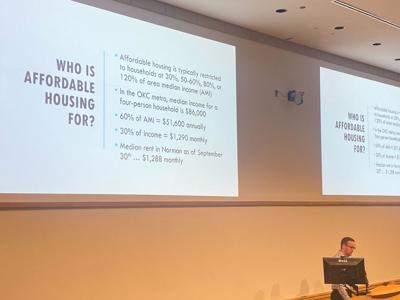
During a Norman City Council town hall last October, City Manager Darrel Pyle said there are 44,915 households in Norman. Of those, over 19,000 are at or below 80% of the area’s median income of $59,866, making them qualify as affordable housing. This means Norman is about 9,000 affordable housing units short of demand, Pyle said.
“All that is different is the demand and as demand grows here, you are headed down exactly the same path. It may take three decades, may take five decades, but you're on that path,” Phillips said.
Phillips then broke down what he believes to be the three most essential fundamentals of affordable housing: supply, stability and subsidy.
Supply
Phillips said Norman must build more housing that will accommodate demographic shifts like population growth, aging population, shrinking household sizes and long-term economic shifts.
“Home values go up most in places that build the least, so housing wealth is largely built by not building housing. There's something wrong with that,” Phillips said.
Stability
With economic forces that are outside of individual or regional control, Philips said stability is key to protecting vulnerable communities and households who may be incapable of keeping up with rising housing prices. According to Phillips, the median renter has half the income of the median owner and one-tenth of the wealth.
“I think it's really important to say it's not about stasis. It's about providing some measure of security and predictability for folks. It does not mean freezing things in amber,” Phillips said.
Subsidy
Phillips said that Norman must be willing to spend money to be successful and meet the needs of the people living in the area, but to be effective, the city must understand different people in different communities have different needs.
“Those needs are valid, but they require different kinds of solutions,” Phillips said. “And then, you know, we're not going to get very far by pouring all of our efforts into supply alone or stability alone, or subsidy.”
Phillips provided Montana as an example of addressing affordable housing. Montana implemented a Senate bill that gave cities within the state a list of housing reforms that they could choose from that, according to Phillips, improved the state's situation.
“The number of people becoming homeless (in Los Angeles) is actually increasing at a faster rate than the number of people that we are helping out of (homelessness). We would be a much worse place if we hadn't invested in those subsidies because the number of people we were helping out wouldn't have increased, but it's become very clear that just throwing more money at the problem is never going to be enough on its own,” Phillips said.
The presentation concluded after Phillips gave the committee and Norman residents words of encouragement for a better future.
“Change happens whether we plan for it, or we want it or not. As I said earlier, you're either growing your housing stock and changing in that way or you're growing your housing prices, and all the consequences that come from that. So you all have the power to make those changes and make sure that they are positive to actually direct them in a way that you want to see. And so I really encourage you to be involved,” Phillips said.
This story was edited by Alexia Aston and Peggy Dodd. Grace Rhodes copy edited this story.


