
This election year, young adults 18 to 25 have shown more civic engagement despite previously being the demographic least likely to register and vote.
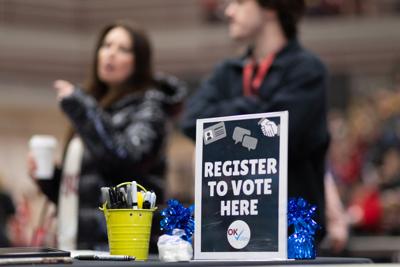
Oklahoma Votes, a nonpartisan student organization, aspires to help OU students and community members register to vote, file absentee ballots and be educated about the importance of being involved in politics.
As the presidential election nears, Oklahoma Votes prepares to get as many people registered and ready to vote as possible.
“Students are realizing who they vote for now is who they get when they get out in the big world,” Faith Martin, OU director of civic engagement, said. “I’ve loved seeing the enthusiasm from the students this year.”
Martin said the organization gives students nonpartisan information and sources about both sides. Oklahoma Votes tries to reach every student, including those on campus, commuters and people in greek life, through different events and meetings with colleges and other organizations.
“We’ve already registered over 400 (students),” Martin said. “If you come here, we can help you with any part of the process. If you need help with the voter registry. If you need an absentee ballot and you need it notarized, we will notarize it and we will pay the postage to send it back in.”
Jhanvi Patel, a business management junior, joined the organization her freshman year and participated in several of its events. Now, as an Oklahoma Votes civic engagement fellow, she is more involved in the planning and organization process of the events.
“(Now) I can see just how much goes into the planning of these events and the challenges that come with trying to get people registered to vote,” Patel said.
Patel said she joined Oklahoma Votes because of its nonpartisanship, as it allows people with different opinions to join.
“It’s really just about getting people interested or getting them involved,” Patel said. “It’s not about who you vote for or the beliefs that you may or may not have. It’s just ensuring that people of our generation who have historically low voter turnout rates understand the importance of their voice and what big of an impact it can make in our democracy.”
Michael Stoyak, Oklahoma Votes civic engagement fellow, joined the organization his freshman year. Now, as a senior, he said he has seen the organization grow immensely.
“I’ve definitely seen increased enthusiasm, and that comes with just the recency of a major election,” Stoyak said. “We saw a good turnout and great response to our efforts in 2022, but 2024 is a different animal.”
To reach out to minority communities, Martin said the organization tries to reach out to other groups including the OU College Republicans, OU College Democrats and Latinos Unidos, a registered student organization that encourages civic engagement among Latino students.
Patel said the organization always makes sure to reach as many freshmen as possible as they haven’t had the time to register or just turned 18 and are unaware of what they have to do.
“We have gone and spoken to foundation classes, because those are freshmen classes. We have targeted federal government classes and gone to their discussion classes, and we’ve had multiple different departments reaching out to us to get students registered to vote,” Patel said.
According to the Pew Research Center, roughly 24 million members of Generation Z — those born between 1997 and 2012 — had the opportunity to vote in the 2020 presidential election. This year, nearly 40 million are eligible.
“If (Gen Z) actually vote, (it) will have the largest voting bloc out there and (students) right now are not represented at the national level,” Martin said.
Stoyak said, while being the largest voting bloc in U.S. history, Gen Z are also the most likely to not vote. However, he believes this year will be different.
“I’m enthusiastic that this year will definitely see a difference, and we can be the generation that changes that,” Stoyak said.
Stoyak listed several reasons why he thinks younger people don’t vote, including accessibility; issues; finding time to vote, especially in the middle of exams and projects; and turning away from politics as some people feel underrepresented.
Patel said more OU departments have reached out to Oklahoma Votes to get students registered to vote this year. She said it’s very encouraging knowing that the leadership at OU and other universities understand the importance of registering students.
Martin said the organization is trying to encourage the OU Faculty Senate to help register students.
“We are asking them to either, every four years, give (students) the day off on Tuesday to go and vote, and if that’s not possible, to at least give (students) an excused absence if you can come back with a sticker or something that proves you went and voted that day,” Martin said.
Martin said Oklahoma Votes tried to get an early voting place on campus but after overcoming many obstacles, the county finally denied the voting place. She said many university leaders, including OU President Joseph Harroz Jr. and Vice President for Student Affairs and Dean of Students David Surratt, backed the organization and pushed for the project to happen.
“We have over 6,000 registered Cleveland County voters on our campus between faculty, staff and students. There’s no reason that we couldn’t have an early voting place,” Martin said. “Everybody was behind it. Everybody was pushing it, and Cleveland County finally just said no because they want to make it harder for you to vote.”
Patel said the organization’s biggest event of the year is national voter registration day on Sept. 17. During the event, she said they tabled across campus in three different locations to reach as many students as possible.
“We’re really just trying to get as many people registered to vote as we can on that day,” Patel said.
The organization held a watch party for the second presidential debate on Sept. 10. Martin said she expected 30-50 people and was quickly surprised by the turnout.
“We had over 100 people show up,” Martin said. “I think (students) finally are starting to get excited, and I’m hoping that that translates.”
Martin said there used to be a civility and respect for politics, and people disagreeing with one another didn’t mean they didn’t respect and listen to the other’s opinions and views.
“I feel that you guys have kind of disengaged from politics, and I don’t blame you,” Martin said. “We’ve not handed you a great platter policy. You have a bunch of things that you guys are gonna have to fix for your future, down to social security, to climate change, to gun reform.
“You guys are actually gonna have to get in there and learn how to work together.”
As he prepares to leave OU, Stoyak said it has been rewarding that his last year as a member with the organization was an election year.
“I just hope that Oklahoma Votes solidifies itself as a resource for students, kind of permeates itself on campus as a place for students to go if they’re passionate about civic engagement and passionate about helping students,” Stoyak said.
Patel said Oklahoma Votes often tells students they don’t need to be interested in the bigger election, as it can be scary and controversial, but rather look into the effect it could have in their day to day lives. She said she hopes the organization can get as many students registered to vote as possible.
“My hope, with our efforts this year, is that students are encouraged to be involved in all levels of the process, not just in the presidential election,” Patel said. “While, obviously, the presidential election has a huge impact on the country as a whole, it’s really local leaders that affect the way we go about our everyday lives.”
This story was edited by Peggy Dodd and Anusha Fathepure. Grace Rhodes and Mary Ann Livingood copy edited this story.


