




Homelessness advocates and an OU professor objected to the idea that Norman’s unhoused population is to blame for rising crime rates in light of recent statistics presented by Norman Police Department.
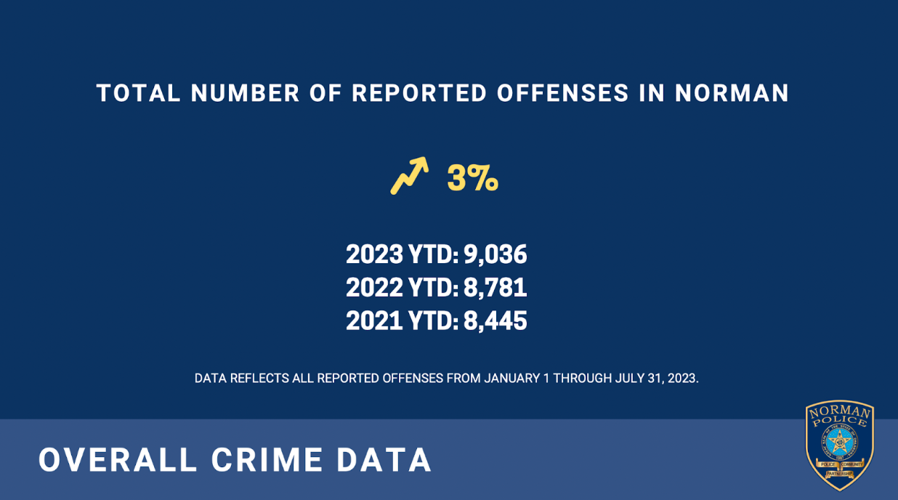
In a Norman City Council meeting on Aug. 29, Norman Police Chief Kevin Foster reported that overall offenses in Norman have slightly risen by 3%. Over the past year, several Norman residents spoke about crime at council meetings, attributing it to the city's unhoused population.
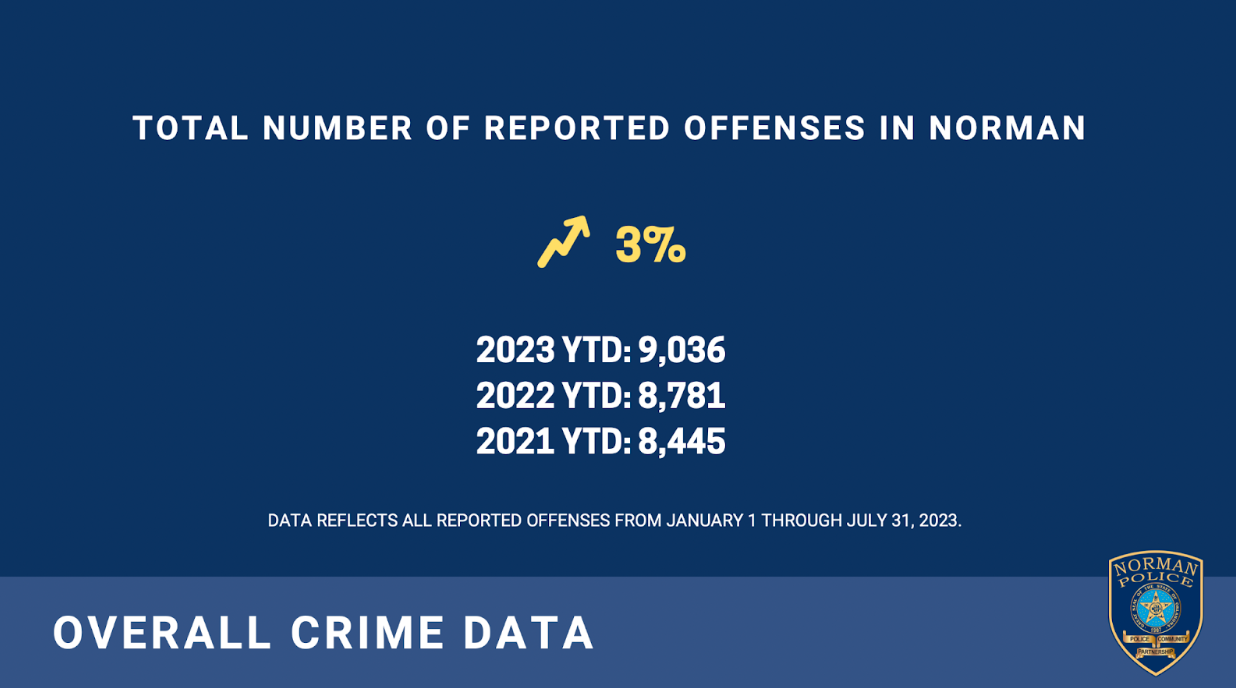
Total number of reported offenses in Norman from Jan. 1 to July 31.
One Norman resident, Chelsey Gravel, frequently speaks at the city council meetings to express her concerns regarding the unhoused population in Norman.
“My rights are being taken away. I no longer feel safe in Norman, in my neighborhood. I’ve given up running, I don’t want to walk alone, and I don’t dare go to a park at all,” Gravel said during a council meeting on May 23. “I find myself wondering what does the future of my city, my safe Norman, look like? I don’t feel safe.”
This narrative coincided with the debate in a council meeting on June 28 over whether Norman should continue renewing its lease on the emergency shelter called A Friend’s House at 109 W. Gray St. Some residents said that the existence of a space for people experiencing homelessness would only attract more people who are likely to commit a crime.
April Doshier, executive director of Food and Shelter, said evidence does not support these claims and that misinformation has been weaponized by certain people within Norman in an effort to eliminate homeless services.
“Our guests at the shelter are kind men and women looking for opportunity,” Doshier said. “Our guests at Food and Shelter are people fallen on hard luck. They grow tired of being generalized and mischaracterized, and this really validates them.”
For Matthew Allen-Morgan, his experience with homelessness was exactly that — seeking opportunity amid instability.
Morgan, outreach manager for the Oklahoma Mental Health Association, said he found himself in a depressive state after the death of his mother in 2011. He was living with friends before he eventually moved to a shelter in Oklahoma City, where he then turned to substance abuse.
Morgan described being depressed as a mental state where he became completely apathetic towards his well-being.
“When you don't care if you're alive or if you're dead, you're certainly not going to be able to manage appointments, you're not going to be able to manage going to work, you're not going to be able to manage keeping your clothes clean for a job, when you don't care if you wake up the next day,” Morgan said.
Morgan said his time spent in a shelter in Oklahoma City was very unwelcoming, so much so that he said he’d rather live on the streets of Norman than remain in that specific shelter. Morgan moved to Norman in 2017 where he panhandled until he was admitted into Transition House, a mental health transitional housing facility, that same year.
Morgan spent six months in Transition House where he focused on maintaining sobriety. He eventually moved to a cottage owned by Food and Shelter where he was able to attain a job as kitchen manager.
“I gained fulfillment from knowing that I was helping out an organization that had helped me literally stay alive,” Morgan said.
According to NPD, the recent findings of crime related to Norman’s homeless population from Jan. 1 to Aug. 10 showed 70 people were arrested from Food and Shelter, while A Friend's Place saw 20 arrests.
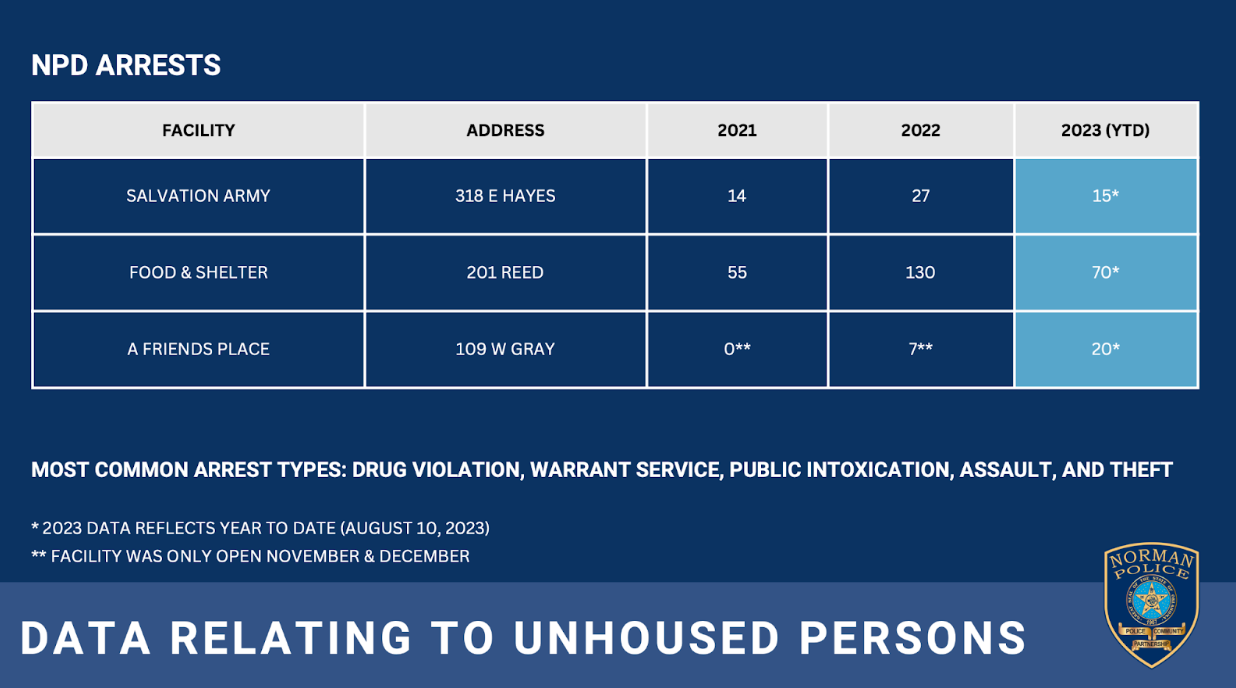
Arrest data relating to people experiencing homelessness based on facility.
According to Foster, the total arrests in Norman as of July was 3,227, which would mean A Friend's Place accounted for 0.61% of total arrests within the city.
There have been arguments within council on whether to maintain a shelter, but, according to assistant city attorney Anthony Purinton, Norman’s city council indicated the goal is to establish a permanent shelter despite the public’s aversion towards it.
“Somewhere along the way, homeless services became political when there is nothing political about our work. We work alongside every caring person in Norman to help struggling people. It is a moral calling, not a political one,” Doshier said.
A Friend's House is currently operating at full capacity with 40 beds, and operators have said they are having to turn away people due to lack of space.
Talks to relocate the shelter to a bigger operating space at 718 N. Porter Ave. were halted after the Norman planning commission voted to deny a recommendation to council to rezone the property on Aug. 11. At that meeting, a flurry of residents took to public comment to voice their grievances of a potential relocation.
Residents’ main cause for concern of relocating the shelter to Porter Avenue was a potential disruption of local businesses, mainly Tarahumara’s Mexican Cafe & Cantina. Claims of exacerbating the crime issue were also made in an effort to strike down any plans for relocation.
“We pay $1,800,000 of payroll every year, and I think it's going to be affected, big time,” Efrain Romero, Tarahumara's co-owner said at the meeting. “As bad as its been, we’ve already had so many problems with people vandalizing customers cars, asking for money, bugging (customers), trashing, littering,”
During the city council meeting, Foster said he plans to increase the amount of sworn officers to cover their jurisdiction. Norman is authorized 180 officers, but, according to Foster, the city only has 167 sworn in. Several Norman residents have also said NPD is understaffed and is losing potential officers to other Oklahoma cities.
David McLeod, OU professor and former police detective, said depending on how crime is measured, having a larger police force may make it appear that more crime is happening. Having access to more police officers makes it easier for people to report crimes that may have gone unnoticed when the force was smaller.
“In some ways, it's really wonderful to have more police available because, if your life is in danger, they can get to your home quicker,” McLeod said. “In other ways, if you go to some parts of our community, they may not necessarily want a lot of patrol officers in their neighborhood because they fear the consequences of being watched all the time.”

Data comparisons between Norman, Broken Arrow and Edmond.
McLeod attributed the rise of anti-homeless rhetoric as a scapegoat tactic and said fear of rising crime rates is a result of consumption of inaccurate information.
“If we look at what's going on there in reality with a city the size of Norman, an increase in the population of people who are unhoused does not necessarily predict crime. It predicts that we have a housing problem. It predicts that we have problems in mental health services,” McLeod said.
Morgan said affordable housing is the key to ending homelessness. For those who feel unsafe around people experiencing homelessness, the solution is not putting them in jail, or moving them across town, but rather advocating to local governments for affordable housing initiatives. Not having a shelter won’t make them go away, he said.
When someone is experiencing homelessness, Morgan said, they are experiencing the worst moments of their life in a public setting. As opposed to an average person who may get intoxicated to numb their own pain, they at least have the privacy of their home, and they have their loved ones to comfort them, he said, but a person experiencing homelessness has no such privacy.
“The person screaming on the street isn't always like that, and, almost certainly, they're suffering more than anybody that's being subjected to them.” Morgan said.
This story was edited by Peggy Dodd, Taylor Jones and Alexia Aston. Mary Ann Livingood and Avery Avery copy edited this story.


