

Norman voters passed a proposition that will fund a permanent homeless shelter in Tuesday’s ballot election.
As of 8:50 p.m., with 17,427 votes cast, Proposition 5 passed with 54.25%, or 9,454 votes, according to unofficial results from the Oklahoma State Election Board’s website.
Proposition 5 will create an $8 million general obligation bond to fund a permanent homeless shelter through property tax revenue.
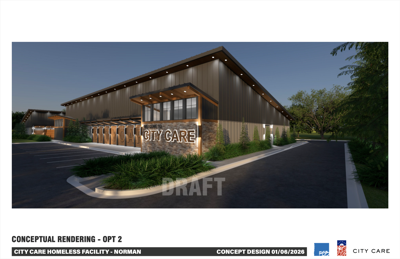
The shelter is set to be constructed within two years at Reed Avenue in East Norman, near other resources like Food and Shelter and the Central Oklahoma Community Mental Health Center. City Care, an Oklahoma City-based nonprofit currently operating Norman’s emergency shelter, is expected to operate the permanent shelter, according to the city’s website.
Norman City Council approved the purchase of the land at a November meeting with the intent to build a homeless shelter, despite some residents’ concerns.
Shawn Loyd, chief programs officer for City Care, told OU Daily Tuesday the shelter will offer a centralized hub where individuals experiencing homelessness can stay during the day. He said because of the shelter’s proximity to other providers, people won’t have to seek services spread across town.
“With this bond passing … it allows us to really step in and create a really big impact in a city that unfortunately is having to pay for services around homelessness already, …” Loyd said. “Norman is still paying for people experiencing homelessness, whether that's through services, whether that's through police, fire … one way or another, it's going to cost the community regardless.”
Mayor Stephen Tyler Holman wrote in a Facebook post Tuesday morning the current emergency shelter on Gray Street, City Care’s Norman shelter, is outdated and located away from necessary resources. Holman wrote that the permanent homeless shelter is a practical step forward to reduce homelessness in Norman.
“The bottom line is this: Doing nothing is not a neutral option,” Holman wrote. “It is the most expensive and least effective option. And it guarantees the status quo continues.”
The facility will house up to 120 people each night through a low-barrier system, meaning entry requirements like sobriety, identification and curfews are diminished to allow quicker access to services.
The facility will include separate women’s and men’s dorms, family units, a laundry room, respite rooms, a dog kennel, storage units, multi-use space, restrooms, showers and staff areas.
According to the January 2026 point-in-time count, Cleveland County Continuum of Care counted 165 people experiencing homelessness, with 73 unsheltered and 92 sheltered. This is 23.6% less than last year’s 216 individuals, and 25% less than the 2024 count at 220.
Heidi Smith, Cleveland County Continuum of Care organizer, told OU Daily in February the decrease could be due to extreme winter weather during the time of the count.
Residents will pay taxes depending on their home value over the course of 20 years, with the taxes funding construction costs. Residents will see an estimated annual increase of:
• $3.26 for homes valued at $100,000.
• $6.81 for homes valued at $200,000.
• $10.36 for homes valued at $300,000.
• $13.91 for homes valued at $400,000.
• $17.46 for homes valued at $500,000.
Operational costs will reportedly be sourced through the city’s general fund and City Care’s fundraising. According to the city’s website, operational expenses are estimated to be around $930,000.

This story was edited by Audrey McClour and Macey Thaxton. Lauren Brogdon and Mary Ann Livingood copy edited this story.


