
Editor’s note: This article was updated at 12:45 p.m. Feb. 4 to include complete quotes from Teresa Borum, to provide more complete context to the candidate’s priorities than previously published paraphrases expressed.
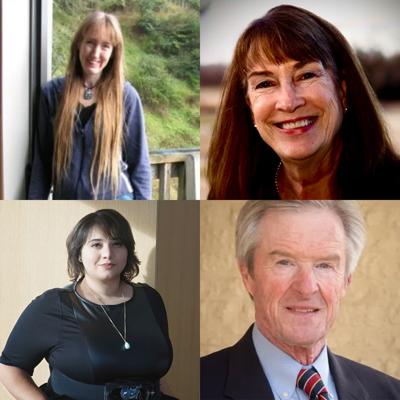
Four candidates are running for Norman’s Ward 4 city council seat after current Ward 4 Councilmember Lee Hall decided not to seek reelection. The Daily interviewed candidates on their reasons for running and biggest priorities if elected.
Mayoral and city council elections will take place Tuesday, Feb. 8. In-person absentee voting takes place Thursday and Friday, Feb. 3-4. If no candidate receives 50 percent of the vote, the runoff election will take place Tuesday, April 5. For more information on where, when and how to vote, visit the Cleveland County Election Board website.
Helen Grant
Helen Grant, a “military brat,” said they grew up in Memphis and have lived in Panama, Georgia, Germany and Arkansas, among other locations.
They graduated from OU in 2011 with a bachelor’s in professional writing and practiced independent journalism for several years before moving to Norman in 2016. They have a position focused on art, sales and marketing at Oscillator Press, and they’re also a Resonator Institute board member.
Norman’s sense of community is Grant’s favorite part of the town, they said. As Grant and their husband were debating between living in Oklahoma City or Norman, they weighed which option had “the essentials” within walking distance and ultimately settled on Norman.
Grant has been involved with Resonator since 2016, and served on several city committees for the Community Development Block Grant in 2017 and 2018. They were also a part of the Inclusive Community Subcommittee in 2019, and made a series of recommendations, including the hiring of a city diversity and equity officer.
They began work with mutual aid groups like Red Dirt Collective in 2020, and became involved with the Uprooted and Rising Indian Territory group in 2021. The organization approached Resonator in September 2020, expressing interest in starting a community fridge.
After the enforcement of city code forced fridge volunteers to relocate the resource, Grant said she worked on an ordinance that would allow the fridge to return. In October 2021, the city council passed a resolution that would exclude community resource fridges from limitations banning “unattended or discarded” fridges. Fridge owners would have to complete a new set of requirements, including securing a permit.
Former Ward 4 councilmember Bill Hickman resigned in 2019, meaning a need for an interim appointment, Grant said. Both they and current Ward 4 councilmember Lee Hall applied for the position, and Hall was chosen. Grant backed Hall, as she ran for a full term in 2020.
After Hall said she wouldn’t run for another term, Grant said they reached out fairly quickly to find out who was running. They said Ward 4 has always felt secure because of Hall’s competence, and they knew someone would have to fill the resulting void.
Hall informed Grant she knew they were interested in the position and encouraged them to run. Grant said one of their other friends pointed out how they were already doing the work of a council member through their involvement in city committees. Being in an official position would only allow them to do more.
If elected, Grant said they want to work to complete ongoing city projects, including a Sierra Club initiative focused on renewable resources that was approved by city council in 2018. They added Norman’s issue of poor drainage in the city center needs to be addressed by local leaders.
Grant’s involvement in CDBG committees has led them to make increasing affordable housing another priority, they said. The committees found that, though families considered low income scattered throughout the city, affordable shelters are relatively hard to find outside of the center of Norman.
The city has several options for accommodating low-income residents, Grant said. The Norman Housing Authority could receive CDBG funding from the U.S. Department of Housing and Urban Development. City leaders might also incentivize developers to make affordable housing units, offering grants to pay for land and labor.
Grant said they have taken inspiration from an Oklahoma City program that acquires vacant and rundown properties in the Paseo District, restores them and markets them to low or moderate-income buyers. It’s important for Norman residents to recognize their community is mixed-income and associate single-resident houses with people that need affordable housing, not students, they said. They added that they’re supportive of housing-first initiatives.
Grant said there’s a significant clash between developers and historical preservation enthusiasts in Ward 4. Though examining city code will likely lengthen development timelines, they said it’s necessary, adding city leaders must evaluate center city code to determine whether a walkable corridor from Campus Corner to downtown Main Street can be built.
“When you see people trying to do building developments that ignore the realities of the environment and the zoning, obviously, that's when I want to step in and ask questions and vote no,” Grant said.
Grant said they’ve been active in promoting alternatives to police response and contributed to the proposal for the Norman Compassionate Response Emergency Workers, an unarmed and non-police crisis response team. They said they believe some crisis response must be relegated to mental health experts.
Grant recalled going to Lazy Circles Brewing with several coworkers for their birthday and witnessing a person experiencing a “psychotic break.” They watched firefighters respond and quickly become frustrated because they lacked the proper authority and resources to address the situation.
“(The firefighters) were like, ‘We are not mental health professionals, and we are tired of responding to mental health calls, and we don't have the power like the cops to take anybody anywhere,’” Grant said. “So, for them, it was just an exercise in frustration.”
Grant also said they’d love to see a city-wide emphasis on participatory budgeting, which would allow community members to directly decide how to spend part of a public budget.
They said they haven’t stopped masking or social distancing and would appreciate stronger COVID-19 measures in place. They believe Norman is at “step one” of combating the pandemic again because of a lack of testing resources.
The north part of Ward 4 is on OU’s campus, and Grant said their partnership with the university will depend on its administration. They said they’d strive to have an open, transparent relationship. They expect to go beyond their council role, attending both required council meetings and any others that might be helpful.
Norman would benefit from more 2SLGBTQ+ voices, as well as greater representation from Black and Indigenous people, and people of color, Grant said. As an individual of Chamorro and Mexican-Indigenous heritage, they said they’d likely be the first woman of color on city council, if elected.
Grant considers themself an artist, writer and a big-picture thinker, and tends to visualize complex concepts as a “constellation.” They believe recent developments, including the expansion of the Norman Regional Health System, will reinvigorate the area.
“Everything that's happening in this ward is very dynamic,” Grant said. “Ward 4 just has so much going on in it, which is kind of perfect, because I don't like to be bored.”
Teresa Borum
Teresa Borum grew up in Shawnee and went to Oklahoma City Community College to study psychology, she said. Though she lived in Moore while in school, she said she visited Norman often to help tutor a friend and came to love the town. She said it had a “completely different feel” from any other place she’d visited, so she moved there with her son in 2002.
Borum said she is a “jack of all trades” with a diverse resume. She worked as a writer, at a bank and helped birth foals. She finally found the career she loves in driving a city bus for Embark, and has been in the position for nine years.
Borum homeschooled her son up until high school and was involved in all of his organizations, including Boy Scouts, she said. She enrolled her son in OU when he was 16 and tutored him through classes. She said she never had an interest in government, but when her son started studying politics, he pulled her into it too.
She became increasingly interested when she learned of planned zoning changes in her neighborhood to accommodate a Food and Shelter food and resource center, and additional parking. Borum said she was against the proposal, like several of her neighbors, and despite several protest letters being filed, the city council voted 7-1 to pass a proposition approving the change on Oct. 26, 2021.
Borum said she feels the location of any proposed homeless shelter or resources should be carefully considered to care for businesses and seniors in Norman.
"So many people on the City Council were pushing to take 718 North Porter, which is right next door to Tarahumara's, and turn it into a homeless shelter. And I thought how was that caring for businesses," Borum said. "I also found out that they were also wanting to, after Norman Regional moved, build a homeless shelter right next to the new senior center, and I didn't think that was a good idea either."
Borum also said she disagrees with placing the shelter next to any of Ward 4’s schools, because she worries about homeless individuals who are “dangerous” or “mentally unstable” being around children. She’s initiated a petition to ban homeless shelters from being placed closer than a half a mile to schools, daycares or parks.
One of Borum’s biggest priorities is addressing issues of homelessness, which she said shouldn’t be confined to Ward 4. In her capacity as bus driver, she also said she’s spoken to several people without homes. Many told her they were "transients" who move between places with the "best benefits and lenient policies," Borum said.
She also said homeless individuals told her they feel safer outside of Norman's shelters because of fears that others might take their belongings, and that a city employee who works with the homeless population told her after a period of time living on the street, it is more difficult to convince people to enter assistance programs.
"I know a lot of them that don't like shelters, they don't want to be in shelters, they want to sleep on the street, they actually say they feel safer on the street," Borum said.
There’s no suitable location for a warming shelter in Ward 4, Borum said. She claimed the presence of Food and Shelter has caused crime rates in the area to climb.
"I never had a problem with any of our homeless shelters, until food and shelter came in. When food and shelter came in, the little homes were wonderful, they weren't the problem, but they have the meals that they serve, that brings in a lot of the homeless to that area," Borum said. "After food and shelter came, the crime in this area went way up."
The Norman Transcript reported that while police response has increased near Food and Shelter, it could be caused by factors like the pandemic and the presence of other resources in the area.
Placing a shelter in the middle of town puts individuals without homes in the city’s business center could harm their sales, she added, which hurts funding prospects for social programs.
"If you have enough business opportunity, plenty of employment opportunity in a city, that helps keep people from being homeless," Borum said. "It also brings money into the city, through our tax income, or a sales tax, so that we have the funds to be able to do the social programs that people want, to be able to do the extra things that need to be done."
The ideal place for the shelter would be north of Robinson Street on Flood Avenue, which is more on the edge of town but still near a bus route. Borum said this placement would give individuals without homes room to wander, but allow them to go into town if they choose.
Borum said many people underestimate people experiencing homelessness, but she believes they’re very capable of using public transportation to access resources, so a shelter can be built anywhere near a bus route to provide access.
"As long as there's a city bus route within the area, wherever you put the homeless shelter, they can (go), they have quite literally all day long to get to where they need to go because they do not have a job," Borum said.
Borum said she’s seen campaigns encouraging residents not to give people without homes food and money. Mayors in some major cities like Philadelphia and Houston have historically asked residents not to give to panhandlers and instead donate to programs that aid homeless populations.
"There's this city that I read about where the mayor, he ran a campaign that said do not give to the homeless. Don't give them food, don't give them money, don't give them tents, don't give them bicycles, don't give them everything that they need to live on the street," Borum said. "If you give them everything that they need to live on the street, that is where they will live."
Borum said housing-first strategies only work for people that don’t need constant supervision to keep them on track, and warming shelters are just a temporary fix. One system she said she believes works well is a closely supervised community for individuals without homes where they’re expected to follow the rules, go to therapy and participate in rehabilitation services.
Referring to a June 2020 vote to reduce a proposed increase in NPD’s budget, Borum also said “decreasing NPD’s funding” has led to a police shortage across the city. She said this has caused unpredictable patrolling instead of an “active” police presence. It’s also contributed to officers feeling overworked on top of constantly being placed in stressful situations, she said.
She claimed that a greater police presence leads to less crime, which leads to less police brutality, as officers are rested enough to think through their decisions. Several studies have found that while more police officers can serve to reduce major and violent crimes, effects can be inconsistent, and the rate of police brutality is not addressed.
Borum said she’s against a vaccine and mask mandate.
"It's wrong to play doctor and pretend that you know everybody's medical history, therefore, you shouldn't be able to tell them what medical treatments they can and cannot have," Borum said.
The city must also do away with excessive business regulations, Borum said. Local businesses help pay for “social programs” like shelters through sales tax, and more employment opportunities keeps people from being homeless.
OU’s student body “brings vigor and expertise” to Norman’s industries, making a partnership between the city and university important, she said.
The city council and mayor are supposed to be nonpartisan, Borum said, but she’s seen a lot of partisanship that’s “inexcusable.” Norman’s government has to be open and honest in all its dealings, Borum said, and councilmembers have to be willing to compromise.
“I'm constantly learning,” Borum said. “I’m constantly being willing to open myself up and hear different points of view, and I'm not stuck into the belief system that I know it all and I don't have anything more to learn.”
Doane Harrison
Certified public accountant Doane Harrison said he grew up in Altus and moved to Norman during high school and graduated from Norman High School in 1964. He graduated from OU with a bachelor’s in accounting in 1968 and was in the army from 1969 to 1970.
After graduating from the University of Texas with a master’s in accounting in 1972, Harrison returned to Norman in 1977. He’s lived in Ward 4 since then and has owned Harrison Associates, an accounting firm, in the ward for over 40 years.
Norman’s size and cultural activities are his favorite aspects of the town, he said. He has four children that all went through Norman Public Schools, and said the school system is excellent.
Harrison is a longtime member of the Rotary Club of Norman and has served in various capacities, including the organization of Le Tour de Vin, one of the group’s major fundraisers. He was on the board of the Norman Regional Hospital Foundation for many years and is still involved with the foundation’s finance committee. He also teaches Sunday school at McFarland United Methodist Church.
Though Harrison wasn’t regularly involved in local politics, he said the June 2020 NPD budget vote got his attention. The lack of transparency in their decision, which he said was evident in a subsequent lawsuit, encouraged him to follow the council more closely.
NPD is an “excellent” department, Harrison said, and he hadn’t heard of any prior complaints of abuse. Because of this, he said he was surprised to see the city council cut the proposed increase as if it “were a department under greater scrutiny.”
When Hall announced she wouldn’t run again, Harrison said an opportunity presented itself. Current city leaders have focused much of their efforts on nonessential issues, Harrison said, while the “nuts and bolts” of the city are being ignored. One example of this is a failed bridge on West Imhoff Road, which Harrison said has caused significant detours for state Highway 9 drivers.
Addressing issues of homelessness has been on Harrison’s mind throughout his campaign, he said. Though he admits the problems are complex and he doesn’t have all the answers, he said the issue needs to be addressed quickly, as Norman’s homeless population has doubled over the past few years.
According to a city of Norman homelessness gaps analysis from December 2021, a January 2020 point-in-time count indicated 266 people were experiencing homelessness in the county, which is a 100 percent increase from 2015.
He said he believes homelessness is almost entirely a Ward 4 issue, as the city’s resources are primarily in that area.
Harrison said he’s also concerned about adequately funding and staffing the NPD. He said he believes the reputation the town has for being “anti-police” is harming recruitment.
“It shouldn't be a partisan issue to protect our citizens,” Harrison said.
Harrison said he’s fully vaccinated and gotten a booster shot, but he’s against a vaccine and mask mandate. He also believes many businesses won’t survive another round of imposed shutdowns.
If elected, Harrison said a close partnership with OU would be crucial because the university is the biggest employer in Norman. Creating an environment conducive to economic growth is also important to him as a business owner. He said local officials must consider the effects of new developments, like the University North Park development he said has “cannibalized” businesses on Ed Noble Parkway.
He said he knows of some employers who won’t consider taking their business to Norman because of heavy business restrictions and local officials’ “anti-police” stances. Costco’s decision to expand to Moore instead of Norman is evidence of this, he added.
Harrison said he’ll look at the cost of the city council’s solutions and, if they make sense from a financial standpoint, he’ll support them. He also said he’ll be open-minded and willing to work with other councilmembers if elected.
A doorbell camera video obtained by the Norman Transcript depicted Harrison opening a Ward 4 resident’s mailbox, taking out a flier from one of his opponents, Gale Hobson, and replacing it with one of his. Theft or receipt of stolen mail is a federal crime punishable by a fine, up to five years in prison or both. Harrison admitted to the Transcript he was the person in the video but said he didn’t recall the incident or realize the behavior was illegal.
“I’m just confused or had the wrong thing in my hand,” Harrison told The Transcript.
When compared with other candidates, Harrison said his business perspective and longevity in Norman is unique.
“I've owned a business, I've hired (and) I've had employees on payroll for 40+ years,” Harrison said. “I've never missed a payroll, had good benefits and retirement benefits. I know what it means to take care of people and run a successful business.”
Gale Hobson
Gale Hobson, a licensed psychologist from a fifth-generation Oklahoma family, said she graduated with a Ph.D from OU in 1982 and got her license to practice in 1983. She’s been in private practice since then.
Hobson moved away from Norman to serve as medical director for behavioral health at Mercy Hospital in Oklahoma City from around 2009 to around 2014. She moved back to Norman in 2013 and has lived in Ward 4 since then, with her private practice in the town for the last five years. Her kids live in Norman and her grandkids attend NPS, she said.
“I'm interested in representing this Ward 4 community (and) the university because I just think it's so important that it be represented with open and honest representation from someone who has a love of our city,” Hobson said.
Hobson said she first joined Rotary Club in the 1990s and has been involved in Sooner Rotary Club since 2014. She was involved in the Oklahoma Psychological Association for several years, holding a number of positions, including its president. She was also named to the Oklahoma Board of Licensed Psychologists for eight years and has participated in a number of book clubs.
She said her main involvement has been acting as ad hoc Senior Wellness Center committee chair for the last three years. She told former Mayor Lynn Miller she’d like to get more involved in city government, and Miller suggested she chair the group.
Hobson said she believes she was picked for the position because she’s skilled at finding common ground. While the creation of the senior center has been divisive for its stakeholders, she said, through compromise, her team was able to get to a place where everyone was “in pretty close agreement” about moving the development forward before the city council voted on it. She referred to the project as her “pride and joy.”
When Hall ran for a full Ward 4 term in 2020, Hobson ran against her. She said though she thought Hall had done a good job in the role over the few months in the interim, it was important to her to have a competitive election. Hall won 87.47 percent of the total vote.
If Hall had run for another term, Hobson said she wouldn’t have run against her again, but she saw the position opening as an opportunity.
Hobson identified addressing homelessness in her ward as a priority, given her hospital experience. She served as medical director at Mercy during the opioid crisis, she said, and she led a group of about 12 therapists in handling crisis response. She said her team evaluated ER patients who were experiencing medical or behavioral crises and mental health problems, as well as many homeless individuals.
Hobson’s campaign treasurer is Food and Shelter CEO April Heiple, and she said she plans to work with her to find solutions. If city leaders aim to house 35 to 40 percent of individuals without homes in the area, she said it will lead to “a big difference” on Norman’s streets.
She said she believes a housing-first strategy to be the most effective, evidenced by a study in Oregon that showed that one year after being housed, formerly homeless, high-need residents had improved access to care and self-reported health outcomes. She said she’ll evaluate all options if elected, though.
Hobson said she believes local police need to be properly funded, but a mental health crisis team that works with NPD would alleviate some of the burden. While she added she thinks Norman has the best police in the state, their tactics can always be improved.
The city council should deal with the local stormwater issue, which has resulted in significant flooding through Norman, Hobson said. She also said she’s aware of residents requesting additional sidewalks and street lights for walkers, and she wants to maintain those resources.
“That'll be a big emphasis to me is how do we develop?” Hobson said. “How do we grow? But how do we keep our city Norman in terms of being a really friendly, walkable city?”
Hobson said she believes in following the science, but she’d have to read the conditions of potential vaccination and mask mandates to determine if she’ll support them. There must be a balance between protecting Norman residents and local businesses, as the city relies on its sales tax for funding.
Hobson wants to see business regulations streamlined but still complete enough to protect the community. An alliance with OU will be important, she said, because of the amount of “bright and capable” people city leaders can partner with on campus.
Hobson said she considers herself to be more “middle-of-the-road” than other candidates, and if elected, she plans to work with other council members. She said she’s concerned by Harrison’s removal of her mailer, noting it’s important for Norman residents to be able to trust elected officials.
She’s called for Harrison to remove himself from the race, donate any remaining campaign funds to the Norman Ethics Commission and apologize to Norman voters. So far, she said he hasn’t agreed to anything.
Hobson said she believes it's important to take reasoned, proactive and progressive looks at city issues. She also emphasized the importance of voting with her constituents in mind.
“I think I just have a very unique history, and I bring that energy and compassion and willingness to work hard,” Hobson said. “... I'm going to work hard at this job, and I want to bring people together.”
Editor's note: This article was updated at 2 p.m. Feb. 7 to reflect the correct spelling of Imhoff Road.


