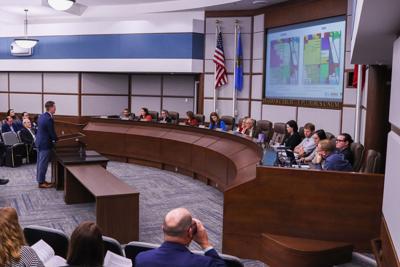

Norman City Council discussed the Norman police and fire safety report at its special meeting on Tuesday.
Ward 1 Councilmember Austin Ball was in attendance despite his recent criminal charges.
Last week, a warrant was issued for Ball’s arrest for alleged criminal misdemeanor charges of embezzlement and false certificate by a police officer. On Monday, he told OU Daily he planned to turn himself in.
The Oklahoma State Bureau of Investigations released a statement on Tuesday confirming that Ball turned himself in to the Cleveland County Sheriff's Office and was booked into the Cleveland County Jail.
Ward 2 Councilmember Matt Peacock was not in attendance. City Manager Darrel Pyle said he had influenza.
Fire Safety Report
The news: Two representatives from Matrix Consulting Group, a consulting firm headquartered in San Francisco, Robert Finn, senior manager, and Richard Brady, president, presented the Norman public safety report to council, which includes police and fire reports.
“We have worked with over 400 police departments and over 400 fire departments around the country,” Brady said. “The way we look at workload and services and community service really drills down into looking at what the outcomes are for the community.”
Objectives of the fire department study, as noted in the presentation, include analyzing fire department workloads, comparing Norman’s fire services to best practices, evaluating staffing levels and operations in every departmental service area, evaluating opportunities to improve the efficiency of fire services and working collaboratively with Norman Fire Department.
The presentation includes four high level conclusions:
• The presentation said residents desire rapid response times and adequate staffing levels, noting 47% of Norman residents believe service levels have declined over the past three years.
• Norman Fire Department call volume has increased 79% since 2014, from 10,977 in 2014 to 19,370 in 2024, according to the report.
• The presentation writes staffing increases are necessary to improve response performance and the development of an effective response force.
• Existing facilities require updates and improvements, and there is a necessity for additional fire stations, according to the presentation.
According to the fire report summary, response performance measurement is based on call process time, the time from the call until notification; turnout time, the time from notifications to units being enroute; and travel time. The presentation adds an “effective response force” defines the ability to place enough personnel on scene in a timely fashion to mitigate an emergency.
Norman was analyzed from urban, suburban and rural perspectives, with call density being highest in the urban center of the city, according to Finn. The presentation adds travel times have increased in rural and suburban areas since 2021 but have improved “slightly” in urban areas. Rural areas in East Norman have some 10-minute travel time gaps, the presentation notes.
Finn said measuring three different perspectives will allow council to monitor growth in each area overtime.
“When we looked at your city, it became very clear that a one-size-fits-all approach is not going to work here,” Finn said. “That's going to allow you to plan better as growth occurs, so the turnpike that's planned on the north, and then the north-south turnpike that's a little bit further toward the lake … as these projects develop and developments go on, and your population densities and risk profiles change, it allows you to understand, as a council, ‘OK, this area is now moving from rural to suburban, or it's moving from suburban to more urban.’”
Finn said there is limited ability for neighboring agencies to provide mutual aid towards the development of an effective response force — which would include eight-minute responses in urban areas and 14-minute responses in rural areas — and developing an effective response force is difficult in “many” areas of the city.
Finn said urban travel times are 6:35 minutes for urban areas while the recommended accepted time for urban industry is five minutes, suburban times are 6:41 while 6:30 is recommended and rural time is 9:27 minutes, which Finn said was acceptable.
Finn said new fire stations would need to be created to improve response times, forming a timely effective response force would benefit from ending the practice of cross-staffing units and increasing staffing on aerial apparatus.
According to Finn, Norman Fire Department needs additional administrative support, policies outlining inspection frequency, facility improvements, the unfunded health and safety officer to be filled and additional assistance in the training division.
“One of the things that we noted during our facility inspections that many of your apparatus exhaust systems are not operating effectively and need to be repaired or replaced, which is important because there's a big cancer initiative in fire stations in terms of health and safety of the personnel,” Finn said.
Finn said high priorities for the next one to three years for Norman Fire Department include adding a full-time data analyst, a full-time instructor to the training division, and an additional plan reviewer and three inspector positions to meet workload requirements for fire and life safety personnel. Other listed priorities include establishing performance standard call processing at one minute, 1:30 turnout times, and five minute urban travel times, 6:30 suburban travel times and 10 minute rural travel times.
”We looked at adding a full-time data analyst to the fire department to improve the use of data for decision making. It's important for them to begin to measure, analyze and understand the data and their performance,” Finn said. “It's a best practice that most fire departments, certainly organizations your size, have.”
Finn said Norman Fire Department should increase minimum staffing of stations 8 and 9 by one personnel on each shift in the next three years, increase the minimum staffing of the two ladder companies from one personnel to four personnel minimum over the next two years, begin the design and construction of Station 10 in the southern region of the city, plan for staffing with an engine and ladder company each with scheduled staffing of five personnel and minimum staffing of four personnel, and begin planning for the replacement of Station Five with relocation to the area north of Highway 9 on Clear Bay Avenue.
Other high priorities listed by Finn include adding a battalion chief to each shift after the completion of Station 10, constructing and staffing fire station 11 in the area of Tecumseh Road and 24th Avenue, and planning for staffing with an engine company with scheduled staffing of five personnel and minimum staffing of four personnel.
Medium priorities over the next three-to-five years include creating a full-time administrative technician, adding an additional part-time administrative technician in the Office of the Fire Chief, adding a full-time administrative support position to the training and prevention divisions, relocating fire prevention to a facility that can accommodate staffing and equipment, staffing the rescue company with a scheduled staff of four and a minimum staff of three personnel.
Finn added the Norman Fire Department should add a public information officer.
“Information is critical for the fire department to be able to get out in a timely manner,” Finn said. “That was something desired by the community and the survey: to see more frequent communication from both the police and fire departments.”
Low priorities listed by Finn include providing additional aircraft crash training for emergency personnel, hiring a full-time instructor to support emergency medical service training needs, establishing a workgroup with communications to help capture response time data, adding timers to fire station bay doors, monitoring ACCESS Oklahoma expansion and beginning plans for fire station 12, and adding foam capabilities to apparatus at fire station seven.
After being asked by Ward 7 Councilmember Stephen Tyler Holman and estimated by City Auditor Shaakira Calnick, Finn nodded that the city should add a total of over 100 new faculty members.
What they’re saying:
Mayor Larry Heikkila said he treats the requirements for facility improvements seriously, including Finn’s inspection that noted NFD’s exhaust systems need to be replaced.
“It’s a health and safety thing for cancers and all kinds of other stuff. It hurts our employees,” Heikkila said.
City Manager Darrel Pyle said the city could prioritize a “modernization effort,” adding the problems could originate from old design decisions.
“We'll put those in a priority order, and try to weed that elephant one bite at a time,” Pyle said.
Police Safety Report
The news: Richard Brady, president of Matrix Consulting Group, presented the police safety report summary.
Richard Brady said there are four high level conclusions for Norman Police Department:
• Field services need to be refocused to provide direct proactive efforts to greater problem-solving, according to Brady.
• Brady said investigative caseloads are excessive and require case-handling detectives and support staff.
• The support provided to the department needs to be improved by adding civilian personnel, Brady noted.
• Brady said such needs will grow, adding NPD workloads will increase over the next 10 years.
“We believe that all of our client communities are unique, but you guys are really unique. And there's something about the services that you're providing in this complex community that includes a lot of residential, a lot of commercial, a big university, casino, all sorts of things,” Brady said. “It has an impact on the efficiency and effectiveness of how you deploy field personnel.”
The presentation notes the top 10 types of calls for service – which represent 40% of all calls for service – consist of disturbances, welfare checks, alarms, larcenies, suspicions, trespassings, non-injury motor vehicle accidents, contacts with subjects, harassment or threats, and area checks. Brady said most of the top 10 calls are issued from midnight to 3 a.m.
“That is unusual for us. Usually it's the reverse. Certainly early evening is busy, but afterwards are usually much busier,” Brady said. “You are very busy in the early morning hours, in part because (of) the university activities, bars and casinos and things like that.”
The median response time for critical calls is listed at 6.5 minutes, the high priority response time is listed at 7.9 minutes, medium priority response time is listed at 9.4 minutes, and low priority response is listed at 18.6 minutes.
”Response times are, you can underline this word, extraordinary, in Norman,” Brady said.
Brady said a “true measure” of an effective police force relies on anticipating future problems while also making the community feel safer.
According to Brady, NPD’s overall proactivity, which includes on-duty staffing hours that are not spent on calls for service and community engagement, exceeds 50% most of each day. Brady said proactive time should be at least 45% of total time for on-duty patrol staff.
“The theory of effective patrol is that they need to have somewhat equal amounts of time on the reactive things, cultural service, and the proactive things, in terms of having time available to work with the community and facilitate problems, problem solve with the community and things like that,” Brady said.
Brady said NPD can meet coverage needs with 70 patrol staff members compared to 94, which would require redeploying 24 staff members to flexible, proactive capacities. Brady proposed expanding the community services section with 24 officers and three lieutenants.
Brady said an analysis of the investigations department indicates “major staffing issues” that impact the effectiveness of follow-up investigations. He added NPD needs six additional detectives and a lieutenant for handling cases, a civilian investigative analyst, along with one staff member to support victims and three forensics staff members. According to Brady, special investigations require two additional detectives.
The communications division requires nine additional staff members and supervision levels to increase by one, according to the presentation.
Brady said the animal welfare division requires an additional position in the shelter and staff should be cross-trained and used between the desk and shelter. He added an animal welfare technician should be assigned to volunteer coordination and one additional veterinary technician is required to assist with medical needs.
According to Brady, the personnel and training division should broaden outreach for new employees locally and through social media, consider remote interviews and multiple online testing dates, develop employee-specific career development plans, implement succession planning at NPD, and create a health and wellness position for non-technical support of staff.
“It's a lot harder to recruit for police officers today … you have to work harder at it now, because it's a harder sell,” Brady said. “There's a lot of other things that people want to do in their lives, and I think especially during 2020 and 2021 there was a lot of negative press that has impacted the ability to recruit and hire.”
Brady said the community outreach division should increase traffic unit staff with two investigators, add a lieutenant position for oversight of investigations and enforcement, better track traffic enforcement performance measures and add a lieutenant to the school resource officer program due to “spans of control.”
According to an 11-year projection by Matrix Consulting Group, index crimes will increase by 8.2%, calls for service will increase by 8% and Norman’s population will increase by 9.9%. The presentation notes the department will require 16 additional sworn positions and five professional positions over 10 years.
The presentation said the city and NPD should begin planning its faculty needs now and conduct a facility needs assessment.
Brady said additional needs for NPD include public cameras, video feed integration software and social media software.
What they’re saying:
Ward 7 Councilmember Stephen Tyler Holman asked council where the city would go following the reports.
City Manager Darrel Pyle said the city has experienced a “ripple” in its usual trend analysis for the city budget following the removal of the state grocery tax.
“We're finally getting back to what it's really supposed to look like. What we're hoping to see is some uptick in general fund growth, because it's only going to come down to just a matter of ‘how fast?’” Pyle said.
Pyle added Matrix Consulting Group is working on internal cost allocation models with City Finance Director Anthony Francisco.
This story was edited by Ismael Lele.


