



Children scurry from between their parent's legs towards a Little Tikes wagon full of books a former school teacher and national nonprofit Laundry Love’s volunteer dug out of her garage.
When the wagon first began to roll through the door, the kids in the laundromat screamed in delight and dubbed that first Little Tikes wagon the Little Read Wagon, now a nonprofit that aims to deliver and provide free books to marginalized communities in the Norman and Oklahoma City area.
Lisa Gerard, founder and CEO of Little Read Wagon, now brings a total of five wagons to community events, parks and the laundromat — often donning a colorful dress printed with planets and spray-dyed red hair in a near-perfect imitation of Ms. Frizzle from the children’s education cartoon "The Magic School Bus."
Gerard said her costumes, which include the fairy godmother, and the very hungry caterpillar, a character from another children’s book, gets children excited about reading during story time. Especially since they are amazed that a beloved character came to read to them.
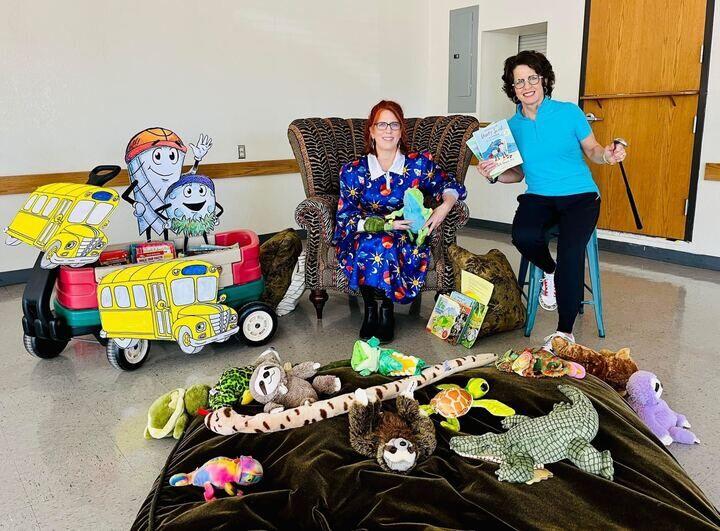
Reading "Adventures with Divot & Swish" with Beth Brown at Norman Common Grounds Coffee Festival on March 2.
“I just did Ms. Frizzle at the coffee festival for Habitat for Humanity and I was talking to a parent while the kids were sitting there and somehow I mentioned my husband,” Gerard said. “There was a little girl there. She was about 7, looking at me and she said: ‘You have a husband? I didn't think Ms. Frizzle was married.’”
Gerard said one of the most rewarding parts of the job is watching how, over time, those who use her books continue to do so. She reads at a summer camp with SunHive Collective, which runs an educational space for young adults with disabilities.
“I go there every month (in summer) to read, I will see the participants — they have a bookshelf and I will see them getting the books about the solar system that we did last summer or other things that we've done,” Gerard said. “They'll sit there and look at them and read them and show me things in the book. So that’s very rewarding because we did that last summer and they’re still looking at those books.”
Little Read Wagon is in all 12 laundromats run by Laundry Love, Gerard said. Her nonprofit also participates in the Mutual Aid Fairat Irving Recreational Center in Norman and other community events. They also supply books to five Head Starts in Cleveland County including the Center for Children and Families and Children's Recovery Center. Gerard said they also stock a mental health and substance abuse program residential for teens and a teen library there.
“We've just expanded into all kinds of other things, pretty much any type of marginalized group or population (and) we supply reading experiences and books to them,” Gerard said.
One of the most important things about Little Read Wagon, Gerard said, is its mobility. Norman’s public libraries were closed in 2020 due to the COVID-19 pandemic when Gerard founded Little Read Wagon. Now, Norman Public Library Central is closed following the discovery of black mold in the building.
“All of those things can be obstacles to getting books if you don't have transportation (or) if you don't have parents that take you to the library,” Gerard said. “So that's so we try to go to places, to events or locations where there are people who are not as likely to have access to books and we give them books.”
With data based on 2019-20 and 2020-21 school years, the U.S. News and World Report found across the 25 schools in Norman, 32% of elementary students tested at or above the proficient level for reading. Of middle school students, 30% tested at or above the proficient level for reading, and 40% of high school students tested at or above the proficient level for reading.
Across 59 schools in Oklahoma City, 10% of elementary students tested at or above the proficient level for reading, 12% of middle school students and 21% of high school students tested at or above the proficient reading level.
Additionally, across the 69 schools in Tulsa, 9% of elementary students, 8% of middle school students and 20% of high school students tested at or above the proficient level for reading.
Gerard said Norman has an advantage with the state’s flagship university being at the heart of Norman, but the literacy rates of young children in the city could in large part also be due to the work of nonprofit organizations and public emphasis on literacy.
“I can find something for anybody that needs something to advance their literacy,” Gerard said.
Gerard keeps her wagons stocked with magazines, cookbooks, educational books, children’s books and novels from all different genres and reading levels.
“I get a lot of grandparents who ask me to help them pick out books for their grandchildren when they visit and I also can connect them to receive services if they want to work to learn how to read,” Gerard said.
Food and Shelter partnered last year with Community Literacy Centers to provide a free adult literacy program in Norman. The Assistance League in Norman also has programs like Operation School Bell that provide clothing for school children in the area.
The Pioneer Library System in Norman also provides a variety of public resources for early childhood literacy.
Kelly Sitzman, director of communications and employee development for Pioneer Library System, said the library has many partnerships with Cleveland County and other surrounding county health departments to distribute books to kids through wellness programs. They’ve also presented their community outreach and services in national conferences and webinars, Sitzman said.
“We definitely are leaders in the industry, I would say nationwide for sure,” Sitzman said.
Sitzman said part of her job in employee development is sending staff to these conferences and other learning opportunities across the country to learn more about how to work with children in an education setting.
Meghan Hollingsworth, the early literacy and school readiness coordinator at Pioneer Library System, said the library’s early literacy and school readiness program focuses on supporting caregivers and their role as their child's teacher, which helps children gain necessary reading skills at a young age.
“That's been really helpful to helping staff understand the developmental needs of children, and then building those skills, continuing that growth at home, not just at the library programs,” Hollingsworth said. “Also it provides resources to families too to continue to do that.”
Hollingsworth said children attending the program get a rhyme book that includes explanations of the foundations of reading and activities a guardian can do with their child to grow skills. They also receive a book to read with a caregiver at home.
Hollingsworth said the public programs at the library could contribute to the relatively higher literacy rates Norman schools have. They also give books to the McLean County Health Department, the Cleveland County Health Department, the Citizen Potawatomi Nation and the Nation’s clinics. Hollingsworth said Pioneer libraries have other initiatives where they try to get books to kids who may not have as much access on top of the programs to help caregivers.
Sitzman said many of the library’s programs are available early in the morning or in the evening so parents or guardians who work can participate with or without young children. The role of the caregiver is extremely important in early childhood learning, Hollingsworth said.
“That caregiver is their child's first teacher, they spend the most time with (the child),” Hollingsworth said. “We really want to help them with engaging with the child to develop those skills, connecting with them and connecting them with the community. That's been shown to really enhance the early literacy in child development when they feel connected to other people and can share with them.”
The various methods by public libraries and nonprofits like Little Read Wagon not only contribute to Norman schools’ average reading levels by providing books and encouraging reading, but also foster a community.
“Just having that as part of our mission — we've always been inspiring engagement and innovation and learning in our communities,” Sitzman said. “Just having that service mindset of wanting to collaborate for a broader impact. That's what the library is about. We are that community place. We don't exist unless our communities use us. So why wouldn't we be out in the world and making those connections and fostering those relationships?”
As Norman’s elementary literary rates continue to improve, Gerard said the most important thing to continue raising literacy across the city is finding new ways for every community within it to access reading.
“Literacy is foundational,” Gerard said. “There isn't a lot you can do as an adult in life if you're not able to read.”
This story was edited Anusha Fathepure, Peggy Dodd and Ismael Lele. Sophie Hemker copy edited this story.


