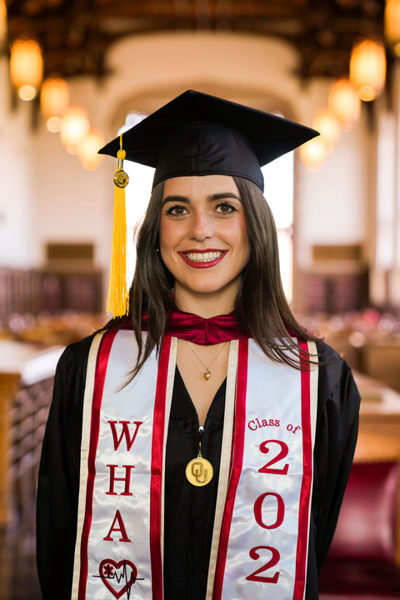


For four months of her sophomore year at the University of Oklahoma, Kylie Hutchison was in agonizing pain.
She was diagnosed with premenstrual dysphoric disorder, or PMDD, a severe form of premenstrual syndrome afflicting anywhere from 3-8% of menstruators, and was experiencing complications from a form of birth control meant to regulate her hormones.
"I started having three to four periods a month. … I was bleeding nonstop," said Hutchison, who graduated from OU in 2023 with a degree in microbiology. "It was hell."
That was until a class lecture helped her diagnose her symptoms and inspired an experiment that would change the trajectory of her health and career.
Hutchison said she has suffered from issues related to her reproductive health since she was 14 years old. In high school, she visited several OB-GYNs who prescribed different forms of birth control in hopes of regulating Hutchison's hormones and alleviating her painful symptoms. None worked.
"It just made things worse," Hutchison said.
Then, the summer before her freshman year at OU, Hutchison got a Mirena hormonal intrauterine device, a type of birth control. Hutchison said the IUD, which improves PMDD symptoms and in some cases stops periods, saved her life.
But in the middle of her sophomore year, things took a turn for the worse.
"I have PMDD, so leading up in my luteal phase and leading up to my period, I feel those symptoms very heavily," Hutchison said. "I was feeling like garbage for four months straight."
She visited two different OB-GYNs, one in Oklahoma and one in her home state of Colorado, both of whom told her medical tests showed nothing abnormal. They suggested putting Hutchison on a hormonal birth control pill, hoping it would help regulate her cycles.
"The last thing I needed was more hormones," Hutchison said.
That's when a lecture in her intro to microbiology class on gut microbiomes connected the dots of her seemingly undiagnosable symptoms, leading Hutchison to experiment with her diet in the hope of improving her health.
Her professor explained the gut microbiome is a significant area of research scientists are beginning to explore, and an imbalance of "bad" and "good" bacteria in the gut could affect every aspect of the body — including hormones.
"In my head, I was like, 'You know what? Maybe I need to look into this,'" Hutchison said. "So I did my own research on the specific nutrients that the beneficial bacteria in the gut and the colon needed to thrive."
Hutchison changed her diet completely, eliminating gluten and high-sugar foods and eating more vegetables and fiber. After three and a half months, every issue she was dealing with vanished.
"It felt very empowering and rewarding because it was like after all of these years I finally found something that I have control over that does make me feel better, that does impact my health in a positive way," Hutchison said.
"It was like a total 180. … That's when I really got interested in (reproductive health)."
This experience ignited in Hutchison a passion for researching gut and reproductive health. For the remainder of her college career, she threw herself into her research and studies and found ways to advocate for reproductive justice on campus and beyond.
"She started really seeing how science could help her own experience and potentially help others," Brittney Hutchison, Hutchison's twin sister, said. "Seeing her just suddenly hone in on that passion from the second she stepped foot on campus was really inspiring and it was like she really came into it."
During her time at OU, Hutchison worked as a nurse technician with OU Health, volunteered at the Norman Regional Health System and was a laboratory assistant and intern with the OU Health Sciences Center.
In 2023, Hutchison was named OU’s Carl Albert Award Recipient, the most prestigious honor given to a student by the OU Dodge Family College of Arts and Sciences.
Hutchison also joined the student organization Women's Health Advocacy as an advocacy officer her sophomore year and worked her way up to becoming the organization's president, a role she served in during both her junior and senior years.
"Joining Women's Health Advocacy, and then just being completely and utterly blessed to be its president and lead it for two years was such a significant moment in my life," Hutchison said. "I say life changing, and I don't say it lightly."
Women's Health Advocacy, which Hutchison and other members of the WHA executive team turned into a nonprofit in 2021, has grown substantially since it was founded as a registered student organization in 2019 by Hudia Jamshed and Joyce Lee.
The organization uses donations to purchase menstrual products and places them in menstrual product stations located in bathrooms throughout campus for students to use for free. During Hutchison's time in WHA, the number of stations on OU's campus skyrocketed from around 12 to over 70 stations.
"Kylie was definitely the driving force for everything that happened," said Stacey Johnson, who served as vice president of education alongside Hutchison. "Period poverty is just a major issue. One in four people struggle with period poverty, one in 10 college students struggle with period poverty. … Those stations helped in such a unique way that OU hadn't really seen before."
In 2022, Hutchison worked with the other WHA officers to join the global organization PERIOD to become the official PERIOD chapter at OU. PERIOD is a youth-fueled non-profit working to eradicate period poverty and stigma through advocacy, education and service.
Hutchison represented Oklahoma as a PERIOD community organizer, helping draft legislation to eliminate the tax on menstrual products in the state.
According to the Alliance for Period Supplies, a national program advocating for more accessible and affordable menstrual products, Oklahoma is one of 21 states that charge sales tax on menstrual products.
Although the legislation, Senate Bill 1499, failed in the house, Hutchison said the fight to eliminate this tax and eradicate period poverty is far from over.
"She took that motivation (for reproductive health) and took that inspiration from the girls before her (in WHA) and just ran with it," Brittney said. "I think that's really a testament to Kylie's drive as a person. If she's going to do something, she's going to do it wholeheartedly, like 110%, and she's going to push down any barriers that might be in her way to get it done."
Hutchison recently worked as the associate coordinator of Justice Necessary, a Colorado-based organization that works to implement systemic and sustainable ways to address hygiene poverty within its community. There, Hutchison lobbied alongside the organization for legislation requiring Colorado K-12 public schools to provide menstrual hygiene products to its students.
The legislation, House Bill 24-1164, passed the education committee and is now heading to the appropriations committee.
Hutchison now works as a clinical research coordinator at the University of Colorado Anschutz Medical Campus at the Diabetes and Endocrinology Clinic trial program division and will begin a doctorate in Biological and Biomedical Sciences Program at the University of North Carolina at Chapel Hill in the fall. She hopes to use her personal experiences and clinical research to help others and increase access and education in the medical field.
Hutchison said her time at OU and with WHA sparked a life-long passion for advocating for reproductive justice and health equity. But, she added, it was only with the support and effort of her team at WHA that the progress made at OU and beyond was possible.
"It's easier than you think to make a difference in people's lives, and it's easier doing it together," Hutchison said. "You can't make large-scale change on your own."
This story was edited by Anusha Fathepure and Peggy Dodd. Kylie Caldwell and Grace Rhodes copy edited this story.


