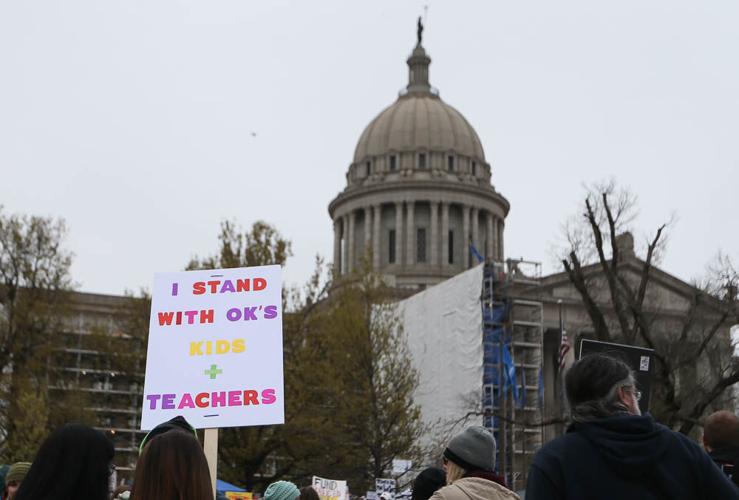

On April 12, 2018, tens of thousands of teachers and students returned to classrooms after participating in what would be known as the largest teacher walkout in Oklahoma history.
For nearly two weeks, cars painted with the words "Follow me to the Capitol" drove around the state as education supporters holding makeshift signs stood across the Capitol grounds. Chants of "The time is now!" rang throughout the Oklahoma state Capitol Rotunda as teachers lobbied for education funding and pay raises.
Five years later, teachers say now is still the time for change as they face an education crisis they describe as even more dire than in 2018.
"We are in a crisis, and teachers feel attacked," said Jami Cole, president of Oklahoma Edvocates. "It's not a good environment for educators right now."
A shortage of teachers and lack of funding for support staff, curriculum and public school students were the driving factors for the 2018 walkout, Cole said, and these issues still exist today.
At the beginning of the 2022-23 school year, Oklahoma schools reported 1,019 teaching vacancies, a jump from 680 vacancies reported the year before. So far in the 2023 fiscal year, there have been 4,048 emergency certifications in Oklahoma as of March.
Emergency certifications are issued to educators who haven't met the state's teaching qualifications but who do hold a Bachelor's degree. The State Board of Education issues emergency certificates as needed if all options to employ a teacher with a non-emergency certification have been exhausted, according to the Oklahoma State Department of Education.
When teachers walked out in 2018, there were 1,975 emergency-certified teachers in classrooms.
"There's just hardly any movement for public education," Cole said. "Right now, it's taking forever to get anything done and accomplished."
Katherine Bishop, president of the Oklahoma Education Association, said many educators are leaving the profession or moving to higher education because of a lack of competitive pay and respect.
In the past six years, 30,000 teachers in Oklahoma have left the profession, 10 percent of Oklahoma's teacher workforce, 2.3 percentage points higher than the national attrition rate of 7.7 percent.
According to Oklahoma News 4, this school year, Edmond Public Schools received at least 150 employee resignations as of Jan. 30, Oklahoma City received 329 employee resignations as of March 6 and Moore received 196 employee resignations as of March 20.
"For the amount of pay and the disrespect that they have to live with every day, day in and day out, for many it's just not worth it," Bishop said.
Cole said those who are choosing to stay in education often have to work multiple jobs, like her teaching partner who also works a retail job.
"(He) makes more money (there)," Cole said. "He's working two jobs because that's basically what you have to do as an educator."
According to the National Education Association's 2022 Education Support Professional Earnings report, full-time education support professionals in K-12 earn an average of $26,121 a year, ranking Oklahoma 50th nationally for school support staff earnings.
For public school teachers in Oklahoma, the average salary is $54,762 for 2020-21, just $666 higher than 2019-20. The regional average is $54,622, and the national average is $65,293, according to the National Education Association.
For 2017-18, the average salary of public school teachers in Oklahoma was $46,300.
Comparatively, the average annual salary for a store manager in Oklahoma is $47,764, according to Indeed.
According to Living Wage Calculator, In Oklahoma the required annual income after taxes for an adult with no children is $28,331.
"The situation that we're in is much like we're in 2018," Bishop said. "We are in this humongous teacher shortage crisis, poor professional crisis. We don't have the resources for our schools."
The 2018 teacher walkout
The 2018 walkout came after tax cuts and falling oil prices caused Oklahoma's revenue to crater, leading to slashes in education funding. At the time, Oklahoma teachers were among the worst paid in the nation, and nearly 20 percent of schools moved to four-day school weeks to save money, according to The Washington Post.
According to the Center on Budget and Policy Priorities, when adjusted for inflation, spending per student also decreased by 21.7 percent between 2008 and 2016.
"We didn't have enough money coming into our state, and they were having to tell schools and other agencies that they (would have) to cut their budget in the middle of the year," Bishop said.
Then, West Virginia teachers went on strike, emboldening Oklahoma educators to plan their own.
Led by the Facebook group “Oklahoma Teacher Walkout — The Time Is Now!” created by then 24-year-old teacher Alberto Morejon, thousands of teachers, students and community members flocked to the Oklahoma state Capitol with painted signs and clear demands for a $10,000 raise for teachers, a $6,000 raise for support staff and $200 million in additional classroom funding, according to The Washington Post.
Morejon was later charged with a felony count of engaging in sexual communication with a minor by the use of technology in 2021.
Bishop, vice president of the Oklahoma Education Association at the time, said this was not her first experience with a teacher walkout.
In 1990, teachers and support staff walked out to the Oklahoma state Capitol to push for votes to pass the Education Reform Act of 1990, a landmark legislation that funded a range of education initiatives through increased taxes.
A student at Central State University at the time, Bishop raced home each evening to watch the walkout on the news, knowing her mother and sister were among the thousands gathered at the state Capitol.
"I just thought they were so brave to do that," Bishop said. "I thought to myself, 'One day, when I grow up, I want to be just like them.’"
In 2018, Bishop found herself standing in the shoes of the women she admired most.

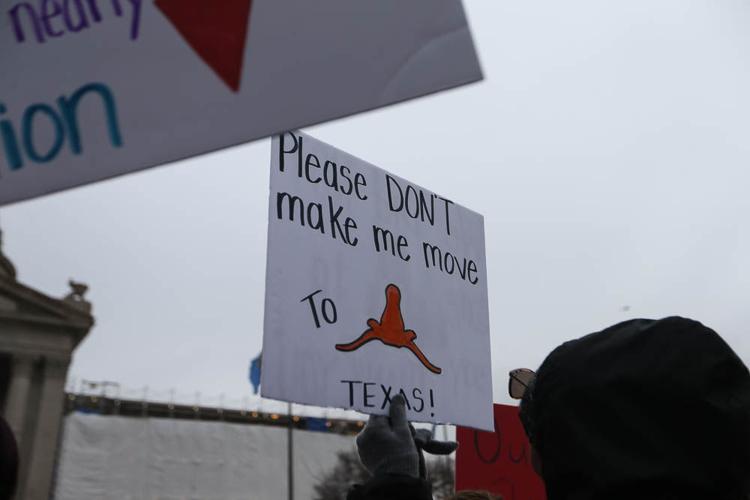
A sign that says "Please DON'T make me move to Texas" is held up during the teacher walkout April 2, 2018.
"I was over at the Capitol every day. Early in the morning till late," Bishop said. "The energy was just so incredible."
Though they were successful in getting a raise of about $6,000 for teachers, depending on experience, and a $1,250 raise for schools' support staff, at the end of the walkout, many teachers returned to their classrooms feeling disheartened with the outcome.
The morale was low coming out of the walkout, Bishop said. Teachers accomplished a lot, but it didn't feel that way because there wasn't that grand finale that everyone wanted.
"I fast forward to where we are five years later, and our teacher pay rankings are still among the lowest in the nation (and) teacher working conditions are not great," Stacy Reeder, dean of the Jeannine Rainbolt College of Education, said. "There's still a lot of work to do."
The current state of education in Oklahoma
Bishop said the main difference between 2018 and now is there is more money in Oklahoma than before.
Currently, Oklahoma has $3.8 billion in state savings and $2 billion more to spend in next year’s budget, according to the Associated Press.
As of 2022, Oklahoma's teacher pay gap is the second highest in the country and the state ranks among the lowest in the nation for education, sitting at 34th for teacher pay and 45th for per student spending, according to the National Education Association.
"Education is the foundation of our society,” Reeder said. “Strong education only happens when we have a really strong teacher workforce. And so we must support teachers."
In March, Senate Bill 482, which would increase teacher pay from $3,000 to $6,000 depending on years of service, passed the Oklahoma Senate.
While a step in the right direction, many educators and advocates say teachers need additional support and respect from legislatures.
"We have a very un-pro public (education) governor. We have a very un-pro public (education) state superintendent … and we have a very un-pro public majority in the legislature,” Cole said. “So, when you have all of those things working against us, it's very hard to keep up morale."
Cole said a lot of recent legislation has villainized teachers and opened them up to litigation, such as House Bill 1775 in 2021.
"I took my Judy Blume (books) home today that I read in fourth grade. She's living in my storage container now. It's just shifted into a cultural war (rather) than what we really need," Cole said. "What we really need to be focusing on and talking about is helping these kids, pouring into their reading, pouring into their math, things like that."
In August, Summer Boismier, former Norman High School English teacher, resigned after a parent complained she was violating HB 1775 by providing a QR code to the Brooklyn Library Books Unbanned. Ryan Walters, state superintendent of public instruction, called for Boismier's teaching license to be revoked.
House Bill 2546, which the house passed in March, would bar conversations and instruction related to sex education, sexual orientation and gender identity in Oklahoma Public Schools. The bill would restrict teachers and directly impact students, particularly those who are 2SLGBTQ+, Bishop said.
This culture war is demoralizing teachers and shaming students for a part of their identity, Bishop said. School is a safe place for many kids but this kind of legislation is tarnishing that, she said.
"It makes my heart hurt," Bishop said.
On March 27, the Oklahoma Senate’s education policy and appropriations committees approved a nearly $630 million education plan that amended two Oklahoma House bills, including House Bill 1935. The bill, which includes a $100 million investment in reimbursable tax credits to be used at a private school, advanced to the House.
Vouchers allow a portion of tax dollars designated for a child's education to be used toward tuition at a private school, according to the State Department of Education. This includes a tax credit of $7,500 for private schools and $1,000 for homeschool families under an income cap of $250,000.
Bishop said many of the families who fall below the $250,000 cap don’t have transportation to take their children to private schools. She also said a voucher doesn't guarantee private school admission for a student.
"They'll say all these private schools have waiting lists, (but) that child that has a voucher is not going to bump anybody on that waiting list," Bishop said.
Cole said she has studied vouchers for five years and that no study that shows vouchers do anything except benefit the wealthy.
"(Teachers) ask me for hope, and I don't know how much more I have to give to them," Cole said. "You may be looking at the end of public education."
Growing up, Reeder said she lived in a small, rural town in Oklahoma where she and her two younger sisters relied on the resources provided by public education.
"The taxpayers of Oklahoma paid for a yellow school bus to come pick us up 180 days of the year and take us to school where these possibilities were laid out for us," Reeder said. "Where I was growing up, we wouldn't have been driven somewhere else to go to school. We depended on the bus to get us to school every day. I am concerned that in some of our smaller schools, if students shuffle away from them, what will happen to those communities?"
Reeder said the teachers she had in public school acted as a window to a world of possibilities beyond her rural town.
"I'm incredibly grateful for that. Not just the teachers but for a supportive public school system that gave us that opportunity," Reeder said.
In Oklahoma, approximately 700,000 students attend public schools.
According to a 2021 report by the Annie E. Casey Foundation, one in five Oklahoma children, or roughly 186,000 students, lived in households with an income below the poverty line and 95,000 Oklahoma children lived in high-poverty areas.
"Those are the kids I'm going to protect and take care of," Cole said. "Our public school kids, and especially our public schools in lower income areas and even rural areas, they've got to have a voice and they've got to have a champion."
Cole said she hopes the campaign rhetoric will end and the Oklahoma legislature will turn its focus toward improving public education and bringing more teachers into the field.
At OU, Reeder said they have seen a 12 percent decline in the number of students going into education or teacher preparation programs, compared to the state decline of 80 percent, according to the Center for American Progress.
Despite this, Reeder said students at the College of Education are eager to join the profession and advocate for children and the community.
"They're as excited as students have ever been about becoming teachers, and so they do give me tremendous hope," Reeder said.
Still, in order to meet the increasing demand for qualified educators created by the teacher shortage, Reeder said they need more students who are interested in teacher education and careers as teachers.
"Because of some of the issues we've had around education, not since the teacher walkout, not even a few years before the teacher walkout, but for decades, of defunding and policies that have made it challenging for people to imagine themselves as a teacher, a career teacher, has really left us with this tremendous shortage. And that's what really concerns me," Reeder said.
Kids don't want to go into education, Cole said. There needs to be an increase in teacher pay, education funding and respect in order to retain and recruit educators.
The 2018 walkout ended on April 12, but the fight for public education continues, Cole said.
"Teachers feel under appreciated, disrespected, undervalued for all that we do," Cole said. "Unless things really drastically change and we stop with the rhetoric and we stop vilifying teachers and threatening their certificates, I definitely do see another walkout."
This story was updated at 5:25 p.m. April 12 to change the amount of emergency certifications from 3,038 to 1,975 to represent the 2017-18 school year and clarify the number of emergency certifications in the 2023 fiscal year. It was also updated to clarify House Bill 1935.
This story was edited by Alexia Aston, Karoline Leonard and Jazz Wolfe. Francisco Gutierrez and Alexandra Powell-Lorentzatos copy edited this story.


