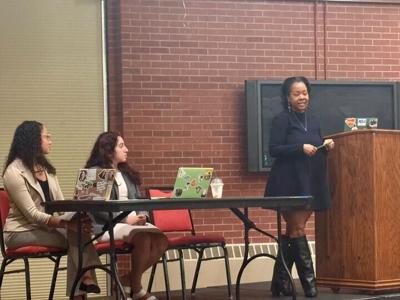

The Black Undergraduate Law Student Association, National Pan-Hellenic Council, Black Student Association, Latin American Law Student Association and Black Law Student Association held a presentation Wednesday night to educate students about the potential impact of recent executive orders.
Presenters included Tamya Cox-Touré, executive director of the American Civil Liberties Union of Oklahoma, Leah Bush, president of the Black Law Student Association, and Fatima Jaime, president of Latin American Law Student Association.
Bush and Jaime opened the event with a presentation over how executive orders work and how to recognize media bias.
“We don’t have one all powerful branch and that’s why even when there are things going on that might not necessarily be good — especially for students of color, people of color facing those executive orders — there are ways to fight that,” Bush said.
Bush said it’s easy to feel bombarded by news about significant changes happening almost every day and it can be hard to find trustworthy news sources.
“It's important to do your research on (bias) before you just start listening to news that you kind of like to hear,” Jaime said. “Sometimes I like to listen to news that I just like to hear, but that’s something that you want to take into account and not fall into that trap.”
Cox-Touré said it's important for students to be aware of what's going on because many recent executive orders will affect their daily lives.
“Selfishly, you should be here because you want to know: how does this impact your daily lives?” Cox-Touré said in her opening.
Cox-Touré spoke about Gov. Kevin Stitt’s 2023 executive order, calling for a formal review of diversity, equity and inclusion in Oklahoma higher education, and President Donald Trump’s February executive order ending DEI programs within the federal government.
During the first few weeks in office, the Trump administration has deployed various policies and, as of March 6, Trump has signed over 81 executive orders. According to JustSecurity, 102 lawsuits have been filed against the Trump Administration as of March 6, many in opposition to the executive orders.
“There's such amazing synergy that happens when bad executive orders are signed,” Cox-Touré said. “When executive orders that harm Black and brown folks, executive orders that harm 2SLGBTQ folks, executive orders that harm trans folks and queer folks, we have organizations that are ready and willing to step up.”
According to Cox-Touré, scholarships for students of color and student associations for people of color, may be impacted by efforts to eliminate DEI.
“There should be concern for Black Greek organizations on campus and Black student associations on campus,” Cox-Touré said. “Those aren’t things to scare you but these are real-life situations that happen when these executive orders come down.”
Kesha Keith, director of strategic initiatives, wrote in an email to OU Daily on Thursday that OU’s Division of Student Affairs continues to provide restructured support for all student organizations, which also includes student groups like the Black Student Association, National Pan-Hellenic Council and others.
“This office provides generalized support and leadership development to all students,” Keith wrote. “The Division of Student Affairs remains committed to fostering an inclusive environment and encourages engagement across diverse student groups.
“We acknowledge that the experience of students can vary, and OU is committed to ensuring that all students have access to resources, spaces, and opportunities that promote belonging,” Keith wrote.
According to an email sent to OU Daily from OU Marketing and Communications on Thursday, the university is currently reviewing applicable state and federal laws, executive orders and guidance, and court proceedings.
OU Marketing and Communications directed the Daily to a frequently asked questions page established about new executive orders.
Cox-Touré said it’s important to remember that “unqualified” people are making decisions about higher education at the federal Department of Education. She references a Feb. 14 “Dear Colleague” letter that states that “discrimination on the basis of race, color, or national origin is illegal and morally reprehensible.”
The Washington Post reported Thursday morning that Trump was preparing to issue an executive order calling on Education Secretary Linda McMahon to “take all necessary steps to facilitate the closure of the Education Department.” Thursday afternoon, sources told ABC News that Trump won't sign the order.
Students were instructed to speak amongst themselves about the presentation, with the room coming to a general consensus that they want to find better news sources and communities to share that news with. Many said they found their news information on social media platforms and wanted to use news websites instead.
“What I’m hearing is that y’all are yearning for spaces where you are safe, where you’re brave, where you are seen and you are heard,” Cox-Touré said in closing. “That is not always allowed or highlighted on campus.”
This story was edited by Anusha Fathepure and Ismael Lele. Sophie Hemker copy edited this story.


