

OU students and organizations, like the Black Student Association, African American Programs and Services and the Kappa Psi Chapter of Alpha Kappa Alpha Sorority, celebrated Black History Month with various events.
Angelique Price, African American Programs and Services coordinator, said the events throughout this year’s Black History Month are meant to highlight certain aspects of the OU community.
“We have different programs that are meant to highlight different things,” Price said. “Specifically during this month, we highlighted Black-owned businesses, the arts, hair care and culture.”
The festivities began with the Black History Month Kickoff Celebration on Feb. 1. The celebration featured music, food, fellowship and a resource fair to honor Black history. Many organizations, such as the Black Student Association and Alpha Kappa Alpha, participated in a tabling event to engage other students with their causes.
On Feb. 9, African American Programs and Services and the Black Student Association held a game night featuring Trap Spelling Bee, a game created by OU alumnus Demarco Robinson, which, according to its website, “highlights the humor and culture within the urban community with the unique spelling of slang and ebonic words.”
The Women’s and Gender Studies Center for Social Justice held the Teach OUt on Race Conference on Feb. 10. This virtual conference, designed for a range of participants, featured a panel discussion on religion, justice and what it means to practice anti-racism.
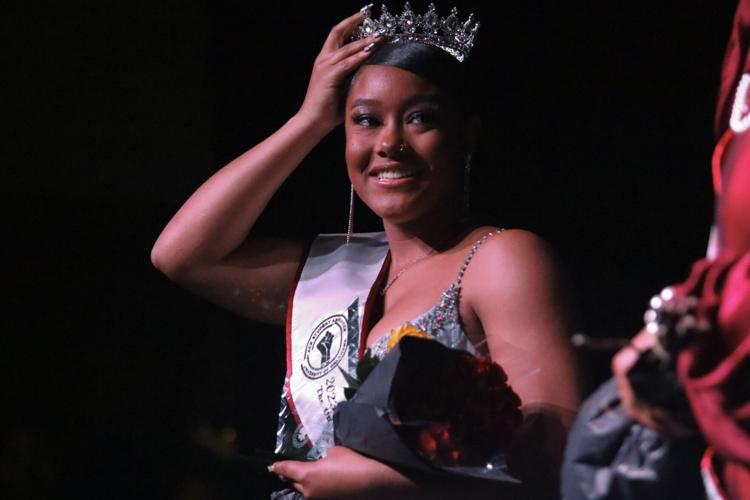
The annual OU Black Royalty Pageant, a scholarship pageant organized and sponsored by African American Programs and Services and the Black Student Association, took place on Feb. 11 with a record-setting crowd. The pageant showcases contestants’ passions for scholarship, service and cultural awareness.

Alaneigh Bruner during the OU Black Royalty Pageant on Feb. 11
“The Black Royalty Pageant had record-breaking attendance of 300-plus folks, so I think Black students on campus are excited about Black History Month, and they look forward to the different programs,” Price said.
On Feb. 20, the College of Atmospheric and Geographic Sciences and Gaylord College of Journalism and Mass Communication presented "Back to OUr Roots: Natural Hair Resiliency within the Broadcasting Industry," which featured Black journalists who discussed natural hair and its intersection with the broadcast industry.
African American Programs and Services organized the Taste of Soul, a culinary celebration of African and African American diversity on campus, on Feb. 22. With a variety of beverages, appetizers and main dishes to choose from, Taste of Soul highlighted cultural diversity and the communal aspect of Soul Food while giving a nod to Black-owned businesses.
Other events included the "Love Yourz: Tiny Desk + Business Mixer," which allowed students to showcase their professional talents, and the “For the Culture” skate party.
Price said that an important aspect of Black History Month is bringing Black students together by catering to the values of community and belonging, which is done on campus by holding such events.
“Some of the things that we hope to highlight in these events is to ensure that Black students on campus have a sense of belonging here at OU,” Price said. “Creating programming that not only creates a community for Black students on campus but also highlights academics, cultural activities, social activities and professional development.”

Julian Ruger competing in the OU Black Royalty Pageant on Feb. 11
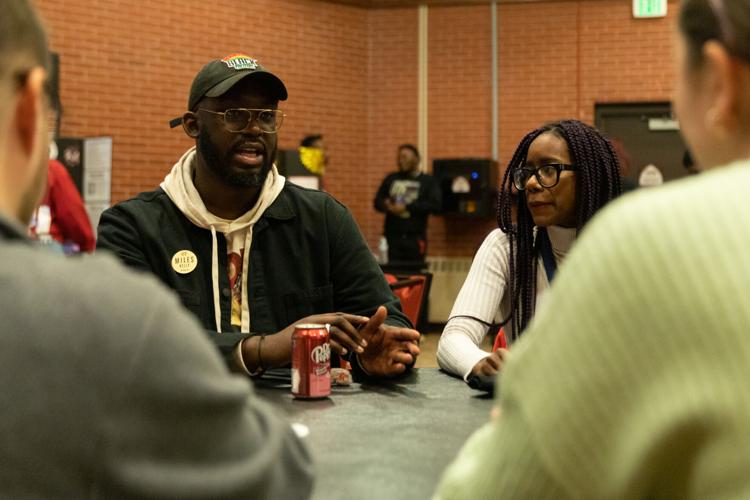
KC Onyekuru, president of the Black Student Association and mechanical engineering senior, said he and many others initially struggled to find their community when first coming to OU but that the Black Student Association strives to offer African American students fellowship.
“It is very common for students to come and not find their sense of community or belonging,” Onyekuru said. “The Black Student Association gives people that chance to open up, connect and feel comfortable on this campus.”
Similarly, Phoenix Davis, a pre-med community health junior and president of the Kappa Psi Chapter of the Alpha Kappa Alpha, said the sorority attracted her with its focus on sisterhood, service and providing a safe space for women of color. She said her decision to become president came with stress, but Davis knew she had the characteristics to fulfill the role.
“I think AKA really helps you grow and gain leadership,” Davis said. “It’s definitely a networking organization, so there are a lot of people involved in your desired career field as well.”
Davis is also the special events chair of Black Girl White Coat, an organization dedicated to providing resources to those pursuing professions in the medical field. She said both institutions she participates in share the value of unifying her community.
“They both focus on unity among specifically Black women and women of color and just making sure that we will succeed in whatever we put our mind to and whatever goals we have,” Davis said.
Onyekuru first joined the Black Student Association after being introduced by his cousins and older siblings, who showed him its social and professional impact. He said the desire to continue giving younger generations opportunities inspired his decision to become the organization’s president.
“After talking to a lot of people and understanding the impact I want to make before I leave this campus, that’s what really encouraged me to step into the role,” Onyekuru said.
Black Student Association offers students varying and valuable opportunities. Onyekuru said that some see the Black Student Association as an outlet to act free and comfortable away from the stressors of school, whereas others view it as a place to learn about the community and its values.
“For me personally, I understand that no matter how I’m doing inside or outside of school, I have a community that has my back and wants to be there for me and have fun,” Onyekuru said.

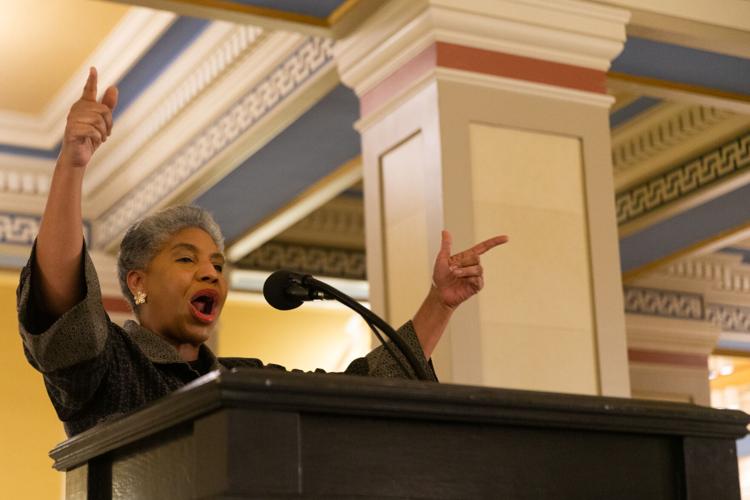
Regina Goodwin, Oklahoma Legislative Black Caucus representative, leads a chant during the first annual Black History Day at the Oklahoma state Capitol on Feb. 13.
Onyekuru said the Black Student Association helps students value their sense of community, traditions and history. He said offering such qualities at a predominantly white institution is particularly significant.
“It’s really important to have organizations like this to allow people to know that no matter where you’re at, you still have the opportunity to be who you are,” Onyekuru said.
Davis said she experienced a culture shock when first coming to OU and that having organizations like Alpha Kappa Alpha and Black Girl White Coat is essential in helping students safely adjust to new environments.
“I think it’s important for people of color to feel like they have a safe space or a community that they know they belong and feel safe in,” Davis said. “We’ll support them and encourage them. Anyone needs that.”
Onyekuru said Black History Month acts as an important celebration for those who made sacrifices that enabled the Black community to exist in current spaces. He said that the most important aspects of Black History Month are recognizing those sacrifices and understanding history.
“It really just helps us celebrate and acknowledge all African American success that has occurred, not just within this month, because in our history, we experienced a lot of racism and oppression,” Onyekuru said.
Price said a crucial component of Black History Month is the understanding of different cultural aspects and awareness of the history and significance that Black Americans played in the past.
Davis said not to underestimate the importance of education. She said Black History Month has improved her own knowledge of historical figures through various posts and recaps, which she said is valuable to her and others.
“One of the most important parts of Black History Month is being educated,” Davis said. “A lot of times people have different perspectives because they don’t know history. It’s good to know your facts before anything else.”
Price said Black History Month has always been an exciting time because it caters to an identity she shares. She said learning more about her community and civil rights leaders has consistently interested her since growing up.
“As I became an adult, learning more has been an exciting piece, and having this particular time throughout the year to really highlight different Black figureheads has been exciting,” Price said. “I think the older I got, the more I learned about [Black History Month] and the more I appreciate it.”
Black History Month is more than just a celebration for many. Davis said that it occupies a different role for her as a woman, and that disrupting the prevalence of negative stereotypes about Black women is necessary to highlight during the month.
“I feel like women of color have it harder than anyone. We definitely get the short end of the stick. We always have to work harder, and we can’t seem too passionate because then it can be seen as aggressive,” Davis said. “I think it’s very important to celebrate our women of color during this month. Actually, every day of the year.”
Onyekuru said that it is essential for people outside of the Black community to recognize the significance of the sacrifices that people have made for African Americans to continue to succeed and grow not only on campus, but also worldwide.
“Understand the success we’ve had within our community,” Onyekuru said. “We fought for the opportunity to be equal and to have the same amount of rights as everybody.”
Price emphasized how influential Black and African American people from the African diaspora are in everyone’s daily life. She said she wants others to continue doing research and understanding their contributions, especially regarding historical understanding.
Davis said she wants students who are not people of color to value exposure to different cultures and diversity. She said she wants others to feel comfortable around her community, but also maintain a level of respect and education.
“You are welcomed,” Davis said. “Feel welcomed in our community, but still respect us and our organizations. Know the do’s and don’ts, and know what is acceptable and what’s not. Be allies.”
Onyekuru said although Black History Month is important, it is also necessary to recognize that Black success is not limited to one month.
“Not just this month is where our success comes from. Throughout the year, throughout every single month, we continuously have success, not just within this campus, but outside of this campus,” Onyekuru said. “Every single month feels like Black History Month for me personally.”
This story was edited by Silas Bales and Emma Blakley. Francisco Gutierrez and Alexandra Powell-Lorentzatos copy edited this story.


