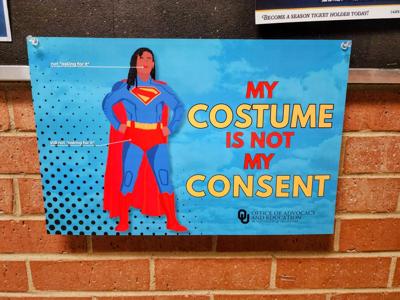

OU’s Office of Advocacy and Education’s “My Costume is Not My Consent” campaign is using trendy Halloween costumes and vibrant designs to encourage students to make Halloween safer and more respectful for everyone.
As Halloween approaches, yard signs and posters appear across OU’s campus with the message “My Costume is Not My Consent.” The campaign, run by OU’s Office of Advocacy and Education, aims to challenge the misconception that clothing indicates consent to sexual activity.
Originally launched within the Women’s Outreach Center in 2015, the campaign later became part of the Gender and Equality Center before finding its current home in the Office of Advocacy and Education. Now, a decade later, its message remains just as critical — especially during what advocates call the “Red Zone,” a period from August through November when college students are statistically at higher risk of experiencing sexual violence. OU’s annual campus safety report showed increased reports of sexual violence.
“It comes from shifting the culture norm of victim blaming off of survivors and back onto the perpetrators,” said Kayla O’Malley, education and outreach coordinator for the Office of Advocacy and Education. “An excuse that's used in a lot of big court cases that we've seen … is that they were wearing a short skirt, or they were wearing something that was showing a lot of cleavage, or their outfit in some way, shape or form was insinuating that they wanted this sexual contact that occurred. … What we're saying with this campaign is clothes never equal consent.”
The campaign centers around bold yard signs and posters featuring illustrated figures dressed as recognizable pop culture characters, such as “Wicked,” “Jurassic Park” and “The Sims.”
The coordinators behind this year’s campaign — O'Malley, Tyler Tennant, Noah Sweet and Chloe Smith — designed the graphics and placed them in areas where they thought they would resonate most, such as a “Wicked” sign near the Catlett Music Center and a “Pokémon” sign near the Esports and Gaming Complex in Cross Village.
“The ethnicities of the characters are different than what they are in the movies and the shows that they're in because we're truly trying to depict people wearing costumes,” O’Malley said.
The designs have also been displayed off campus in Greek houses and Campus Corner businesses to expand the campaign’s reach and ensure conversations about consent, boundaries and safety extend into all areas of student life. The timing of placing these signs in the Red Zone is intentional.
“Party culture increases the risk of sexual violence in general because when we see alcohol and other substances mixed into that, we're seeing lowered inhibitions, a higher likelihood that people will perpetrate and a higher likelihood that people will become victims,” O’Malley said.
The Office of Advocacy and Education Runs prevention efforts year-round with initiatives such as “My Costume is Not My Consent” in the fall, “Consent Never Goes on Break” in the spring and “Take Back the Night,” which occurs each April during Sexual Assault Awareness Month.
O’Malley said the Office of Advocacy and Education has seen overwhelmingly positive feedback from students this year, several stopping by to say they love the signs or engaging with the campaign through a social media contest, dressing as characters featured in the posters and tagging the organization on Instagram to win themed T-shirts.
Even when signs go missing, the team sees it as a positive indicator.
“We like to hope that it's because they think they're so cute and amazing that they just want to keep it. If they have their favorite character on them, they're like, ‘Oh, I need that.’ And that's kind of our hope too, that it resonates with you,” said Sweet, education and outreach coordinator for the Office of Advocacy and Education.
The coordinators emphasize that the campaign is not about restricting how students dress or celebrate; it’s about fostering safety and respect.
“This campaign is a really unique way for us to have fun with the content that we're providing. … This is about you being able to enjoy yourself on our college campus and off the campus. We're not trying to wag our finger at you,” O’Malley said. “We just want to keep people safe and switch that narrative of the assumption of consent, because consent cannot be assumed.”
As the organization looks to the future, O’Malley said the team hopes to expand collaboration across campus by working with student organizations, academic departments and creative programs to co-design future campaigns. O’Malley said they also envision producing video content or interactive educational materials with programs such as Gaylord’s Creative Media Production.
“No matter what campaign we're doing, no matter what workshop we're doing with students, … it doesn't just apply to their lives on campus. It applies to their life in general, no matter where they're going to be,” O’Malley said.
If you or someone you know needs support, contact the Office of Advocacy and Education or OU Advocates by phone at 405-325-4929 or email at oae@ou.edu. For 24-hour crisis support, call or text 988 for the Suicide and Crisis Lifeline.
This story was edited by Madisson Cameron. Tori Pham and Avery Avery copy edited this story.


