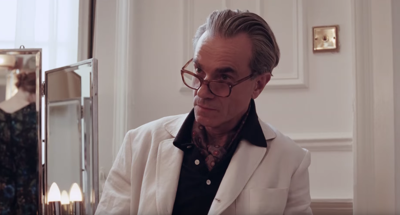
“Phantom Thread,” a high-fashion historical drama, is directed by Paul Thomas Anderson with meticulous precision and features a brilliant performance from Daniel Day-Lewis.
The film is nominated for six Academy Awards, including Best Picture. The other nominations are Best Music (Original Score), Best Actor in a Leading Role, Best Actress in a Supporting Role, Best Director and Best Costume Design.
Set in the elegant world of London in the 1950s, “Phantom Thread” revolves around Day-Lewis’ character, Reynolds Woodcock, a renowned fashion designer. Woodcock is a man of habit, obsessive about every detail of his environment, from the clothes he produces to his breakfast ritual — he believes breakfast should be enjoyed silently.
When Woodcock meets Alma, a waitress, played by Vicky Krieps, she disrupts the tidy world he had constructed for himself. Woodcock invites Alma to join his studio as his companion, muse and assistant.
Alma is at first happy to play this role because she’s enamored with Woodcock and her new luxurious life, but she soon grows frustrated with his sterile demeanor and his tendency to spend more time focusing on his designs than on her.
The conflict is inevitable — Woodcock is too demanding to allow anybody else control or attention in his fashion house, while Alma, decades younger than her lover, wants to feel recognized and appreciated. She goes to great lengths to get Woodcock to notice her, even going so far as to make noise at breakfast.
The two lovers spend much of the movie’s latter half fighting for control over one another until Alma makes a bold last play to gain advantage over Woodcock, resolving the movie’s conflict with a bizarre, intriguing twist.
The role of Alma is one of Vicky Krieps’ first prominent roles in an American film after years of acting in her native Luxembourg. She holds her own opposite Day-Lewis, capturing both Alma’s innocence early in the film and her darker edges later on.
Lesley Manville, who plays Woodcock’s sister and manager, Cyril, earned a Best Actress in a Supporting Role nomination for her understated role that balances perfectly against the two leads’ melodramatic performances.
The unquestioned star, though, is Day-Lewis. He was in nearly every scene in the movie and was mesmerizing in each one. He acts with such physicality that audiences can feel every gesture he makes, and every glance or furrowed brow has been carefully thought out.
Like Woodcock, Day-Lewis is an obsessive master of his craft. The actor said he would retire after “Phantom Thread,” a great loss for Hollywood.
Katrina Boyd, assistant professor of film and media studies at OU, said that because Day-Lewis plays many kinds of roles and does them all so well, he cannot be typecast into one genre of film like other actors.
"I think Daniel Day-Lewis kind of escapes that," Boyd said. "He’s a lead performer who has a lot of the aspects of a character actor."
At times, Day-Lewis’ acting strength was so good it worked against the overall effect of the film. In many ways, “Phantom Thread” resembled the Oklahoma City skyline, and Day-Lewis’ performance was the Devon Energy Center — beautiful and striking, but it towered over its surroundings so much it seemed out of place.
If Day-Lewis were to win the Academy Award for Best Actor in a Leading Role, it would be well-deserved, as would Best Costume Design for the mid-century high fashion throughout the film.
Whether the movie should or will win other awards is harder to say. It may not be popular with the Academy because its story about love and control is dark and strange, but even so, “Phantom Thread” is artfully constructed and wonderfully acted.


