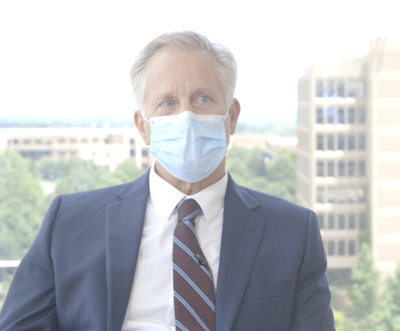

Dr. Douglas Drevets, OU Medicine’s chief of infectious diseases, discussed record positive COVID-19 cases in Oklahoma, asymptomatic carriers and the importance of cautionary measures during a July 8 live stream.
Oklahoma has seen a significant increase in new cases and hospitalizations following June 12, Drevets said — which is when Norman implemented Phase 3 of the Healthier at Home plan. In total, Drevets said Oklahoma has had nearly 18,000 total positive cases and 50 percent of hospital patients are in intensive care.
About 10 percent of positive-testing individuals have been hospitalized and around 20 to 25 percent of those are deceased, Drevets said. This rise is not a reflection of increased testing — rather, it illustrates increased transmissions in communities, Drevets said.
“Community spreading … could be in … home transmission from an infected individual … in restaurants, bars (or) anytime where you're with a group of people for a prolonged period of time in a closed space,” Drevets said. “A prolonged period of time could be only 15 to 30 minutes. … If you're close enough and somebody is coughing, speaking or doing other things that put particles in the air, you can get infected in a very short period of time.”
Drevets said it is important to consider asymptomatic carriers, which account for over 40 percent of individuals who contract COVID-19. It is these patients, Drevets said, that make the virus so difficult to control.
“The question is why do some people have severe courses of disease and why do some people have absolutely … no disease manifestations,” Drevets said. “(It depends on) how (much) of … this case of virus you are exposed to. … In general, the people who have a higher inoculum … are going to get sicker sooner and have more symptoms.”
Although there is a possibility of being an asymptomatic carrier, Drevets said Oklahoma residents should not seek testing unless they are showing symptoms. Exceptions to this guideline include people who care for elderly relatives or those who are subject to crowded conditions where masks and social distancing are not readily held.
Drevets said to seek isolation the moment symptoms are observed.
“If you develop symptoms and you go out and get tested, you should isolate yourself until you get your test results back,” Drevets said. “Just because you are developing symptoms doesn’t mean it’s going to be COVID-19, but if you feel sick enough to go get tested, then the right thing to do is to act as if you are (positive) … and protect those around you until you get results back.”
Drevets also said individuals affected by the virus have shifted from the 15 to 54 age group to people over 65. This fluctuation, he said, is important to note as older individuals are at the highest risk of being seriously impacted by COVID-19.
“(The rise) is really focused on those over the age of 65 … (especially) with underlying conditions such as kidney disease, liver disease and cardiovascular disease,” Drevets said. “This indicates that we need to do a better job of protecting these individuals (in Oklahoma).”
On average, Drevets said it takes five to 10 days for someone to develop symptoms and about three days from the onset of symptoms for positive test results. He said this is because it takes time for the virus to replicate enough for tests to detect.
Even with substantial increases in new cases, Drevets said 95 percent of Oklahomans remain susceptible to infection. He said it is important, especially within younger populations who tend to avoid severe cases of infection, to remember how easy it is to contract the virus.
“Most people do have the opportunity to spread the infection to somebody else … so really the things that you need to do to slow transmission … is to wear masks when reasonable and practical,” Drevets said. “It’s important to remember much of this is you’re … changing a probability from say 50–70 percent to maybe 20–30 percent.”
The likelihood of reinfection was among other topics of discussion. Drevets said it is difficult to prove unless medical professionals can sequence back to the contraction points and differentiate cases.
“What is clear is that although people do develop immune responses when they’re infected … it seems their antibody levels are higher if they have symptoms than if they don’t have symptoms,” Drevets said. “It (also) seems to be clear that after a few months, the amount of antibodies in your system tends to go down — it’s not clear how long the protection lasts after you’ve had the infection.”
Amid rising cases, asymptomatic carriers and possible reinfection, Drevets emphasized the importance of masks, which he said are crucial in filtering out airborne virus droplets.
“What I tell my family, several of whom are in health care, is that we need to stay in masks and protect ourselves until we get vaccines (and) until we know how good they are,” Drevets said. “I think we have to plan like we're in this for the long haul, and if it ends up being a shorter haul, then we can all be thankful.”
Norman has included itself in the initiative to promote mask-wearing as the city council voted in favor of an ordinance requiring face coverings in public settings during its June 7 meeting. The emergency clause of the ordinance allowed it to be immediately enacted.
Drevets said, for now, masks and social distancing are the new normal as medical professionals continue to develop vaccines. Until then, Drevets advised Oklahoma residents to consider their general health and to not be overwhelmed by the virus.
“It seems that a reasonable strategy is to not push hospitals … up to their capacity,” Drevets said. “Hospitals need to care for people other than simply COVID-19 patients. It is all important and we can’t forget the rest of our health care system because we are so overwhelmed by COVID-19.”


