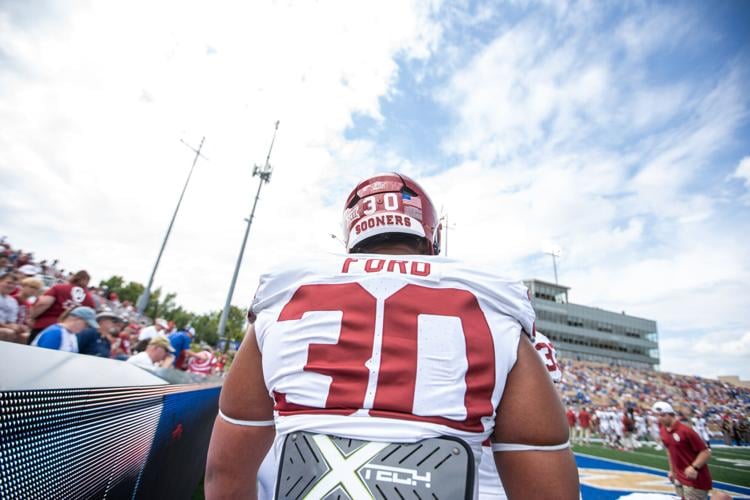


Oklahoma State coach Mike Gundy added fuel to the final rendition of Bedlam when he was asked about Oklahoma State transfer Trace Ford, who joined the Sooners on Dec. 28, during his weekly press conference on Monday.
“I’ve watched a lot of tape and, honestly, have not paid attention or noticed,” Gundy said when asked about the uniqueness of Ford being with OU. “I look at concepts, schemes, numbers … what to attack, what I want to stay away from, things like that more so than who it would be. So I don’t really notice things like that.”
The comments elicited a response from Ford during a radio appearance on WWLS The Sports Animal on Thursday.
“Gundy is really smart with the media,” Ford said. “He knows exactly what to say. He’s a little celebrity when it comes to that stuff. He loves being petty. I can’t wait to play him. I can’t wait to see his face.
“If he hasn’t seen me on film yet, I hope he does this weekend.”
Despite their recent comments, including Ford claiming Gundy “didn’t care” that he left OSU, OU’s defensive lineman didn’t leave Stillwater for any reason having to do with Gundy or even Oklahoma State. Rather, he wanted a change of scenery after a bombardment of injuries kept him sidelined in 18 of the Cowboys’ 27 games in 2021 and 2022.
It got so bad the redshirt senior would feel a mental toll just upon entering Boone Pickens Stadium, where he’ll return for the first time since transferring when the Sooners (7-1, 4-1 Big 12) face the Cowboys (6-2, 4-1) at 2:30 p.m. Saturday in Stillwater.
“The change of scenery meant a lot to Trace,” Ford’s mother, Desirae, said. “Being able to start fresh where there weren't already expectations about him with the team or with the coaches or anything like that and where he didn't have those preconceived ideas about how things were gonna go, it was just a new start for him. That immediately buoyed his mood.”
While recovering from his injuries, two torn ACLs in opposite knees in 2020 and 2021 and a fractured patella in 2022, Desirae saw his mood descend and flood into other aspects of his life.
“He doesn't thrive in a happy spot when he's not playing, so it was definitely hard to watch him not be in there,” Desirae said. “Not being able to play, worrying if you'll ever be back to how you were before, that was the general feeling. Anxiety and just sadness from not being out there and anxiety about will I ever be the same again.”
The injuries not only gave Ford a greater appreciation for football, but an understanding of mental health struggles.
“I used to not really believe in depression and all that, (but) now I see people who are sad or just having a bad day (and) instead of walking past them, I want to be there for them,” Ford said in August during OU’s fall camp. “I want to help anyone that's having a hard time, and that experience I had helped me help others.”
Desirae noticed an immediate change in his outlook upon arriving in Norman. Though his numbers — 10 tackles, two for loss, and an interception — have declined from those which bolstered him to consecutive Honorable Mention All-Big 12 honors, Ford has bettered the most crucial aspects of his life — an improved mental state, heightened appreciation and a healthy season.
“He's really enjoyed the team, working with coach Venables, coach Chavis and coach Roof. He’s really bought into the process there. He's been having fun with it, and so it's fun to watch him having fun. As far as injuries, Trace and all the rest of us are just trying to focus on the positive, not even worry about stuff like that. Everything has been a blessing and everything that happens from this point out is just icing on the cake as far as we're concerned.”
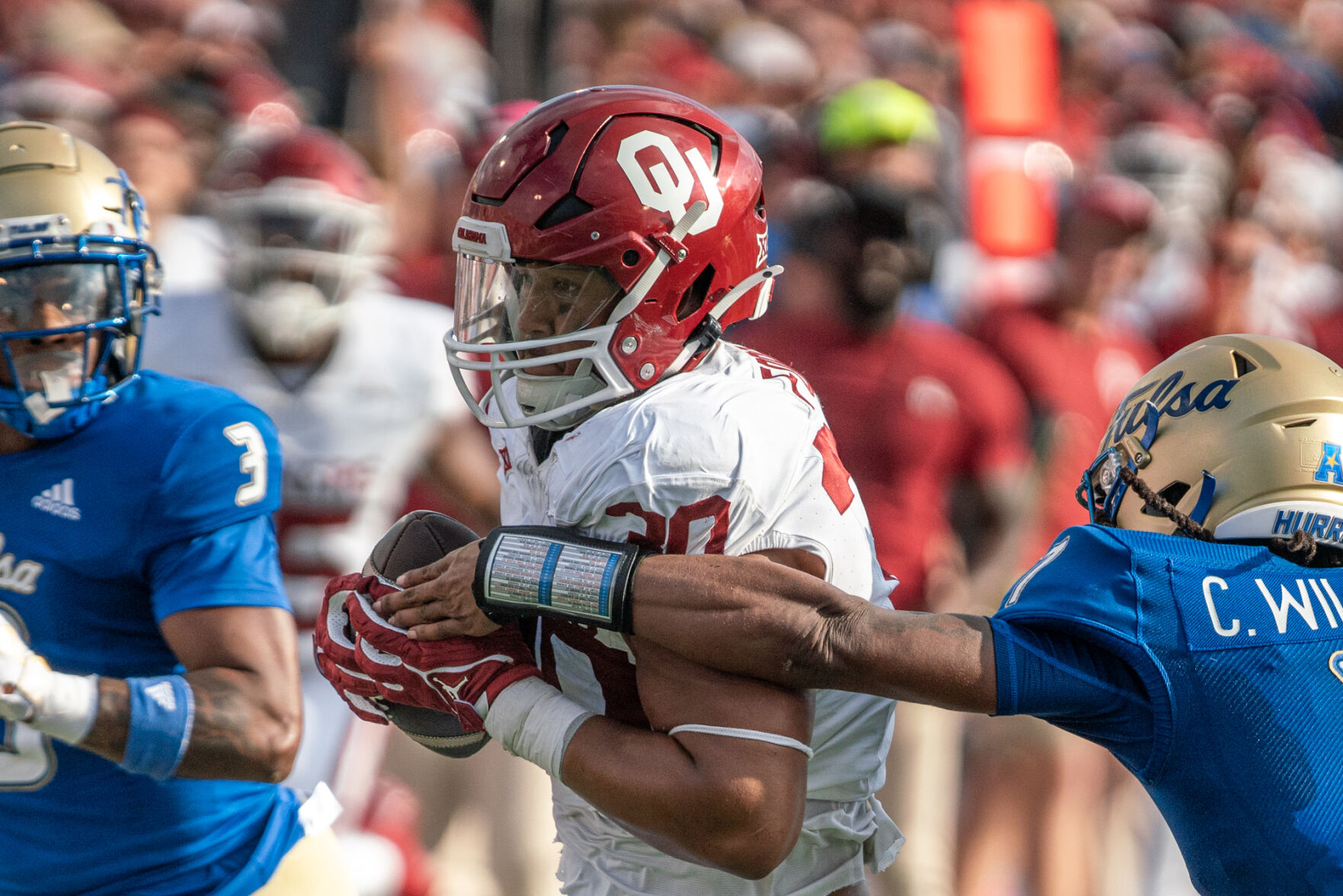
Redshirt senior defensive lineman Trace Ford during the game against Tulsa on Sept. 16.
Ford’s confession about mental health struggles meant more than him, Gundy or Bedlam. It represents what the Sooners have wanted to accomplish since hiring the first full-time, in-house licensed psychologist to serve a college athletic department in 2004 — stopping the stigma around mental health.
The openness about mental wellness presented by a 6-foot-2, 252-pound defensive lineman certainly boosts OU’s goal of awareness.
“If I talk about mental health to a student athlete or I stand in front of a team, it's worth $1. If a student athlete does that, it's worth a million bucks,” Dr. Dolores Christensen, director of Psychological Resources for OU Student Athletes (PROS), said. “So anytime a student athlete, especially from a male sport who maybe has marginalized identities, if they go out of their way to normalize mental health as a good thing, help-seeking, positively taking care of yourself, it’s almost priceless.
“... That's contagious, when student athletes take that upon themselves and not buy into this idea that athletes are tough, have no feelings and that their lives are perfect because they're student athletes at the University of Oklahoma. If we can break down those narratives to ones about holistic wellness and proactively taking care of yourself, that's gonna have ripple effects for years.”
Christensen has seen the common saying “stop the stigma, start the conversation” thrust into action over the course of the five years she’s worked at PROS. OU enacting mental health services so early is a big reason why.
When new coaches get hired, such as Brent Venables in 2021, they’re almost immediately introduced to PROS and pitch it as a resource to their athletes. The system appears to be working as Christensen has seen “unprecedented demand for mental health services” and PROS hired two additional full-time staff members over the summer.
“Our coaches have gotten really skilled at talking about PROS and really encouraging student athletes to see it as a good thing,” Christensen said. “I think in part because of how much we're at practices and we've built relationships with coaches, that has only continued to get better in the five years that I've been here. I think student athletes just sort of expect to see us around.
“Let's say I have a busy couple of weeks, and I don't make it to gymnastics practice, usually when I walk in they’re like, ‘Where have you been?’ So it just shows that they really look to us where maybe 5-10 years ago, that wasn't the case.”
Ford’s decision to enter the transfer portal revolved around bettering his mental state by entering a new setting. His school of choice left him the target of scrutiny from many OSU fans, but, according to Desirae, those who knew him best were either indifferent or supportive of the move.
The same can’t be said for OSU transfer and current OU softball pitcher Kelly Maxwell, who’s former coach blasted her for making the transfer to the Cowboys’ rival.
“My only disappointment for Kelly is that she went to OU because now she’s lost everything here that she’s ever done,” OSU coach Kenny Gajewski said, according to The O’Collegian. “And as long as I’m here, it’ll be hard for her to come back here. That’s just the way it is. ... If you don’t want to be here, go away. I don’t want you here if you don’t want to be here and wear this logo and represent this school.”
The change of scenery was a positive for both, while the response — whether it be from fans or coaches — added a mental toll, representing the double-edged sword commonly seen from the transfer portal.
“On one hand, I think the transfer portal has given athletes a lot of freedom,” Christensen said. “I don’t know about you but I don't want to be bound to the decisions I made when I was (a kid). So I think the transfer portal gives athletes freedom to honor what they need now. The downside, the stress associated with it is if someone enters the portal and they're not picked up, that's super hard.
“... I also think there's an anxiety about athletes may be more willing to say, ‘Well, if this doesn't work out here, I know I can transfer,’ and so much about sport is teaching us to work through adversity, work with people we may not like, get feedback that's tough to hear. And if I can just say, ‘I don't like how (a coworker) talked to me today I'm gonna leave OU at the end of the semester,’ I lose an opportunity to grow. I don't think there's any data on that and I don't think many of our athletes see it that way, but it could be seen as a downside to (the portal).”
Ford came to OU with an opportunity to play football, something he doesn’t take for granted after injuries in three consecutive seasons. After over half a season, he’s gained a heightened understanding of a concept often diminished by burly, tough football players for years.
Now, amid a feud with his former coach, Ford faces the mental test of returning to the place he sought a change of scenery from.
“He gives it his all every game,” Desirae said. “But this one means a little more.”


