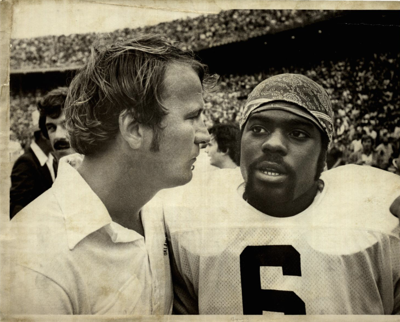

Thomas Lott turned his back to the field on third-and-8, anticipating a punt.
With little over one minute left, Lott and No. 1 Oklahoma trailed No. 4 Nebraska 17-14 during the teams’ 1978 matchup in Lincoln. After OU’s defense forced a change in possession, he expected to get the ball back for one last drive.
“We’re about to go down and score,” the senior quarterback told starting right guard Greg Roberts, that year’s Outland Trophy winner. Roberts, who was facing the field, replied with the death knell of OU’s comeback hopes.
“Homeboy, it’s over,” Roberts said, after watching agitated OU cornerback Basil Banks punch a Husker, resulting in his ejection. Banks’ personal foul gave Nebraska the first down it needed to drain the clock and finish the upset.
“I saw the flags on the ground. I saw the referee pointing that it was against our defense, and he was absolutely right,” Lott said. “It broke my heart and a broken heart is a broken heart, it never healed from that, because at that moment, we lost everything.”
The agony of that defeat, still felt over 40 years later, reinforces the magnitude of the Sooners and Cornhuskers’ rivalry, which stands among the greatest in college football history. After first competing in 1912, the teams began clashing annually in 1928, and by the 1970s and ’80s they were the perennial powers of college football, constantly warring for the Big Eight title and a chance at the national championship. In those decades, the Sooners and Huskers combined for 19 Big Eight titles and five NCAA championships. Their rivalry was one predicated on stature — unlike OU’s hatred of Texas and tolerance of Oklahoma State — and tempered by the teams’ mutual respect.
However, OU-Nebraska is not what it once was. The historical impact has been lost to the point that Oklahoma head coach Lincoln Riley had to educate his players about it this week, some hearing the legends for the first time. The pageantry of Sooners vs. Huskers has been overshadowed by business-driven changes to college football, which generated benefits and consequences for both.
This weekend, Oklahoma will face Nebraska for the first time since 2010 and the first time in Norman since 2008. On paper, the matchup appears a simple victory for the Sooners, who have remained rulers of the Big 12 and will soon transition to the Southeastern Conference while the Cornhuskers have floundered since moving to the Big Ten around 10 years ago. But the significance of Saturday’s contest supersedes the on-field product. Numerous former players from both teams will return to Norman to relive the good old days. The programs have done their best to promote the contest, which will commemorate the acclaimed 1971 Game of the Century between the two.
For one weekend and one game, some of the pageantry lost will be restored.
‘It’s about respect’
Dante Jones wasn’t much of an Oklahoma fan before he signed with the Sooners. Despite that, the star linebacker enjoyed four prosperous seasons at OU, which included a national championship in 1985.
The Houston native who now resides in DeSoto, Texas, was a consensus All-American and the 1987 Big Eight Player of the Year before a seven-year NFL career. While he didn’t know much about the OU-Nebraska rivalry before he came to Norman, he quickly became acquainted with its significance.
“We lived through it once a year in November, the biggest game of our season,” Jones said. “Every year, we had to beat Nebraska to win the Big Eight to have a chance to play for the national championship. That was the mission.”
The mission culminated in multiple memorable matchups, the 1971 Game of the Century foremost among them. In a Thanksgiving Day showdown between No. 1 OU and No. 2 Nebraska, the Cornhuskers came to Norman and knocked off the Sooners 35-31.
Coach Chuck Fairbanks’ Oklahoma offense featured running back Greg Pruitt, who rushed for 1,760 yards and 18 touchdowns that fall. Nebraska coach Bob Devaney countered with wingback Johnny Rodgers, who made one of the greatest plays in college football history that day, weaving through traffic for a 72-yard punt return touchdown. Rodgers went on to win the Heisman Trophy the following season while Pruitt, who missed the initial tackle on Rodgers’ return, battled injuries.
“It was the first time I ever saw OU play, or Nebraska, and it was the last time that I saw OU and Nebraska play until I came to Norman,” said Lott, who came to Oklahoma four years later. “But it was something about OU that kind of stayed on my mind when I saw that game. I know OU lost the game, but I still was leaning toward the Sooners in that game.”
By 1978, Lott was the starter for Barry Switzer’s Sooners, who had won five-straight matchups over Tom Osborne’s Huskers. His backfield mate was Heisman-winning running back Billy Sims who ran for 1,762 yards and 20 touchdowns behind a strong offensive line led by Roberts.
However, Osborne finally got the better of OU, which, in the face of 20 mph winds, lost six of nine fumbles on that cold, wet day in Lincoln. Perhaps the most painful was Sims’ flub on the 3-yard-line with just over three minutes remaining.
The powers continued their struggle into the ’80s, engaging in Game of the Century II in 1987 when No. 1 Nebraska hosted No. 2 Oklahoma. After the Huskers took an early 7-0 lead, the Sooners rallied behind cornerback Rickey Dixon’s two interceptions for 17 unanswered points in a 17-7 victory. The stout OU defense led by the late Dixon and Jones allowed the Cornhuskers to cross midfield only three times.
Fierce competition through the ’70s and ’80s brought a balance that wasn’t present early in the rivalry. Nebraska won 16 of the teams’ first 22 meetings beginning in 1912, before OU ripped off 16-straight victories through most of the 1940s and ’50s.
Oklahoma holds a .523 winning percentage over Nebraska — much closer to an even split than its deficit against Texas (.422) or its thrashing of Oklahoma State (.782). The rivalry’s evenness cultivated a sense of admiration between the teams that was unique, and drastically different from the Sooners’ little-brother feud with the Cowboys or their animosity toward the neighboring Longhorns.
“With Texas, it’s all about hatred,” Jones said. “With Nebraska, it’s about respect.”
OU struggled through the ’90s, allowing Nebraska its longest winning streak in the rivalry’s history with seven-straight victories under Frank Solich. But Oklahoma redeemed itself with its 31-14 defeat of the Huskers in 2000, which set the stage for its most recent national championship.
The last time OU and Nebraska played was in the 2010 Big 12 Championship Game, which the Sooners won 23-20. But since, the business of college football has increasingly overwhelmed its grandeur, like a wishbone pitch slingshots a running back past would-be tacklers, and the rivalry is different for it. Oklahoma has remained the power broker of the Big 12, while Nebraska has become just another team in the Big Ten.
It doesn’t take an expert eye to notice the times have changed. Former Oklahoma fullback Trey Millard grew up in Missouri with no real connection to the Sooners and Cornhuskers’ competition, but he quickly learned its importance. Since traversing the sidelines during the teams’ most recent clash, he has recognized the matchup’s deterioration.
“I don’t think that they’re in a good spot,” Millard, who played at OU from 2010-13, said of Nebraska. “It’s kind of almost sad looking at it right now.”
‘Rivalries ebb and flow’
In 1996, conference realignment shook up college football and fabricated the Big Eight into the Big 12, with Texas, Baylor, Texas Tech and Texas A&M joining as new members. Those revenue generating additions split the Big 12 into North and South divisions, meaning Nebraska and OU went from playing annually to just twice every four years.
Then in 2011, with rumors swirling that OU, Texas and Colorado might leave the conference, Nebraska bolted to the Big Ten, seeking better financial stability. In the aftermath, its rivalry with the Sooners stumbled because money took precedence over pageantry.
“When you're making these business decisions, they do fundamentally change the relationships that these teams have,” said Cody Havard, associate professor of sport commerce at the University of Memphis. “And I think in some instances, it leads to 20 years from now, somebody saying, ‘Oh, you know what, those two teams used to be big rivals, and they used to play a whole bunch.’... I do think it’s changing the landscape of how people view college football.”
Havard brings an intriguing perspective to the OU-Nebraska rivalry. He earned his undergraduate degree at Texas, and became interested in studying sports rivalries after Oklahoma narrowly edged the Longhorns for a Big 12 South title and subsequent national championship berth in 2008.
His wife is also a Lincoln native, and conversations with her family have led to deeper understanding of the Sooners’ and Cornhuskers’ history. He noticed the mutual respect within the rivalry, but also the alterations initiated by economic endeavors like conference realignment.
Now, OU is on the cusp of a similar shift to Nebraska’s a decade ago, having accepted, along with Texas, an invitation to join the SEC in 2025 in pursuit of increased television revenue and better kickoff times. The Bedlam rivalry with Oklahoma State is among the pastimes in jeopardy, again threatening the pageantry of college football.
“Moving with your rival, you would think (OU-Texas) would probably still be the most important rivalry game for both schools, but that also could change as well,” Havard said. “What if they do something just really crazy, and they start these pods like they're talking about? And what if Oklahoma gets put in a pod with Alabama? That makes no geographical sense whatsoever, but if they're playing each other every year, maybe that happens.
“All of these things could be changed, and they are being changed because of the business decisions that are being made, which I'm not saying are bad business decisions either. This is just one of the unintended consequences of those decisions.”
In recent years, Nebraska has become well acquainted with consequences, not having found the success it aspired to upon joining the Big Ten.
Since 2011, the Huskers have rotated through six athletic directors — four official, two interim. On March 12, reports surfaced that Nebraska was attempting to back out of its game with OU by scheduling another opponent for Sept. 18, but Sooners athletic director Joe Castiglione stood pat, insisting Oklahoma intended to play. Nebraska athletic director Bill Moos admitted the Cornhuskers had tried to add another home game, and later resigned on July 30.
In the Big Ten, the Cornhuskers have gone just 68-55 and averaged only the nation’s 24th best recruiting class, while the program has flipped through four head coaches. Current coach Scott Frost has been in Lincoln since 2017, but owns a 14-21 record and is under NCAA investigation for possible violations. The Huskers already lost their season opener to Illinois and are projected for a six-win season at best. The program hasn’t struggled this much since posting only three winning seasons between the 1940s and ‘60s.
“I don't know if they're going to come here believing they can beat OU,” Lott said. “I don't see how they could with the way they've been playing. … I'm sure the people in Nebraska probably don't believe it. It's gonna be pretty interesting just to see them shock the world, and that's exactly what's going to happen if they end up winning this game.”
Meanwhile, Oklahoma underwent a smooth coaching transition from Bob Stoops to Riley, and developed Heisman winning quarterbacks Baker Mayfield and Kyler Murray while making four College Football Playoff appearances. This fall, the Sooners are looking for their seventh-straight Big 12 title, and hope to win their first national championship in 21 years, led by Heisman contender Spencer Rattler.
“They haven't played in 11 years now, and there will be, hopefully, a lot of talk about what a fun rivalry and what a fun game this always was,” Harvard said. “But rivalries ebb and flow because of the product that the teams are putting on the field, and for the last at least 20-25 years, Oklahoma has put a really good product on the field.
“And so that influences the way I think Oklahoma fans view upcoming rivalry games with whoever they're playing if that other team isn't performing at the same level. … So it's really interesting coming up on Saturday's game, the history of it, and also where the two teams are right now.”
‘Few things in life stay the same forever’
After a 62-7 thrashing of Oklahoma State on Nov. 18, 1978, OU’s athletic trainers urged players to return to the locker room while fans were still trying to congratulate them on the field. Lott wondered what could be so vital that Switzer sped his players into a post-game meeting after the regular-season finale.
The opportunity for vengeance, it turns out.
The Orange Bowl Committee had called and was offering Oklahoma a rematch with Nebraska, which had slipped up against Missouri that week after beating the Sooners the week prior.
“That's when I knew there was a god,” Lott said. “Because I'd been saying all week, if they blocked off I-35, we would play them on I-35. We would play them anywhere, because we knew we were a better team than them, and we hated the idea that people were saying that they were hitting us so hard that we couldn't hold onto the ball. We just wanted an opportunity to play them again.”
No. 9 OU maximized its opportunity, knocking off the No. 4 Huskers 21-17 in the 1979 Orange Bowl thanks to Buster Rhymes’ 1-yard touchdown run with under a minute left. Since, comparable moments of ecstasy have dwindled in a series now defined by its past and oft-forgotten because of its present.
“The rivalry thing isn’t for the players today,” Jones said. “It’s kind of for the past players, and so that’s probably why they’re bringing us back this weekend right here, because it’s something we all lived through.”
While the rivalry is different, bonds forged from it remain. Pruitt and Rodgers developed an enduring friendship that overshadowed their on-field competition. Lott holds an annual charity golf tournament in Oklahoma City, and former Nebraska players Tony Davis, Tommie Frazier and Mike and Guy Rozier are among the regular participants.
But money and media have forever altered the college football landscape, and OU-Nebraska is simply a microcosm of those changes. It has even touched Stoops, who had a guarded relationship with the media while with the Sooners, but has now joined its ranks. His role this season on Fox’s Big Noon Kickoff pregame show will, on Saturday, have him broadcasting outside the stadium he coached in for 17 years.
“Very few things in life stay the same forever, right?’’ Stoops told The Daily. “That’s just the way it is, so things continue to evolve and that’s the way this (rivalry) has gone, so that’s life.”


