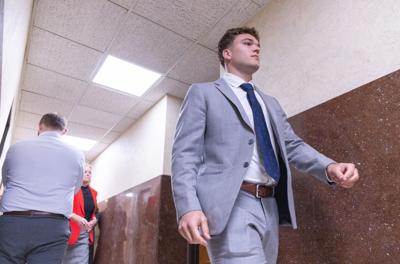


A Cleveland County judge granted OU linebacker Owen Heinecke another year of eligibility Thursday afternoon.
OU athletics director Roger Denny released a statement following Judge Thad Balkman's judgment.
"We're grateful for today's decision," Denny said. "This is a fair outcome for a young man who has handled this process with integrity and resilience. We're proud to stand with Owen and look forward to to supporting him as he returns to competition in a Sooners uniform."
Heinecke thanked all who supported him in his case following the verdict and expressed gratitude for Balkman's decision-making process.
"I'm extremely grateful to everybody who poured into this case (and) was able to help out," Heinecke said. "I'm appreciative of Judge Balkman and his discernment. I'm excited — Sooner for one more year."
Heinecke said testifying in the court room made him feel heavier than he does before a game.
"My heart was racing probably harder than it is before a game when I was up on the witness stand," Heinecke said. "Pretty crazy day, pretty surreal to have case taken this far but ... I'm excited."
OU linebacker Owen Heinecke after judge grants injunction to play another season
Heinecke also spoke about his exchange with head coach Brent Venables, who testified during the hearing, following the decision.
"To hear him be excited is something special, ..." Heinecke said. "It's a good coach-player relationship. I'm excited for one more year with him."
Heinecke testified before Balkman, an OU Law graduate, on the basis that he has played only three seasons of college football, though the NCAA’s rules give every student-athlete four. Heinecke added he was prevented from playing football his freshman year at Ohio State due to COVID-related recruiting disruptions, injuries and the program not holding walk-on tryouts until spring 2022. He ultimately played lacrosse for the school.
“It wasn’t a circumstance (within his control),” Heinecke’s lawyer, Michael Lauderdale said. “Owen is seeking, ‘let me play my fourth year as promised.’”
A Cleveland County judge ruled OU linebacker Owen Heinecke will be eligible to play next year
Heinecke, who will be in his sixth year of college during the 2026 season, played three games of lacrosse at Ohio State his freshman year, which the NCAA counted as a full year of eligibility, previously preventing him from playing another season of football. He was classified as a redshirt junior on OU’s 2025 roster after he rose from medically redshirting in 2022 to appearing in all of the program’s games in 2023-25, including five starts and 74 tackles last season.
OU football general manager Jim Nagy testified in support of Heinecke.
Nagy said Heinecke’s recruiting profile was one that depended heavily on an in-person evaluation. Coming out of high school, Heinecke had not decided whether he would play linebacker or safety and Nagy stressed that the ability to see his on field product first-hand would help them decide where he could be utilized.
“You want that in-person evaluation on that,” Nagy said. “The physical characteristics, you need to see in person.”
Nagy added that Heinecke’s potential return carries weight far beyond what he could do in the next season and that it could be vital for his NFL trajectory and development as well.
“The NFL tried to avoid one-year wonders, a guy with one year of production. Having another full year of production would be huge,” Nagy said. “Their biggest jumps are between their first year as a starter and second year as a starter.”
He also said Heinecke’s return would not come at the expense of other players on the roster.
“Everybody would open Owen back with open arms,” Nagy said.
Venables testified before Balkman as well.
“When he first stepped on campus, he had a knee issue that set him back. … I saw a guy that laid it all out on the line,” Venables said. “The game was just starting to slow down for Owen. I really believe there’s another opportunity for Owen to take a huge leap. … He’s just scratching the surface on what he can become.”
Venables said he did not submit anything as a part of Heinecke’s waiver request.
“We rotate. Owen’s opportunity does not take from someone else’s opportunity,” said Venables.
Venables also noted that the COVID-19 pandemic strongly impacted recruiting and that OU was “not having walk-on tryouts.” However, Venables took a chance on Heinecke aided by his recollection of one of Heinecke’s relatives who played for him in his first season as co-defensive coordinator in 1999.
“It was a leap of faith because his uncle (Cory Heinecke) was a starting defensive end for us back in 1999,” said Venables.
He added that, for college recruiting, they need to see players in person, and he was not able to evaluate players in person during the pandemic.
Heinecke’s high school coach, JJ Tappana from Bishop Kelley High School in Tulsa, also gave statements at the stand.
“My contention basically is Owen was denied the opportunity to be recruited at the level he should have been recruited at. … The recruiting process was basically shut down during that entire time,” Tappana said. “There were no recruiters on campus. … There was a dead period. … All virtual.”
Tappana believes that both junior spring and senior year is “vital to the recruiting process” but the non-traditional approach affected where Heinecke received offers despite being “the best (he’s) ever had.”
“I got text conversations from Oklahoma State. … I had a conversation with someone from Duke. … They were not offering anyone they had not seen until March. … They loved him.”
Outside of power-four programs, Heinecke was also recruited by some of the United States service academies, but Tappana stressed that playing for them would not be the same as a traditional football program.
“I’ve had a couple players at West Point. I’ve had a couple players at Air Force Academy. It’s a different lifestyle,” Tappana said. “Ultimately, the kids I’ve had at service academies, they have to give up their years after football. … It’s not apples to apples. It’s saying you had a chance to join the military.”
Tappana said the NCAA did not ask about the letter he provided to the association before the hearing. His text conversations with Oklahoma State, Duke and others have not been provided to the NCAA.
At the beginning of your second season, you have to sign a letter of intent to join the military, or if you do not do so, you leave the program. Tappana is aware of this but said that Heinecke’s “integrity” prevented him from taking a path like that.
Heinecke committed to Ohio State to play lacrosse in November of his senior football season, meaning in the middle of the season, though the football national signing days were later in the year.
“Owen wanted to be an athlete at the highest level, and that was the opportunity right then,” Tappana said.
When asked about Heinecke’s football recruitment in high school, Tappana recalled that Oklahoma State was in the mix, but he would “have to go back to the files” to confirm interest from other schools.
Later in the hearing, Tappana noted he had a text from Oklahoma State he found in a search, which said, “We need to see him in person."
Heinecke’s legal counsel, led by Mary Quinn Cooper of McAfee & Taft, included Michael Lauderdale, another OU Law alum, and Woody Glass, former OU football chief of staff.
On Monday, Heinecke’s legal counsel submitted a notice of supplemental authority referencing the October NCAA case of Nalani Lyde, a student-athlete who started her career in 2019 playing volleyball but was granted another year of eligibility with Providence College’s basketball team for the 2025-26 season.
Balkman’s decision comes in spite of the NCAA’s rebuttal arguing Heinecke chose to attend Ohio State on a lacrosse scholarship despite receiving multiple scholarships to play football at Division I institutions.
Heinecke is not the only college football player to have successfully filed an injunction for another year of eligibility in 2026. Mississippi quarterback Trinidad Chambliss, a sixth-year senior next season, was granted another year of eligibility after a Mississippi Supreme Court judge denied the NCAA's appeal of his injunction. He redshirted for Ferris State in 2021, missed the 2022 season due to respiratory issues, played two seasons there in 2023-24 before having a successful season at Mississippi in 2025.
Heinecke could play in OU’s spring game, which will kick off at noon Saturday.
This story was edited by Anusha Fathepure. Mary Ann Livingood, Hannah Lambert and Andrew Higgins copy edited this story.


