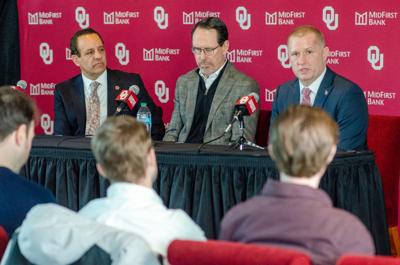

OU athletic director Roger Denny and President Joseph Harroz Jr. see the Protect College Sports Act as the most reasonable fix to college sports’ issues.
The Protect College Sports Act is a bipartisan federal bill designed to bring unification and stability across college sports. It strives to establish firm ground rules for name, image and likeness compensation and seeks to provide a revenue-sharing cap.
“It just provides so much needed stability in our industry, and I know I've said at times, it's not a perfect bill,” Denny said to local media members last Thursday. “And even today, it's not a perfect bill. There are parts of it that I don't love, but I do think it's the best hope we've got today to get some of the structure in place in our industry that we so badly need.”
Denny added that it was significant that the SEC and Big Ten commissioners, Greg Sankey and Tony Petitti, joined in supporting the bill.
“I would give a lot of credit to commissioner Sankey and to commissioner Petitti,” Denny said. “The willingness that that they demonstrated to to work with our senators and and their legislative staffs to refine that bill into a bill that made sense for the SEC and the Big 10 and and the Power Four at large, I think, took a lot of work and just seeing some of the movement behind the scenes on that.”
The leaders of two of the biggest conferences in college sports brought new life to the initiative in late July with a joint statement.
"The Big Ten Conference and Southeastern Conference support the Protect College Sports Act as currently drafted, following detailed and productive negotiations with Senators Cruz, Cantwell and Schmitt and their respective staffs,” the conferences wrote. “We appreciate the substantial work that has gone into this effort."
Harroz has also been a major part in discussions facilitating the act, according to Denny. He has been a presence above the SEC level.
“President Harroz, in particular, has been a vocal advocate for really building structure and governance in college athletics and has been a leader in those rooms and in rooms a lot bigger than the SEC room and just makes you really proud to be on his team as we go through that,” Denny said.
According to Denny, college sports is being disrupted by antitrust law and has two options for protection: legislation and collective bargaining. If all of the power was in the athletic director’s hands to fix college sports, he would lean into collective bargaining. However, Denny acknowledged that focusing on collective bargaining as the one solution would be a long road.
“When I tell you it's not perfect, what I would tell you is, if we were sitting here today, and I got the magic wand, and I got to design the system however I wanted, we'd be in collective bargaining right now,” Denny said. “But the pathway to that is really hard to get to, … so the only viable option today is the legislation.”
Denny believes the Protect College Sports Act is close to its passing and intended effect.
“There are a lot of great ideas out there,” Denny said, “and I tell our coaches I really do believe, for the first time in a while, that we're on the verge of building some structure into college athletics.”
This story was edited by Charlie DiVincenzo.


