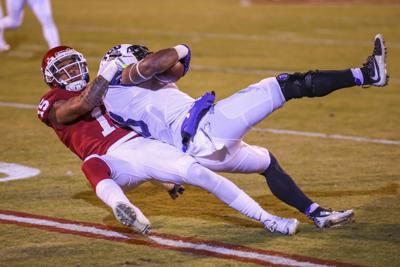
The National Football League has come under fire in recent years for its handling of head injuries over the past several decades.
As a result of the long term impact on the mental health of ex-players, more research has been done on the detrimental effects of concussions. Lawsuits have been filed. Rules have been changed. Lives, far too young, have been lost.
And that’s just in the NFL. But what about at the amateur level?
Collegiate players are undoubtedly more informed of the potential consequences of repeated head injuries — OU established a sports psychology department in 2004 — than they were several decades ago.
“I think a lot of people I talk to say ‘football is dangerous,’” offensive lineman Nila Kasitati said. “But it’s one of those things that’s not for everybody. Some people can do it, some people can’t.”
While that’s one positive improvement that’s happened over time, it’s not the whole battle. Players who haven’t sustained a concussion in their career — like OU linebacker Eric Striker — are less likely to be warned off by it.
“A concussion has never crossed my mind,” Striker said. “I’ve never had one so I never think about that.”
In some ways, that approach will never change. In the heat of the moment, players aren’t thinking about staying away from concussions or any other injury.
“You definitely don’t worry about injury when you’re out there playing,” cornerback Zack Sanchez said. “It’s a part of the game. It’s a violent and physical sport. But it’s not something that guys worry about on a day-to-day basis.”
So, the game has adapted. The NCAA implemented “targeting” rules, which bans players from launching themselves to make helmet-to-helmet contact with an opposing player.
The NCAA also revamped its concussion guidelines in January of 2014. That meant a new protocol for student-athletes attempting to return after suffering a concussion.
That policy manifested itself as Oklahoma went to the locker room against No. 18 TCU on Saturday night.
In the second quarter, quarterback Baker Mayfield took a hard hit to the head from TCU linebacker Ty Summers. Summers was eventually ejected for targeting, but Mayfield remained in the game for the rest of the half.
Coach Bob Stoops said Mayfield admitted to having a headache at half time. At that point, the training staff decided to pull Mayfield for the remainder of the game.
And while that’s good news for family and friends of student-athletes, it doesn’t alleviate all concerns from friends and family.
“My mom worries about everything,” Sanchez said. “Her stomach tosses and turns every game.
“But she knows how much I love this game and what it’s done for me in my life, so I don’t think it’s anything that she would ever want me to stop doing. But obviously as a mom, you worry.”
Sanchez wasn’t an outlier in that regard.
“Your family members near and dear to you really care about your health,” Striker said. “Not even about just concussions but just getting injured, because it’s a contact sport. But yeah, they do care.”
As far as getting players to be more aware on the field, that might be impossible. Most players are acting on instinct and don’t think about concussion safety before or during a play.
“If you’re thinking about that type of stuff, I don’t think you’ll be on the field much longer,” Sanchez said. “I think you’ve got to be mentally tough to play this sport.”
But as time passes and more people begin to be impacted — both on and off the field — by concussions, more and more players will start to consider their long-term future beyond the gridiron.
“You definitely want to keep it in mind,” senior receiver Durron Neal said. “I know it’s the competitive nature in those players to shake it off, but it’s also good to let trainers know because (concussions) can somewhat impact you in a way if it gets too bad and you don’t tell anybody.”
And at least one Sooner thinks he has the key to preventing concussions.
“I’d like to say my hair helps,” Kasitati joked. “It’s concussion proof — knock on wood.


