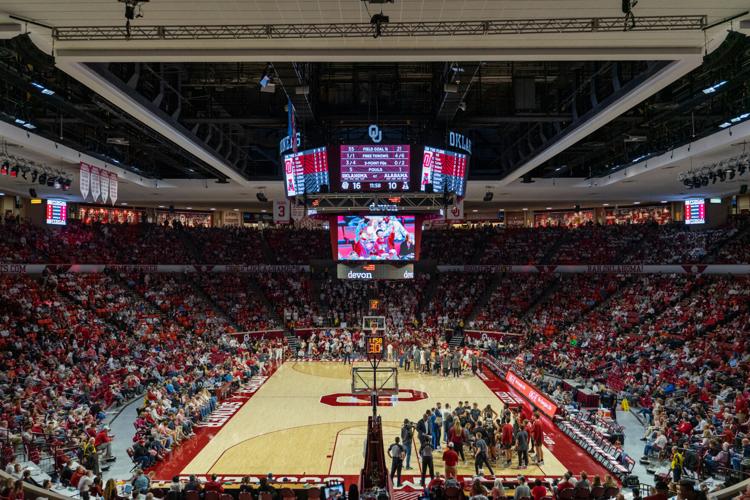




Leah Beasley and Tyler Cofer strolled the top-level bowl of the Lloyd Noble Center, dreaming up the limited possibilities inside the 48-year-old, 11,528-seat arena ahead of the 2022-23 basketball season.
Both associate athletics directors who specialize in fan engagement and marketing, inspected the crimson seats, the tunnel and later conjured up potential changes to the video board.
The pair, aware of the creative confines of the aging arena, remain positive of the arena’s future direction, however.
The LNC was created as a multi-purpose complex in 1975. Beasley, who was hired from Mississippi State in April 2022, says the goal is to create a more intimate basketball setting.
And the clock is ticking with OU’s upcoming move to the Southeastern Conference ahead of the 2024 sports calendar.
Oklahoma is weighing its options on renovating the Lloyd Noble Center or constructing a new arena. Beasley explained Oklahoma wants to prioritize tight-packed seating, create several standing-room areas and implement built-in suites within the venue, something the LNC lacks.
“We're looking at the sub-10,000 range,” Beasley said of the potential seating capacity for a new or renovated arena. “We don't want to get to a position where we're selling ourselves short, and we're cutting our revenues because we don't have enough room.
“We're trying to make it to where the renovated LNC or the possibility of a new arena has different areas, where there are some options for standing room. If it's not a game where you think you're gonna have 10,000. Then you're making it into more of a social space.”
The program’s assessment for a future arena correlates with the attendance among men’s and women’s basketball the past three non-COVID reduced seasons.
Oklahoma men’s basketball has averaged 7,552 fans in the combined three seasons, minus 2020-21. During that span, the Sooners have eclipsed 10,000 attendees nine times out of 45 home contests, two of which occurred this season when OU had 10,869 and 13,224 fans on Jan. 28 and Feb. 1 for games against Alabama and Oklahoma State, respectively.
Women’s basketball, which has seen an increase in attendance, still lags in comparison to men’s basketball. It’s averaging 3,035 in the three combined seasons and has only eclipsed 10,000 fans once, the Sooners’ latest matchup against Texas when it had 10,137 in the stands.
It was the largest women’s basketball crowd since 2013.
Oklahoma, if it were to downsize seating, would be duplicating trends from around the nation.
“If you know you’re not going to have a big crowd, you still want it to look full and still be impactful and still be intimate,” Beasley said. “Then, how do we create that environment? Those conversations are definitely happening, but you see it across the nation.
“There (are) programs that are intentionally losing seats because the crowds necessarily aren't coming as consistently as they had in the past. Because as we know, everything is on TV, they can find everything just from sitting on their couch.”
Texas, which upgraded to the Moody Center ahead of this season, is among those. The Longhorns moved on from the 46-year-old Frank Erwin Center, which held 16,540 people, to their new arena holding around just over 10,000.
Alabama, a future SEC foe, unveiled plans in 2022 to also build a new arena, seating approximately 10,136 fans
Oklahoma announced a proposal for an entertainment district and new arena in 2017 in Norman’s University North Park district totaling an estimated $90.75 million for public incentive investment, but it was struck down due to community opposition. A recent survey revived community feedback, but it remains in limbo with the latest results pending.
The 2017 proposal included a 10,000-seat arena with 800 club seats, 30 loge boxes, 20 luxury suites, 12 regular suites and 2,600-lot parking garage.
“It's still an ongoing process,” Beasley said. “We were consulted, and we were involved in that, and we were a party to that survey, but it did originate with the city of Norman and a lot of the ideas are stemming from that group. We want to be good stewards of obviously the overarching university, within our community and our state.
“We're in that fact finding and survey results stage right now. We're obviously leaning on and ... kind of seeing where that falls from the City of Norman.”
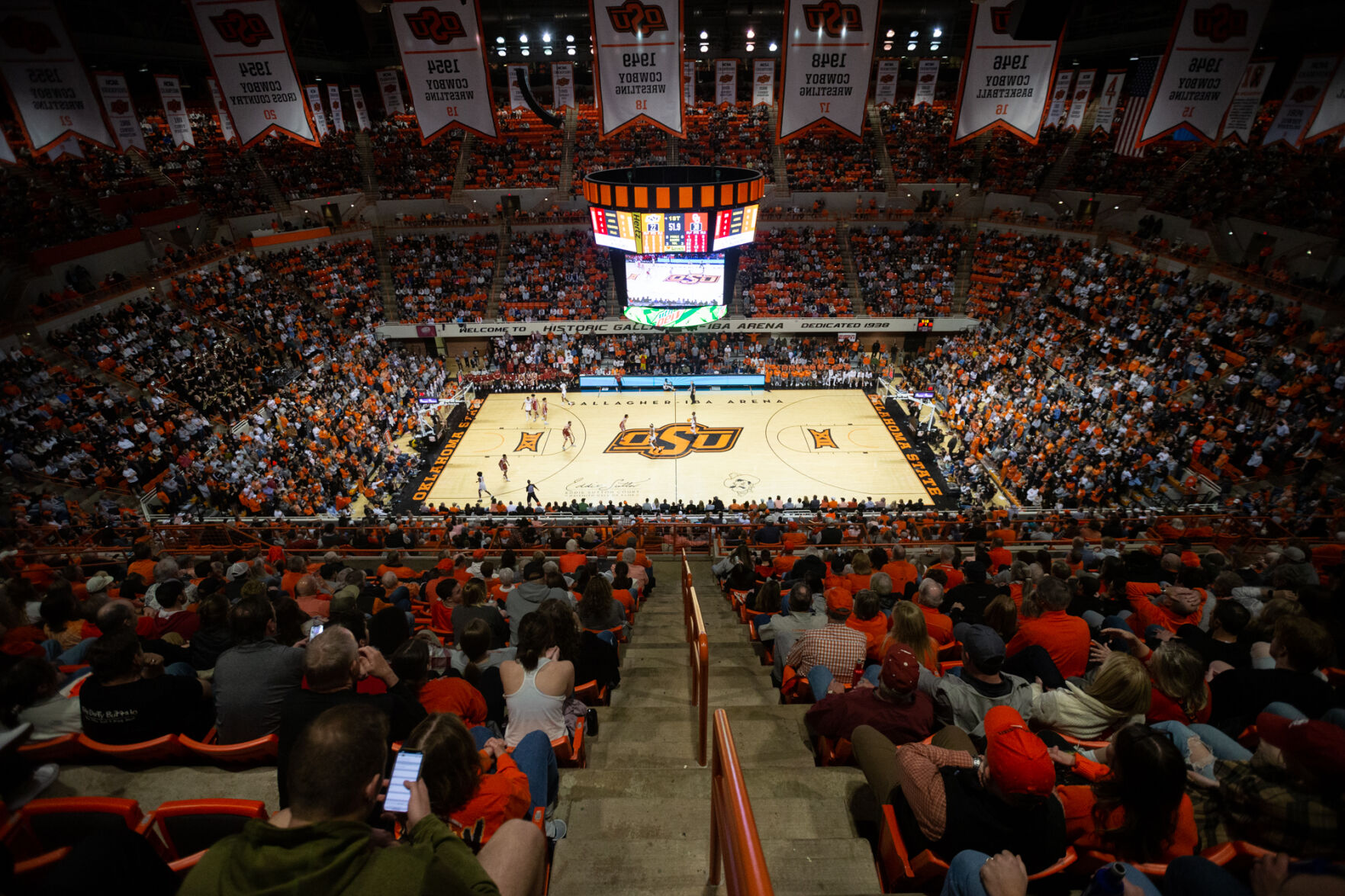
Gallagher-Iba Arena during the game against OSU on Jan. 18.
'I know it can be done'
Porter Moser hung his head low and headed towards the locker room following a 72-56 blowout loss to Oklahoma State at Gallagher-Iba Arena in Stillwater as 10,789 fans towered over him from their orange seats.
Throughout the contest, air horns reverberated off the steep arena walls, boos directed at the Sooners bounced off the hardwood, and members of the student section roared just inches behind OU’s head coach.
It’s the kind of atmosphere Oklahoma is looking for with its complex soon.
“I remember sitting there and my back was right here, and I think I could touch the students,” Moser said of the Gallagher-Iba atmosphere. “They’re literally right on top of you.”
Moser is familiar with the energy in the Gallagher-Iba. He coached Arkansas Little-Rock against Eddie Sutton’s Cowboys in 2000, their first home game following its groundbreaking ‘raise the roof’ renovations, nearly doubling its capacity from 1998-99.
Gary Sparks, a now-retired architecture veteran, led the renovations of the historic venue built in 1938. After helping with an interior design project at OSU, Sparks was driving to Tulsa in 1996 when he turned on the radio and heard the news of OSU’s plans to build a new arena west of Stillwater.
“I thought to myself, ‘that is a horrible idea,’” Sparks said. “I didn’t know why in the world they wanted to build off campus. It's just a bad idea. All the way back to Tulsa I kept thinking there's got to be a way to renovate. The only thing wrong with the Gallagher-Iba was that it was too small.”
When he returned home, Sparks began sketching renovation designs on a piece of paper and presented it to his structural engineer. He wanted to build a shell over the arena, and rebuild the infrastructure of the historic arena by raising the roof, an architectural feat never done before, anywhere in the nation.
Months later after presenting his idea to Oklahoma State, Sparks proposed the idea to then-OSU athletic director Terry Don Phillips. The cost of the project was $45 million in 1998, and — if a similar renovation was done today on the LNC — would cost $82,592,944.79 in 2023.
Sparks, who had a near 30-year background then, beat out four other architecture companies, all which planned to move forward with a new arena. They all disagreed with Sparks’ notion of building a concourse over the existing snake-pit of the Gallagher Iba arena and were unwilling to help if he was given the go ahead.
“Most people didn’t want to move off campus, but it was the only thing that had been suggested,” Sparks said. “That's when I showed them my direction, and we presented them an alternative, everybody jumped on board. They wanted to stay loud. There’s a lot of pride and it's a really rowdy environment we didn’t want to lose.”
Similarly, to Oklahoma State, OU faces a similar situation of either building an off-campus arena in north Norman or renovating Lloyd Noble Center, which lies 1.5 miles from its campus.
While Sparks upgraded the Gallagher Iba 25 years ago, he feels that downsizing the LNC might pose a similar challenge, but the job could be done by the right person. Like Gallagher Iba, the Lloyd Noble Center would require stripping out old electrical wiring, bathrooms and other structures inside and adding new, modern infrastructure.
“I know it can be done,” Sparks said of a potential downsizing renovation to the Lloyd Noble Center. “I think it might happen more because it can generate more revenue and you can charge more for those tickets.
“But downsizing Lloyd Noble, to me, would be a piece of cake compared to upsizing planning. If you wanted to add 3,000 seats, you're talking about a much bigger issue.”
Sparks noted issues might arise with the building code if the Sooners were to slope the stands steeper, which might not be possible in 2023 like it was in 1996. His company barely teetered on the edge of the fire marshal’s approval then.
He thinks moving the seats down and building a skybox, much like he did with the Gallagher Iba Arena, would be the most feasible plan.
Still, Sparks thinks that OU’s potential goals of repurposing and renovating the Lloyd Noble Center to make it a modern-level arena is more than possible.
“I’m 99% sure that it could be achieved in that existing building,” Sparks said. “It's gonna take somebody that is passionate about renovation and sports architecture.”
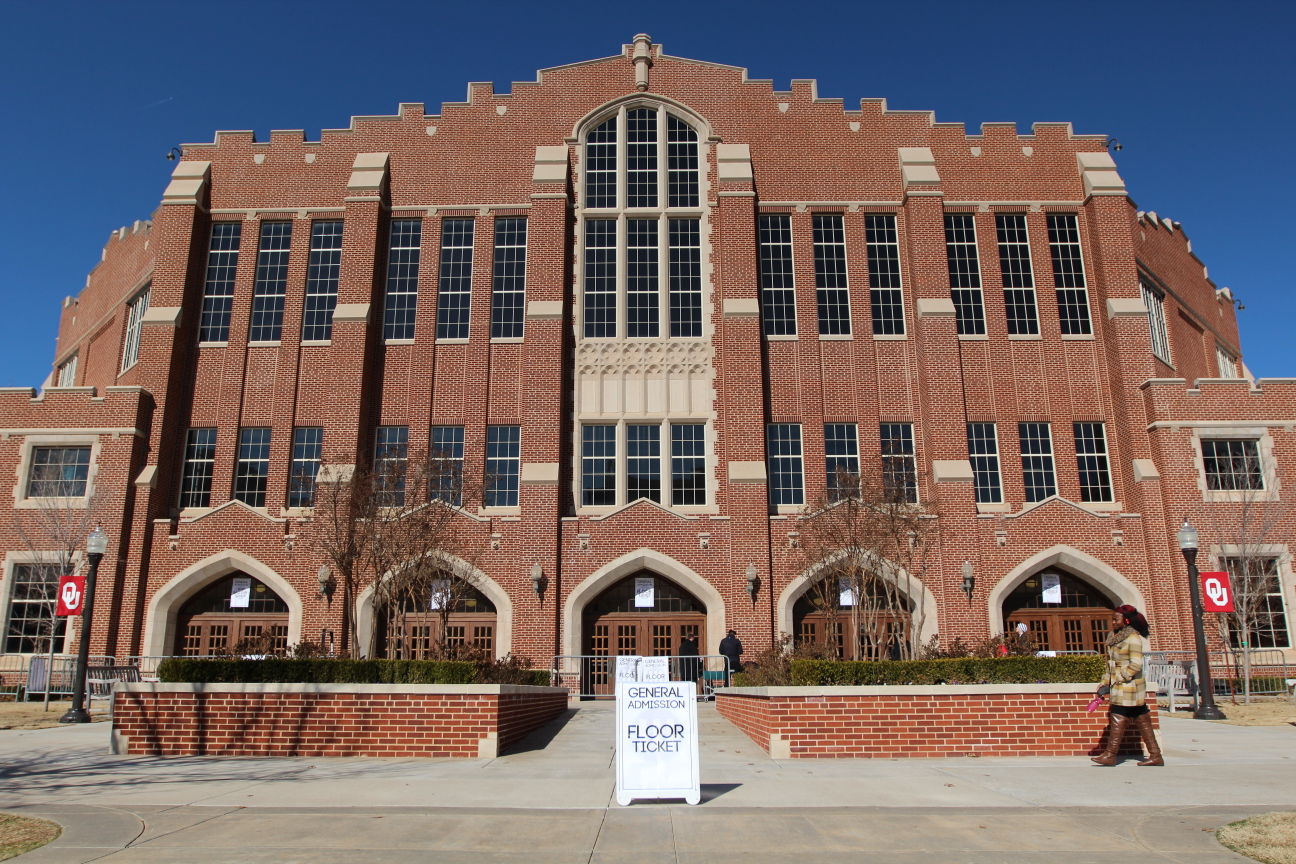
The McCasland Field House was the home of Sooners basketball until the Lloyd Noble Center opened in 1975.
'It was home'
Alvan Adams rummaged through his treasure trove of old newspapers tucked away in his Phoenix home.
The 69-year-old former OU basketball star then pulled out his camera and flicked pictures of newspapers from the OU Daily.
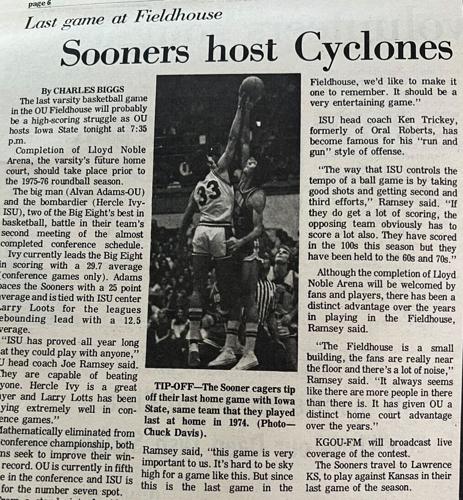
While reliving past memories, he came across a headline from March 1975 that read “Last Game at Field House, Sooners host Cyclones.”
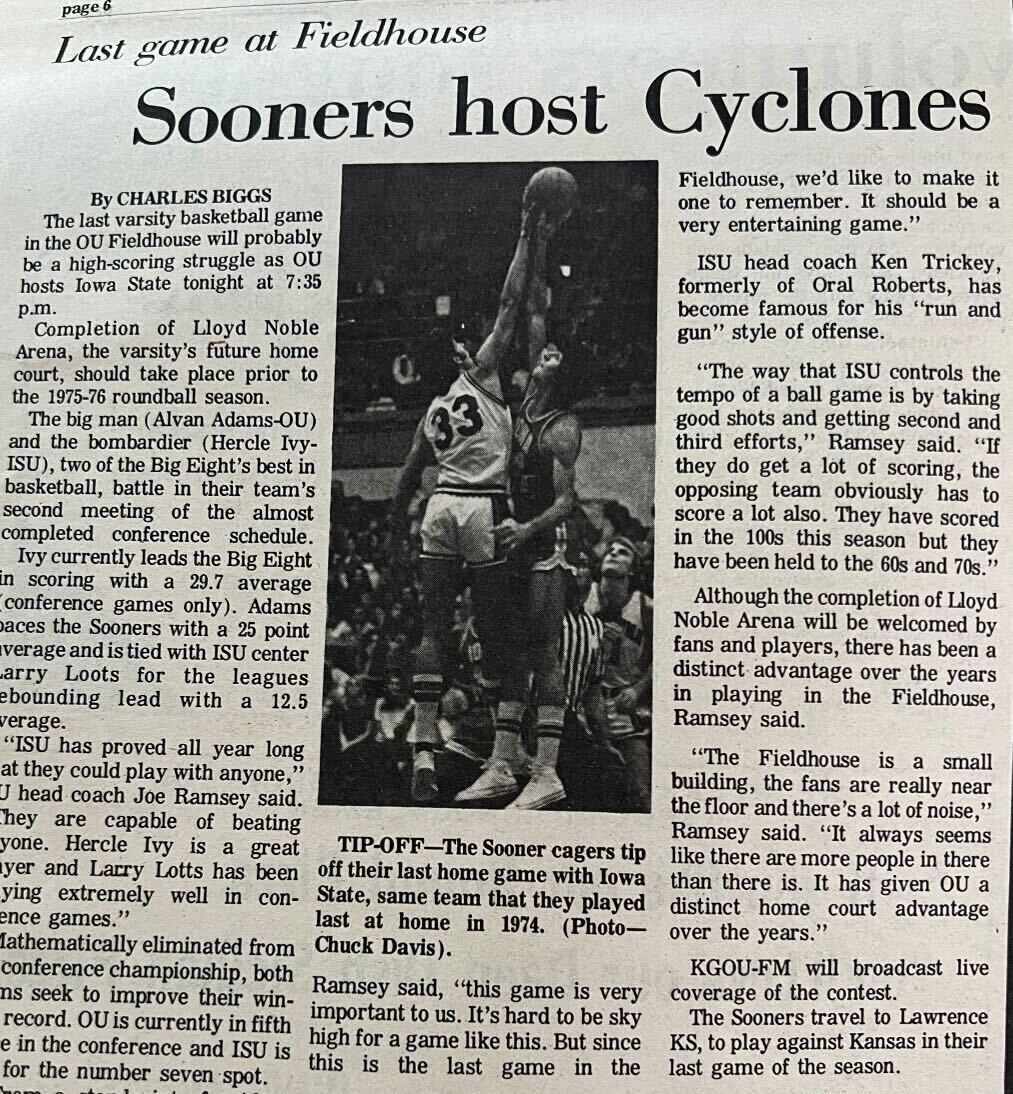
Screengrab of OU Daily archives from March 5, 1975.
In the final game of OU’s once-jam packed home, Adams dropped a then-program record of 43 points along with 25 rebounds, leading the Sooners over Iowa State before a crowd of rowdy OU fans. It was the last game before Oklahoma’s move to the new, 6,528-seat larger Lloyd Noble Center just south of campus.
After the game, he and former captain Mike McCurdy cut the nets down at the McCasland Field House, which now houses OU wrestling and volleyball.
“It was home,” Adams said. “It was always jammed. It was always loud. Everybody always has a better winning percentage at home, and we were no exception to that rule. So, when we played it, we always expected to win.”
The Field House featured a logo-less wooden floor, red-stained brick walls feet away from the backboard and steel overhang beams holding yellow lights.
It housed one of President Jimmy Carter’s campaign speeches in 1976, weeks before his eventual bid into the White House. It also hosted Wilt Chamberlain in 1957 in a game against the Sooners. For many, however, it was home of a raucous home-court atmosphere, which resembles a smaller version of what OU is looking for today.
Fans often clambered over one another on the bleachers, fighting for spots. They would crowd behind the opposing team’s inbound passer, touching them as they tried to inbound the ball.

Former Sooners star Alvan Adams pictured in OU Daily archives from March 5, 1975.
On the south baseline, Adams’ fanbase, “Alvan’s Army” would hound the opposing fans and support OU’s players. It was, for Adams and many Oklahoma players, as on-top-of-the-action any fan could get.
“It was great to have it on campus in the middle of housing,” Adams said. “Most of the many students lived nearby, so it was an easy walk back then, and it only held 5,000 people and you know, it was pretty easy to fill the place. … But, just being that much more compact and intimate (was great).”
Rick McNeil, who played four seasons at OU including the last season at the Field House and the first at the LNC, remembered the arena being a recruiting pitch when he was in high school. As a high school senior, the program was lobbying that the Lloyd Noble Center would be finished by his sophomore season in 1974.
South Carolina, ranked No. 5 at the time, thought they were to play in the LNC. Instead, the Gamecocks were forced to go into the Field House because construction was behind schedule.
“We played South Carolina, and they were ranked like No. (5) in the nation and came into play my junior year,” McNeil said. “If they knew that we were going to be playing at the Field House they would not have scheduled us.
“It held 5,000 people, but I don't think so. If it did, they were hanging off the bleachers. It was just a barn, the Big Eight had a lot of barns at that time.”
According to McNeil, the Sooners struggled to replicate the animated atmosphere in the first season of the LNC.
“It takes a lot of people when you have a situation like the Lloyd Noble Center,” McNeil said. “It wasn't near as loud. Sometimes, even small crowds, if they really got excited — if you had a crowd of 5,000 or, or something like that — they could make noise. But the biggest crowds were when we went on the road.”
Many routines have changed since then, but OU is still searching for the magic that once existed in the Field House.
“I tell you, nobody wants to play in that environment,” McNeil said. “If they're a good team, they don't want to come to play you in your barn. The environment and the atmosphere, it’s everything.”
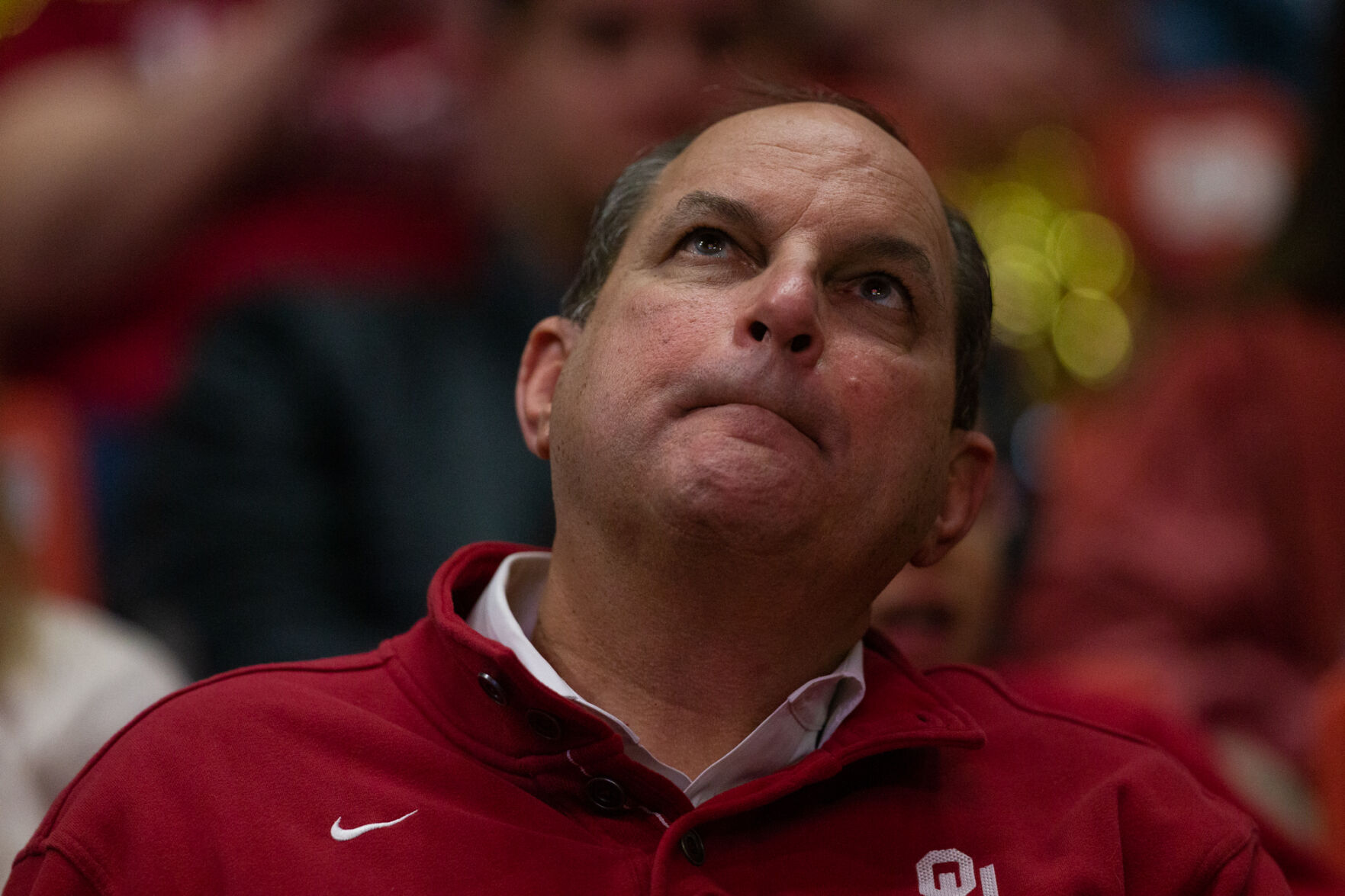
OU athletics director Joe Castiglione during the meet against No. 5 Utah on Jan. 22.
'We’re going to be good to go'
Kevin Micue and Sara Brown, season-ticket holders since the 1990s, sit in the fourth row of the first section off the floor in the Lloyd Noble Center.
They were among the 10,137 fans at OU’s loss to Texas on Feb. 25, the Sooners largest women’s basketball crowd in the LNC since 2013.
They’ve noticed the drastic changes made to the Lloyd Noble Center this season but have increasingly enjoyed the family-like atmosphere built among both basketball programs.
OU coaches Jennie Baranczyk and Moser have expressed their appreciation for fans in attendance since both were hired ahead of the 2021-22 season.
“It all starts with the attitude of the team and the attitude of the coach,” Micue said. “That's where it all started. They make it very obvious to us fans that our presence is appreciated.”
Brown, like most fans in the lower-level sections, wished she could be closer to the action.
“Acoustically, it would probably be nice to have us more on top of the action,” Brown said. “We could have more of an impact with our cheering if the goal is to make it smaller and better.”
Cofer oversees fan engagement at various OU events alongside Beasley.
His expertise reigns from his time with the Oklahoma City Thunder and Vegas Golden Knights, commonly known for having some of the best gameday atmospheres in the NBA and NHL, respectively. He’s aware of the limitations inside the LNC, but thinks his team is making the best of its complications.
The video board, as noted by Cofer, doesn’t use LED’s, making it difficult to have top-notch displays. The venue, designed to be multi-purpose, lacks enough electric plugs needed for all the technology Beasley and Cofer want to install.
Like the Knights, Houston and other programs around the nation have programmed graphics that project onto the floor.
“It definitely has complications and obstacles,” Cofer said. “It is what it is, and it hasn’t changed our mindset. We know the canvas that we're working with. Now we're going to try to make the best piece of art out of it.”
This season, Cofer helped the program install more pyrotechnic machines, more than the two they’ve used in the past. The program rigged steel beams below the ceiling, and the pyro machines ignited extra fire during the Sooners’ pregame intros.
Cofer and Beasley’s marketing team has also experimented with free T-shirts and promotional alcohol nights. Oklahoma also partnered with StadiumDrop, a food delivery service bringing concessions to fans in their seats.
For the most part, these experiments, paired with Baranczyk and Moser’s calls for fan support, has worked. OU hosted the second-largest crowd in the LNC’s history against the Cowboys.
The goal, whether in a renovated LNC or new arena, is to carry over the success from this season and enhance it in a modernized space.
“I definitely would love to have a more concentrated presence just on the court,” Cofer said. “I think I would just love to have a little bit more of an intimate feeling.”
Beasley has also pushed for the marketing team to heavily involve BoomSquad, OU’s student section, changes from which could begin showing up elsewhere.
“We put a DJ out there (in the student entrance),” Beasley said. “We did a lighting truss. We made it more of a vibe. That’s what we want to do like all over the arena. So, there are some plans for the facade of you know, like different entrances of the LNC to make them a little easier and more welcoming, a little more open.”
BoomSquad President Dawson Wolff views the students as Oklahoma’s boots-on-the-ground thinktank and feels OU’s lack of engagement among students is an awareness problem.
Student sections across the country, including Kansas, Oklahoma State, Kentucky and more, are often the heart of a rowdy atmosphere, keeping the opposing team on its heels. For OU, Wolff has come across multiple students who had no clue the games had free student attendance.
“We’re making people aware of stuff going on on campus,” Wolff said. “I think people were struggling going to the basketball games because they didn't know it was free to attend the whole season. Often multiple students when they came to the basketball game, and they’d walk up to me and they were like, ‘We had no idea that it was free the whole year.’"
Rob Patterson and Chris Opheim, who are among the directors of fan engagement, oversee music, video board memes and other in-game action to keep fans involved. Opheim, who came from Mississippi State, controls the action for men’s basketball and Patterson, from Mississippi, is involved directly with women’s basketball.
They’ve added a blend of modern R&B and hip hop to keep the crowd moving during timeouts. Cofer measures their success by using the app Decibel x:dB, to see how loud the crowd is during the game.
Student section showed out for the #Sooners game today. It’s the largest I’ve seen it all season. pic.twitter.com/v6yDRbTnHm
— Jason Batacao (@J_batacao) January 21, 2023
They want to make sure OU is more than prepared for the benchmark set in the SEC. So far, after measuring and analyzing the activity of other future conference venues, OU is ahead of the curve with engagement-based ideas.
“We're going to be good to go,” Patterson said. “I've seen that space. We're going to be ready to go. We know it's a challenge, but it's a challenge we're embracing, especially on the basketball side. … We want to be the benchmark.”
This season, Beasley has seen, in fits and spurts, things taking shape.
As a sea of crimson and cream stormed the court on Jan. 28 after OU’s win against then-No. 2 Alabama, she watched athletic director Joe Castiglione measure the madness taking place from his usual east baseline seat.
Postgame scene of the #Sooners storming the court pic.twitter.com/RPvfZMidMQ
— Jason Batacao (@J_batacao) January 28, 2023
In awe, Beasley waited for a break in the crowd, OU’s first court-storm since 2011. Finally, reaching Castiglione once he inched back away from the court, she smiled as the two exchanged looks.
“(Is) this the special moment?” she remembers asking him.
Castiglione then smiled and nodded, affirming Beasley’s claim.
This story was edited by Austin Curtright and Colton Sulley. Ansley Chambers copy edited this story.


