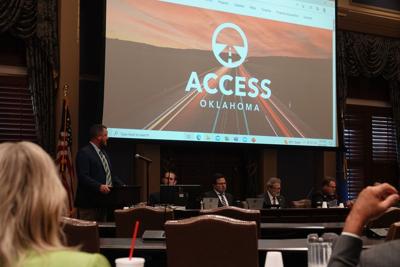

Legislators from across the state heard concerns regarding the operation of the Oklahoma Turnpike Authority and ACCESS Oklahoma from members of Pike Off OTA and Cleveland County residents during an interim study at the Oklahoma state Capitol Tuesday.
The new study, requested by Sen. Rob Standridge (R-Norman), followed another focused on how the OTA is run and what the authority can and cannot do. The first study only included OTA Deputy Director Joe Echelle and Secretary of Transportation Tim Gatz as speakers.
Anti-turnpike grassroots organization Pike Off OTA — formed following the Feb. 22 announcement of ACCESS Oklahoma — a 15-year, $5 billion turnpike improvement and construction plan.
Pike Off OTA members included Amy Cerato, a civil engineer, Tassie Hirschfeld, an OU anthropology professor, and Robert Norman, the lawyer in a suit filed by the organization. Richard Labarthe, co-counsel in an Open Meeting Act violation case filed by over 150 Cleveland County residents, also appeared at the study.
Two of Norman’s elected officials, Ward 5 Councilmember Rarchar Tortorello and Cleveland County Commissioner Darry Stacy, asked legislators to take action against the authority at the study.
Echelle took to the podium following a short introduction from Standridge. When asked if the authority knew the homes that would be affected by the turnpike, Echelle said OTA wouldn’t know for sure until purchasing was complete. However, he did give the estimate of 200-250 homes. On its website, Pike Off OTA claims the total of lost homes is 665.
Further, Echelle said the authority continues to seek public input through its website and phone calls and hopes to continue communication with the City of Norman throughout the progression of ACCESS.
Following Echelle, Norman discussed the Turnpike Enabling Act found in the Oklahoma State Statutes, beginning with the authorization of the Turner Turnpike in the 1940s. In 1954, voters approved “cross pledging,” meaning revenue from one turnpike can be used to pay for another, a practice Norman says will never allow turnpikes to become free.
Norman thoroughly discussed Statute 69, section 1705(e), which authorizes the OTA to build turnpikes in 35 locations. In his lawsuit, Norman argues that the South Extension Turnpike route was never authorized in this statute, nor the Kickapoo Turnpike, which was built during the Driving Forward program in 2016.
Norman goes on to cite the lack of “sunset” provisions in the statute, meaning that there is no time limit following authorization on when the OTA can build authorized turnpikes. He then compared the Oklahoma Enabling Act to Kansas and Florida, where their turnpike authorities are required to collect public and local government input and conduct studies prior to authorization.
Two ACCESS projects, the East-West Connector and the Tri-City Connector, were authorized legislatively in 1987, according to Norman, but because they were not built with funds from the original bond package, the statute says they can’t be built using separate bonds.
“What this ultimately comes to is putting some guardrails on the OTA,” said Norman. “Let’s go back, and let’s put (back) representative democracy, let’s respect individual liberty and let’s respect the rule of law.”
Labarthe delivered updates regarding his lawsuit during the study, noting the trial date set for December. He also proposed a new amendment to the state’s constitution that would require a special election prior to turnpike route authorization, turning routes to voter approval.
According to his presentation, the election would only be among property owners affected by proposed routes. For an amendment to actually be written into the constitution, it would either have to be passed by the Legislature and approved by voters, proposed and approved by voters, or voted on at a constitutional convention.
Cerato focused on increased accountability for OTA, pointing toward the lack of independent oversight. Regarding environmental impacts, Cerato also discussed the impact to rose rocks and wildlife.
Hirschfeld called for a full audit before any new bonds or construction occur, or limits on tolls increase, along with new OTA leadership and mandatory reporting of all real estate transactions. Further, Hirschfeld presented “market based suggestions,” saying the OTA should pay the true market price for homes.
“A lot of turnpikes don’t make good engineering sense,” Hirschfeld said. “They don’t make good economic sense, and it’s just this relentless overexpansion that does not do any service to the people of this state.”
Both Hirschfeld and Cerato would lose their homes to an ACCESS project. Tortorello represents several residents who would also have to sell their properties, and he discussed the turnpike's potential impact on Norman itself.
Noting that the municipality was kept “in the dark” about the project, Tortorello said councilmembers were shocked at the announcement and, specifically, the impact to two major sources of drinking water — Lake Thunderbird and the Garber-Wellington Aquifer.
Further, Tortorello discussed the human impact and argued the turnpike would cause a “mass exodus” of Normanites, as the city’s housing shortage would be stressed even more as a result of the project.
“They have no idea what’s going to happen to them, today, tomorrow or the next several years,” Tortorello said. “They have no idea if they’re going to sell, stay or go.”
Stacy, similar to Tortorello, expressed concerns about the watershed, adding concern about school bus routes being impacted during construction and damage to existing roadways.
Should any legislator wish to file a bill in relation to the OTA, the final day to request a bill is Dec. 9, a month before bills are introduced at the Capitol. The session itself begins on Feb. 6.


