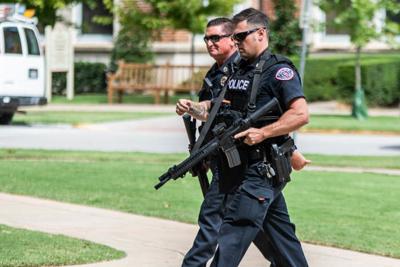

Unused patrol cars parked outside, empty cubicles in dark rooms and piles of paperwork on cluttered desks are just some of the visual symptoms of the OU Police Department’s struggle to retain its officers.
Since 2017, the department’s staff has declined amid a lack of competitive pay as the university continues to grow its student population. The issue has left OU increasingly less prepared to ensure community safety from thefts, assaults and shootings across campus, according to an OUPD employee, who the Daily granted anonymity to ensure their job security.
Nathaniel Tarver, the OU Police Department chief and associate vice president, said only 27 of 40 allocated positions at the OU-Norman campus police department were filled as of September.
That means for every 1,056 undergraduate students, there is one officer.
Compared to some Big 12 schools, only OU has a ratio of more than 1,000 students per officer. However, among the 10 schools in the conference, only six campus police departments list employment numbers online. OU is not one of them.
Oklahoma State University is the closest, with a ratio of 705 students per officer. The smallest ratio is at Texas Christian University — a private research institution — with 190 undergraduate students per officer.
The University of Kansas has the most similar undergraduate student population to OU with 27,685 undergraduate students — compared to OU’s 28,502 — among the six Big 12 universities with publicly available data. Its student-to-officer ratio is 486 students per officer, meaning OU’s ratio is over 100 percent higher.
The department has also consistently lost officers in recent years. According to the OUPD employee, 35 officers have left the department since 2017, and the department’s total retention rate since 2017 is around 55.5 percent. Of the 22 officers it has hired in the past five years, 16 have left.
Despite a decline in officers, enrollment numbers have steadily increased since 2017. OU has repeatedly broken university records for the largest freshman class in 2017, 2019, 2020, 2021 and 2022.
Tarver said part of the challenge of employing officers is not having a competitive pay rate. OU offers a starting salary of $51,563, according to OUPD’s website. In comparison, the Norman Police Department offers $55,923 with raises every six months, and the Oklahoma City Police Department offers $60,427 for officers with a $5,500 signing bonus, according to each department’s website.
Additionally, recruiting officers is a slow process, Tarver said. It takes around a year for officers to complete courses at the police academy and training on campus protocols and culture.
“(People) look at campus policing and they think it is something less than a municipal police officer or state police officer, and it’s just not,” Tarver said. “The duties, the skills, the training that we do is on par with all those agencies.”
OUPD can recruit only two to three new officers at a time, Tarver said. It would take about four to six years for the department to fill all of its empty positions, assuming no officers leave during the process.
OU President Joseph Harroz Jr. told the OU Daily in September he had conversations with Tarver about potential solutions for OUPD’s understaffing and low pay.
Harroz’s solution was to reallocate around $491,000 to the OU-Norman campus and Health Sciences Center police departments. The funding is temporarily coming from the salaries of the open positions, Tarver said.
“I asked the question point-blank of the police chief: ‘Is this what you need?’” Harroz said in September. “And he said, ‘Yes.’”
Harroz said he was also looking into future solutions.
Tarver confirmed the university is exploring options for additional funding, but he said this method will only be sustainable for a few years if the department can’t quickly fill the open positions. He said he hopes this method will help retain current officers while recruiting more.
“The positions we have right now that are empty, that’s basically what we’re using to fold into (the budget),” Tarver said. “(We will) cannibalize those to raise salaries of the existing people here now.”
There are multiple methods to determine the best student-to-officer ratio on a campus, according to the International Association of Campus Law Enforcement Administrators.
One of the more common methods among campus and municipal police departments is the minimum-staffing model, in which police leadership chooses a minimum number of officers to be on each patrol.
However, there is no standard ratio suggested among campus police departments, according to the organization’s website.
OUPD doesn’t disclose why there are 40 allocated positions on its website. However, Tarver said the university has set a minimum number of officers per patrol shift, a policy similar to the minimum-staffing model.
Tarver said he would like more officers patrolling the 5.2-square-mile campus. He said it isn’t safe to disclose the exact number they have patrolling at a time but that he would ideally double the minimum number.
Overworking officers because of low staffing is another concern, Tarver said. Daily events and incidents on campus require OUPD’s presence, he said, which keeps them spread thin and prevents them from taking time off.
During the week of Oct. 3-9, there were 958 incidents involving officers, according to OUPD report logs. A majority of the incidents were labeled as patrol.
Additional reports included welfare checks, safety escorts, medical assistance and thefts. There was an average of 137 incidents per day, and other weeks show similar numbers.
Serious and violent crimes like domestic violence and burglary on campus happen regularly, according to OU’s 2022-23 Annual Security and Fire Safety Report. The report showed an increase in domestic violence and motor vehicle thefts on and around campus in 2021. It also included over 100 drug- or alcohol-related arrests and several hundred disciplinary referrals each year.
Tarver said the small staff and heavy caseload also doesn’t provide enough time for refresher training — a standard practice in law enforcement — because most officers are preoccupied during their shifts.
OUPD’s officers conduct regular active shooter trainings within the department and offer similar sessions to those on campus who request it. Tarver said the department has seen a sharp increase in training requests in the past six months because of the national attention mass shootings have received this year.
Shootings — particularly mass shootings — have been on the rise in the past decades. In 2016, a report from the Citizens Crime Commission of New York City showed there had been a 153 percent increase in shooting events from 2011-16 compared to 2001-6. The events also had a 241 percent increase in casualties.
On May 24, 21 people were killed in a shooting in Uvalde, Texas. About a week later, five people died in a shooting at the Saint Francis Hospital in Tulsa. On Oct. 5, a professor was shot and killed in his office at the University of Arizona by a former student.
Data from The Violence Project, a nonprofit research center, shows instances of mass shootings were steadily increasing until 2020, when there was a sharp decrease around the same time the COVID-19 pandemic began. In 2021, instances of mass shootings rapidly returned to previous numbers.
A similar pattern remains in 2022. As of Sept. 5, there have been 464 mass shootings in the U.S. this year, an average of almost two shootings per day.
When asked about the potential for an active shooting on campus, Harroz said his son had recently gone through active shooter training at his school. He said he was comforted, but also saddened his son had to have the training, calling it a tragedy and a crisis.
“If you’re not planning for (an active shooter), you’re not being honest,” Harroz said.
Tarver said he is confident OUPD would keep campus safe in the event of an active shooter and that its partnership with the Norman Police Department would allow it to respond quickly, swiftly and proficiently to any threat.
All active shooter events are different, however, and Tarver said it can be hard to plan for what the department would do in the worst-case scenario.
“I’m not sure anybody’s actually prepared for an active shooter,” Tarver said.
In 2019, Gallup Poll reported that nearly half of Americans fear they will be a victim in a mass shooting. That fear can be devastating to a person’s physical and mental health, said Linda Barnum, an OU psychology professor.
If a person does not feel safe a majority of the time, it becomes difficult for people to recognize when they’re safe, and hypervigilance can make it nearly impossible to think, Barnum said.
She added that the constant state of adrenaline can weaken the immune system, making people more vulnerable to disease.
“Each generation has always had to face their version of what is safe and what is not,” Barnum said. “The generation before me had World War II. The generation before (this) maybe had Vietnam. Society, as always, had an interaction with violence. In our current culture in America, (this) generation has this.”
Experiencing that level of hypervigilance exacerbates anxieties students experience on a college campus, Barnum said. Arriving in a new place with more freedom often leads people to neglecting to certain physical needs, such as sleeping and eating well, she said.
Many students come into contact with alcohol, nicotine and marijuana for the first time in college, causing mental and emotional strains on the average student, Barnum said.
The consistent fear of dying from something uncontrollable can make it nearly impossible to function, Barnum said.
“The issue will always be at a human level,” Barnum said. “How do we maintain our own right to a felt sense of safety in a world that has never been safe?”
As issues across campus arise, Tarver said he wants everyone to feel assured that OUPD will respond.
Tarver said his main priority is to ensure the safety of students and faculty on campus with the staff he has, but he emphasized the importance of people being aware of their surroundings to keep themselves safe.
“I want everyone to know and feel safe enough to realize that yes, we will respond and we will address the issue,” Tarver said. “But the safety issues that everybody needs to be concerned with fall within themselves, to be aware of the things that are around them and how (they) are going to react.”


