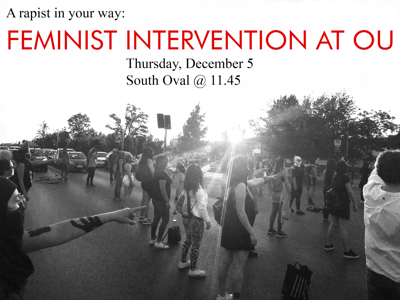
A group of students held a rally in light of a momentous international movement raising awareness of the prevalence of gender-based violence.
The protest, called “feminist intervention,” began Thursday, Dec. 5 at 11:50 a.m. on the South Oval.
Feminists from the group LASTESIS gathered in Santiago to perform a song in protest of sexual violence and femicide in Chile, according to Huffington Post India. The song and dance eventually spread across the internet and was replicated and adapted in other Latin American countries and eventually in other parts of the world.
The students wanted to bring the same protest to OU because they believe not enough action has been taken to protect students from sexual and gender-based violence on campus, architecture senior Magdalena Schaffernicht, who participated in the rally, said.
Schaffernicht said people on campus have a tendency to be complacent and that “things happen and people keep walking.” A culture of complacency is one of the reasons the group wanted to hold the rally on campus.
“The group that (has) been organizing this were all Latinas or Spanish speakers,” Schaffernicht said. “I thought it would be right for it to be both Spanish and English so that people can understand that (and) so that we also feel comfortable and to reference that this is something that was born in Latin America.”
The group performed a rendition of “Un Violador en tu Camino,” which is translated to “A Rapist in Your Way,” according to a report by Quartz. The song was originally written by the Chilean feminist collective LASTESIS. The song has been adjusted in other countries to “their own situations,” said Schaffernicht.
The students also edited a part of the song in order to reference unity between protesters in Oklahoma and Latin America. In English, the song references “the rapist” being “my ex, my professor, my boss, the cops, the congress,” and “the president.”
Like the protesters in Chile, the students wore thin blindfolds while they danced.
Schaffernicht said she and other women she spoke to believe the blindfolds could symbolize the fear women have of becoming a victim of sexual violence
“(LASTESIS says the blindfolds are) a symbol of the lack of justice in every sense,” said Schaffernicht. “It also makes me think that there is a reference to the blind eye turned by too many to the systematic violence against women ... we are all one, fighting.”


