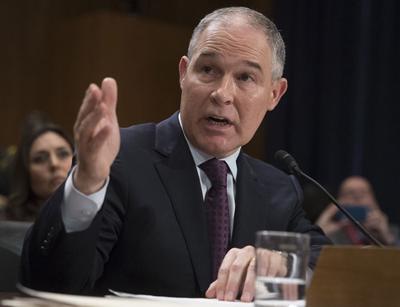

An OU professor and an environmental organization have filed a complaint against Environmental Protection Agency administrator Scott Pruitt that could lead to an investigation.
The Center for Biological Diversity and Kristen van de Biezenbos, associate professor in the OU College of Law, have filed a complaint with the Oklahoma Bar Association against the former Oklahoma attorney general for lying about using a personal email address for work-related matters in his Senate Environment and Public Works committee hearing Jan. 18, van de Biezenbos said.
When asked whether he used an email address for business other than his government email address, Pruitt said no, according to the hearing transcript.
The Center for Media and Democracy filed a lawsuit against Pruitt Feb. 7 for not releasing 3,000 emails the organization sent open records requests for in 2015 and 2016. On Feb. 16, the day before Pruitt was confirmed as the EPA administrator, an Oklahoma judge ordered him to release the emails.
On Feb. 22, more than 7,500 of Pruitt's emails were released, revealing that Pruitt did use a personal email account and that he had been communicating with organizations like American Fuel & Petrochemical Manufacturers, discussing changes he could make in the EPA that would benefit them, among other things.
The release of more of Pruitt's emails was delayed Feb. 28 for an unspecified period of time.
While use of a personal email address for government business is not illegal in Oklahoma, it is a violation of ethics to lie to a tribunal like the Senate committee that held Pruitt's hearing, van de Biezenbos said.
“The legal profession is a self-policing profession," van de Biezenbos said. "We have certain ethical standards we are supposed to uphold, which includes not lying to Congress, and it’s up to us really to enforce those kinds of rules."
"In an ideal world, you would expect since it does not appear that he was candid with the Senate committee, that they would demand that he explain. It doesn’t seem like that’s going to happen," van de Biezenbos said.
Amy Atwood, endangered species legal director for the Center for Biological Diversity, said the Office of the General Counsel of the Oklahoma Bar Association will handle the complaint, possibly submitting it to Pruitt for a response, and decide if the complaint warrants an investigation.
If the Office of the General Counsel finds that Pruitt's actions violated his ethical duties as a barred attorney, it will take disciplinary action, such as temporary suspension of his bar license or disbarment, van de Biezenbos said.
“On the one hand, you wouldn’t anticipate very stringent disciplinary action based on a single incident because I don’t believe that Mr. Pruitt has had any previous ethics violations filed against him with the Bar Association here," van de Biezenbos said. "That being said, this is a particularly egregious violation of ethics."
Atwood and van de Biezenbos said they do not know how long the process will take, but Atwood said while they are waiting they will look out for more evidence and anything that would help their case, including sifting through additional emails when they are released.
Atwood said Pruitt lying during the hearing raises questions about what else he may have lied about.
“It’s a real concern whenever a public servant misrepresents any facts during a confirmation hearing to Congress, especially when they’ve put the questions to him so directly and where he was really emphatic about how his personal email address was never used for business — he was very clear about that," Atwood said.
Van de Biezenbos said although Pruitt is part of President Donald Trump's administration, the issue at hand goes beyond political affiliation and is more a concern of not lying to a government body.
“I really do think that no matter what your political affiliation is, that everyone should be able to agree that if you lie to members of Congress, there should be consequences for that," van de Biezenbos said. "And we as a profession, as attorneys, we expect a pretty high ethical standard from members of our profession — which would include not lying to Congress."


