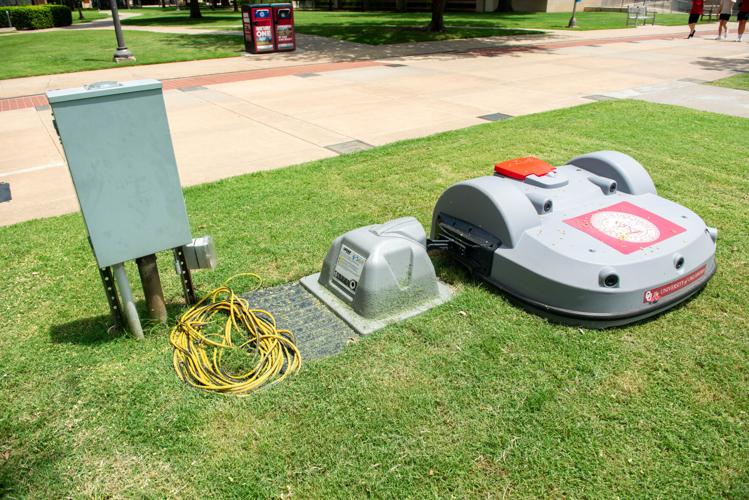
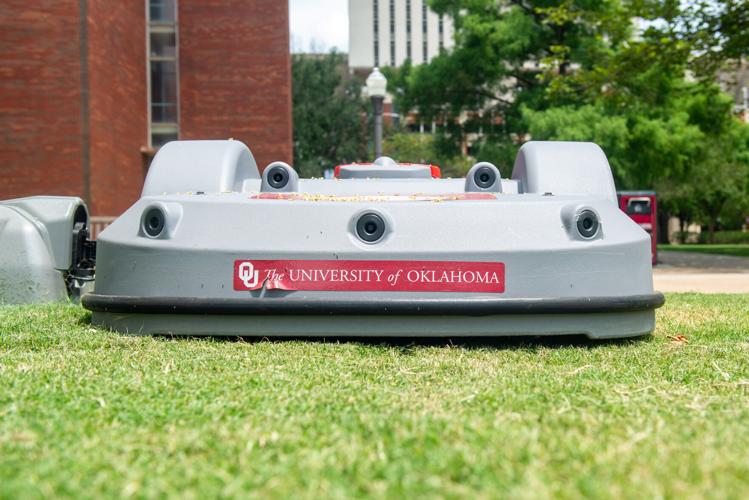


OU implemented two mowing robots across the Norman campus early July in an effort to enhance efficiency and contribute to the department’s sustainability goal.
Marissa Pierson, OU Facilities senior director, wrote in an email to OU Daily Wednesday that the robots, Barry and Bob, named after former football coaches Barry Switzer and Bob Stoops, are currently deployed on the North and South ovals and surrounding lawns. Bob focuses on the North Oval while Barry focuses on the South Oval.
Pierson wrote the mowers are a great addition to operations.
“There have been some kinks to work out with mapping,” Pierson wrote. “But they are performing well overall.”
OU grounds technician Tucker Craig said landscaping leadership was looking for a way to make mowing across campus more efficient.
“They were trying to figure out a way to keep the South Oval maintained and nice-looking at all times,” Craig said. “We’ve been trying them out here.”
According to Pierson, Barry and Bob operate day and night, with each robot mowing up to 15 acres per day. The robots use real-time kinematic GPS coordinates and navigation to understand their working area, Pierson wrote. As they continue to learn their zones, staff have been following Barry and Bob, but Pierson wrote the supervision is temporary and they will soon be able to operate on their own.
According to Craig, Barry and Bob are all-electric, relying on charging stations around campus. The mowers have about a 12-hour charge and drive back to their charging docks as soon as their battery gets low, he said.
The robots were purchased in late June and learned their mowing zones and travel paths in early July, according to Pierson. Pierson wrote the total upfront cost for the two robotic mowers, charging stations and additional support was approximately $53,000, which she believes was worth the investment.
“The mowers are expected to pay for themselves over time through lower fuel, maintenance and labor costs,” Pierson wrote. “Making them a cost-effective solution in the long run.”
If an issue occurs when the mowers operate unsupervised, an automatic message is sent to trained and authorized landscaping leadership, Pierson wrote.
Pierson wrote the robots operate safely around pedestrians and obstacles through their built-in sensors and geofencing technology. If the robots are lifted or tipped they shut down automatically, Pierson wrote.
“They’re like Roombas,” Craig said. “If they get close to you and they bump you, they’ll gently tap you and then turn around and go the other way.”
According to Pierson, the switch to robotic mowers is part of an effort to enhance efficiency. The robots allow the landscaping team to focus on more specialized tasks, Pierson wrote.
Pierson wrote the mowers also contribute to the department’s sustainability goal of lowering emissions due to their electric-powered nature.
The robots also have a life span of up to 15 years, which is longer than gas or diesel mowers. Pierson wrote she expects this will result in cost and labor savings.
“This allows us to use resources in other areas to help enhance Landscape operations,” Pierson wrote.
Craig said the robots are also better equipped to get into smaller places than large mowers.
“The robotic mowers are not replacing staff,” Pierson wrote. “They’re supporting them.”
This story was edited by Ana Barboza and Natalie Armour. Ryan Little and Gretchen Schultz copy edited this story.


