
"Oh, my God. I am going to die."
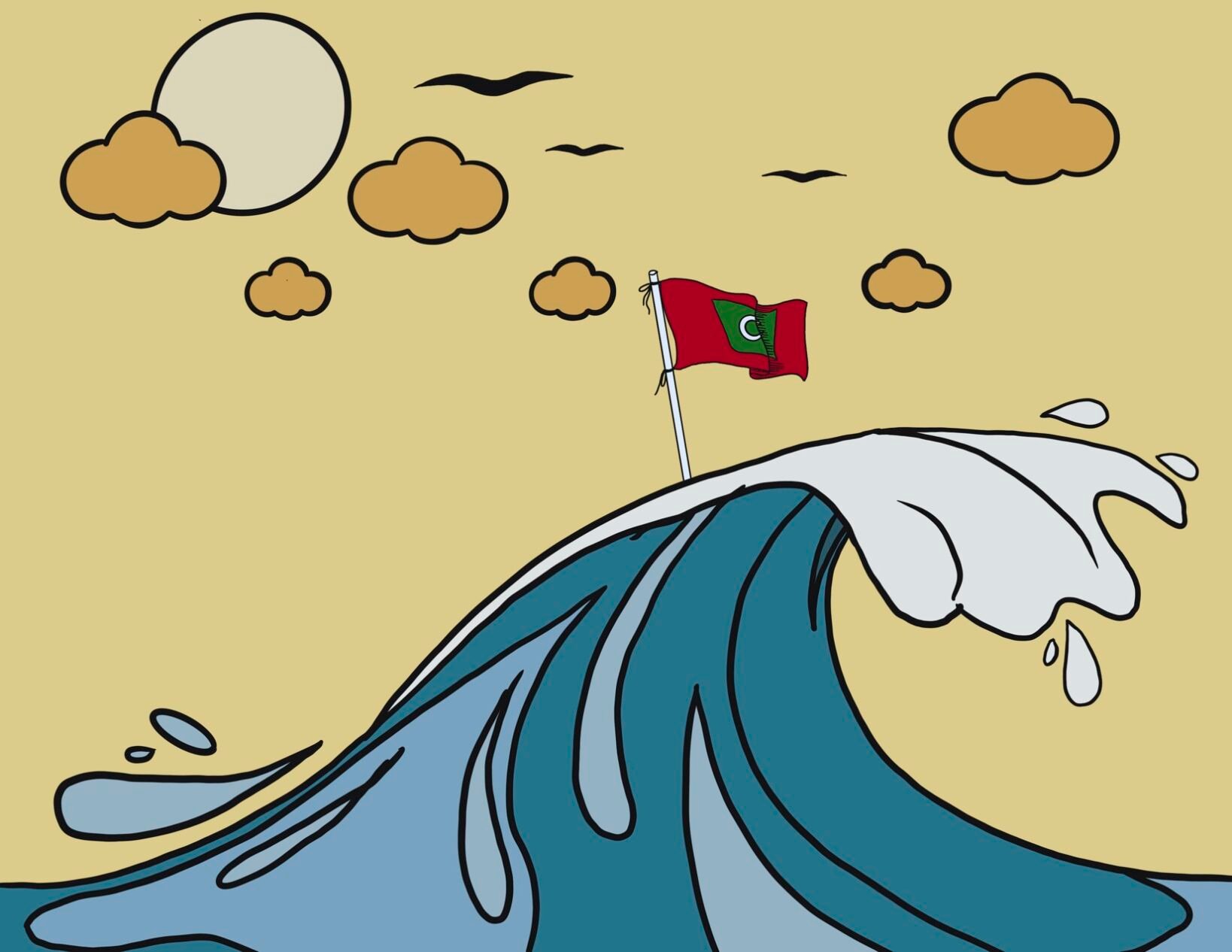
The thought ran through Nayifa Nihad's head as a tsunami struck the Maldives, the country she calls home.
The earthquake hit at 5:30 a.m. on Dec. 26, 2004, rumbling the small islands and ensuing chaos as residents had little experience with earthquakes.
"We weren't prepared for that to happen at all," Nihad, a professor of global perspectives at OU, said. "And then around 9:30 (a.m.), that was when the wave hit."
The Maldives, a collection of 1,196 coral islands located in the Indian Ocean, sits at an average 1.5 meters (4.92 feet) above sea level, making it the lowest country in the world.
The 2004 tsunami was one of the largest natural disasters to strike the Maldives to this day, displacing hundreds of residents, wiping away 14 islands and killing over 100 people, according to UNICEF.
"People (were) being washed away," Nihad said. "There just weren’t a lot of places people could get to for safety."
With no higher ground to escape to, all the residents could do was climb onto the nearest roof and watch as the streets flooded below. After the wave hit, Nihad said silence fell across the island as people looked at the damage and tried to find ways to reach out to their family.
Electricity was out on many of the islands while the wave passed, so people couldn’t contact loved ones to make sure they were OK, Nihad said.
"We didn’t know how many people died in the country or what to expect next," she said.
Now at OU, nearly 10,000 miles away from her home and family, Nihad said it is hard for her to watch from afar as the climate crisis in the Maldives worsens.
Nearly 19 years after the 2004 tsunami, the islands are at an even greater environmental risk. According to Virginia Tech University, as climate change causes sea levels to rise, so does the risk of catastrophic natural disasters, such as tsunamis.
"Sea level rise can significantly increase the tsunami hazard, which means that smaller tsunamis in the future can have the same adverse impacts as big tsunamis would today,” Robert Weiss, an associate professor in the Department of Geosciences at Virginia Tech, said.
Weiss and his partners conducted a study published in 2018 using computer-simulated tsunamis to show the effects of sea level increases. They simulated tsunamis in the Chinese territory of Macau, a coastal region located in South China, at current sea level and then with increases of 1.5 feet and three feet.
The results showed that sea levels rising dramatically increased the frequency of tsunami-induced flooding by 1.2 to 2.4 times for the 1.5-foot increase and from 1.5 to 4.7 times for the three-foot increase, according to the study.
For the Maldives, the prognosis is similar. The Maldives is projected to experience a 1.5-foot increase in sea levels and lose 77 percent of its land area by the end of the century. If sea levels rise by three feet, the Maldives could be almost completely inundated by about 2085, according to the Union of Concerned Scientists.
The 2004 tsunami was very traumatic, Nihad said. Hundreds of families were left without permanent housing and many residents began to fear the ocean, which is an integral part of Maldivian culture.
"If something like that were to happen now, … I can't even imagine," Nihad said.
Nihad came to OU in 2016 to earn an undergraduate degree in international studies and a master’s degree in global studies. Nihad is now an international admissions counselor and professor of global perspectives at OU, a first-year experience course that promotes an intercultural awareness that allows students to interact more effectively with others.
During her time at OU, Nihad has advocated for climate justice in the Maldives by giving guest lectures, participating in protests, speaking at rallies and creating the organization Eco Baddies to uplift the voices of climate activists across the globe.
Nihad formed Eco Baddies in 2020 to provide a platform for activists, particularly those of color, to talk about the issues that are important to them. Nihad also wanted to help activists communicate with one another and advocate while in-person meetings and protests were on hold due to the COVID-19 pandemic.
Nihad said the inspiration for Eco Baddies came after an organizer at a climate rally said, "Now, we are going to give a voice to the voiceless," before introducing her for her speech.
"I did not take it very well," she said. "We are not voiceless. We're just not heard."
Though Nihad said she is grateful to have opportunities to advocate for climate justice at OU, it’s difficult for her to be in the U.S. while her family and friends experience the consequences of climate change in the Maldives.
"I'm very privileged," Nihad said. "It's my guilt, not being home and understanding that I'm not the one who is experiencing the changes that are happening back home."
Raifa Riza, an international psychology student from the Maldives, said living in the U.S. makes her feel disconnected from the climate crisis back home.
"I am in a much more privileged position than they are, and if the changing of climate (remains) at the same pace as it is right now, within (the century), it would be so severe that Maldives actually sinks," Riza said.
As sea levels continue to rise, the Maldives, which is comprised of 99 percent water, actively faces the consequences. Coastal erosion, made worse by coastal development, is wearing away at the beaches at alarming rates, leading to receding beaches and collapsing palm trees, according to reporting by The New York Times.
Coral loss is another concerning consequence of climate change. In 2016, 60 percent of the Maldives coral reefs were affected by a bleaching event, many of which have not recovered since. In some parts of the Maldives, 90 percent of coral is believed to have been lost due to changing climate conditions such as rising sea water temperature.
Increases in water temperatures can cause corals to become stressed and expel the microscopic algae that live in their tissues, resulting in the corals turning white, "bleaching," and increasing their risk of starvation and disease, according to the Great Barrier Reef Foundation.
The Maldives is partially formed from and surrounded by coral, making it a crucial part of the country's ecosystem. Coral also provides natural sea defense against tsunamis as it can absorb an average of 97 percent of a wave's energy. Without healthy coral, the Maldives is at a greater risk of erosion and is more vulnerable to flooding and destruction caused by large waves, according to reporting by ABC News.
In 2019, Nihad received a grant from the Davis Projects for Peace Program, a global program that encourages young adults to develop innovative, community-centered and scalable responses to the world’s most pressing issues, to build an underwater coral garden on her local island of Felidhoo.
Through her project, Safeguarding the Future of the Maldives Islands, Nihad took broken, but living coral from the ocean and replanted it somewhere it would be safe and could grow. Nihad said she hopes to continue these efforts in the future.
Many activists and nongovernmental organizations are helping, Nihad said, but there is still a lot of work to be done.
When talking about the climate crisis, Nihad said women and minorities that live furthest from the capital of Malé are one of the communities most affected by climate change.
The Maldives is a centralized country, so the rural islands furthest from the capital don't see the benefits from development and are impacted by climate change the most, Riza said.
"The government doesn't really invest in a lot of local islands, so we don't have a lot of good infrastructure to help with the flooding," Riza said.
As the climate situation in the smaller, less developed islands becomes more severe, more people are relocating to Malé and the surrounding areas.
Malé is smaller than OU's Norman campus and houses nearly a fifth of the Maldivian population, approximately 103,693 people, four times greater than OU's Norman on-campus student population.
The country is so centralized that people also have to live in the capital to find jobs, Ismail Azman Abdulla, a sophomore creative media production major from Malé, said.
"Rent is high. People (are) living shoved together in a box,” Abdulla said. “It can be very tragic, especially with cases like fire."
The government has started expanding to nearby islands by building bridges and harbors, but development comes with an environmental cost. According to The Conversation, development of harbors and bridges near the shore can dramatically change how sand moves along the shoreline, potentially causing whole beaches to disappear and leading to more frequent flooding and damage to residents' homes.
The Maldives has also expanded airports, resorts and guesthouses to support its tourism industry, which is the largest sector of the country's economy, providing for more than 28 percent of gross domestic product and 60 percent of foreign exchange.
According to Human Rights Watch, trees and mangroves, which provide natural protection against flooding, are being bulldozed to make room for the development of airports and resorts. This results in increased flooding and the loss of resources that many locals, particularly women, rely on for their livelihoods.
"You can risk the environment for the economy and have it pay off somewhat, but the issue is that the economy is based off (of) the environment here," Abdulla said.
Abdulla said development and climate change are threatening the very thing that brings in tourists: beaches.
"A lot of people don't want to talk about the actual danger that we are facing because of the climate crisis due to the tourism industry," Nihad said. "So if they keep on talking about the Maldives (like it's) a nightmare, like the Maldives is sinking or the beaches are eroding or there aren't pretty corals to see any more, … there's a really big chance people won't want to come any more."
Being in the U.S., Nihad feels she has a responsibility to spread awareness about these issues. However, while people are generally growing more aware and sympathetic toward the climate crisis, Nihad said it hasn't always been the case.
When Nihad first came to OU, she was surprised to see that most people didn’t discuss climate change or know about its impacts, particularly to vulnerable countries.
"That was one of the biggest cultural shocks for me, just to see that (awareness of) global issues varies based on different countries and where you are in the world," Nihad said.
When she was a student at OU, she said climate change was very politicized, which often made it difficult to talk to others about the climate crisis in the Maldives. Nihad said she had instances of students denying the reality of climate change or telling her to go back to the country she came from.
"I do see people are more conscious about it now,” Nihad said. “But I do remember when I was a student, especially just coming out here, was very interesting because there were many climate deniers."
Nihad said she hopes people will continue to become more aware of the climate crisis and be thoughtful toward different issues occurring around the world.
"You don't have to experience something to start caring about it," Nihad said.
This story was edited by Alexia Aston, Karoline Leonard and Jazz Wolfe. Nikkie Aisha and Mary Ann Livingood copy edited this story.


