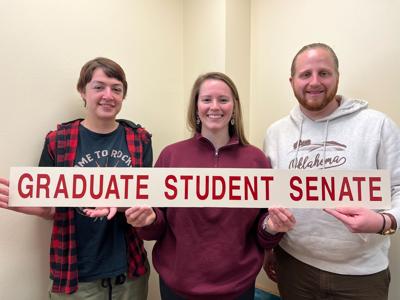

Leaders in the OU Graduate Student Senate are striving to bring the organization out of “oblivion” by creating better communication and bridging the gap between undergraduate and graduate students.
The GSS, like the Undergraduate Student Congress, is a legislative body which seeks to represent its student constituents interests and goals. Claire Burch was elected as GSS chair in April 2021 and she said one of her main goals as chair is to create more awareness of the senate’s place and purpose at OU.
Over the past couple years, the GSS has “fallen into oblivion,” Burch said, and she hopes to change that with outreach between the senate, the other branches and other student organizations.
She said the senate’s reach to build relationships with the OU administration and the graduate student population isn’t being used to its fullest extent. There is more they could be doing to help graduate students on campus, she said.
“I recognize that past chairs have been very insular, and we are working really hard to kind of break that culture,” Burch said. “There’s a pretty good chance that (grad students) don’t know that we exist currently. (For example), if they see articles that only mentions the Undergraduate Student Congress, that creates the perception that they don’t have a voice. They do.”
Burch and her vice chair, Rin Ferraro, said they are seeking to have a direct connection to administration through the graduate college to express graduate students’ interests. Departments don’t always offer the best way to voice concerns, so the senate acts as an alternative made of peers rather than staff or faculty, Burch said.
Ferraro said everyone on campus wants a voice, which is “especially difficult” for graduate students, and the senate hopes to fix this.
“Sometimes (graduate students are) forgotten in student affairs,” Ferraro said. “We’re considered students or staff, and usually whatever it is doesn’t benefit us. We’re one of the few universities that has a specific branch dedicated just for grad students, and it’s just a great opportunity for us to be heard and be part of different, like Student Affairs on campus.”
Ohio University, the University of Iowa and Texas Christian University offer a separate entity for graduate students within their student governments. Other universities, like the University of Texas, only have a “Graduate At-Large Representative” position in its legislative branch.
Burch said she has been approached with the question of why GSS — which has many of the same responsibilities as congress — is needed at OU, where only 22 percent of the student population are graduates. She said that, no matter the percentage, every voice deserves to be heard and considered in decision-making.
The senate represents graduate students so the undergraduates don’t have to, Burch said, since they don’t necessarily always understand what a graduate student’s experience looks like.
Ferraro said graduate students exist in a “weird role” where they’re both staff and students, with many of their peers being enrolled full-time while also teaching course sections.
“One of the things that we had to work with was how the graduate college … transfers (students’ classes and credits) from previous degrees,” Ferraro said. “If you’re in a Ph.D. program, you can get classes from your Master’s to count sometimes for your degree requirement, but they’re usually from a different university (or) another country. It’s a totally different system.”
Development and Philanthropy Committee Chair Jacob Matney said he thinks it’s important both bodies exist so the needs of their specific constituents are met with the full attention they deserve. He said he felt like specific needs would be overlooked in either body if it was the only one present.
“Undergraduates have a lot more things they have to deal with (and) much bigger, broader amounts of information they have to sort through,” Matney said. “A lot of the issues that we talked about in the senate tend to be things that are about funding for going to conferences, for research grants (and other) important things that could apply to undergraduates, but more so apply to the graduate school.”
Ways and Means Committee Chair Lexi Walton said she and her committee manage research and creative activities grants, the conference and travel grant allocation. She also serves in an oversight role for the SGA Budgetary Committee.
Unlike the congress Ways and Means Committee, which is responsible for allocating the SGA budget out, Walton and her committee members are responsible for awarding grants to graduate students who are in departments that are in “good standing” with the senate.
Burch said a “pretty significant part” of a graduate students’ career is finding money to travel or complete components of their research which may elicit costs beyond their departments’ funding.
“(GSS offers) this unique financial support to graduate students that’s accessible in both the fall and spring semester for the various conferences that they might be attending or the research that they’re doing,” Burch said.
To allocate funding for grants, Walton said she and her committee members grade applications in teams of two and focus on criteria such as formatting and length, signature expectations, the statement of importance and the budget justification.
Walton wrote that in spring 2022, applicants who scored a 90 or higher received the full amount requested up to $750, applicants who scored 80-89 received 80 percent of their requested funding, 70-79 received 70 percent, 60-69 received 60 percent and scores less than 60 received 50 percent.
She also wrote that cut-offs change depending on how many applicants they have per semester and all applicants were provided with feedback specifying areas where they lost points, so they could continue to improve their grant writing skills.
Walton said the GSS seeks to mimic real life to help graduate students understand the expectations for future projects or research.
“It’s a very, very specific process, (and) you have to have all those necessary pieces,” Walton said. “Formatting matters (and) language matters. We’re trying to help graduate students get experience in that while, at the same time, not penalizing as harshly. We try to make sure that every applicant gets at least a little bit of something.”
On Feb. 15, Burch presented a bill in front of congress to make Walton’s position salaried to recognize the preparation and writing that goes into the grant application process. Walton said her position is one GSS struggles to fill because of its workload.
For example, Walton said the grant review session this semester was six hours long, which is “pretty short” compared to past semesters.
“I think that was the impetus behind turning (my position) into a funded one — to help encourage graduate students to step into this role,” Walton said. “It’s a great experience, (and) I love my committee, but it’s a lot of organization, a lot of communication (and) a lot of leadership. People just don’t have time, (and) they’re not sure what the position entails.”
The senate also has an International Student Affairs Committee, unlike congress, which addresses any issues concerning international graduate students. Chair Olawale Alo said being able to provide his peers voices in senate decisions has been “a great experience.”
“I have learned so much, (and I’ve had) the opportunity to see the totality of the university from different perspectives, not just from (domestic) students,” Alo said. “It’s really been a great experience and one that is enriching my own experience.”
Alo said domestic and international graduate students have specific needs that need to be met during their time in college, and the senate creates a “real opportunity” for students to be able to have a say in their graduate experience.
“The truth is, being able to really have a classification that identifies specifically the graduate student is really very important,” Alo said. “Graduate students feel detached from the general student body (and) disconnected from anything that’s run (only) by undergraduates. Now, when you have a body that is specifically geared towards graduate students, you feel (you) belong, (are) appreciated and wanted.”
Burch said she wants to ensure graduate students have a concrete place at OU and are represented in any and every space. A part of the university’s strategic plan addresses building OU’s graduate student population, which she hopes to build off of for this purpose.
“I saw GSS (as a place) where, if we had leaders who wanted open lines of communication, then we could make real change on campus if we put our minds to it,” Burch said. “The strategic plan … presented the perfect time to get GSS involved in conversations to make sure there was actually a graduate student voice being heard.”


