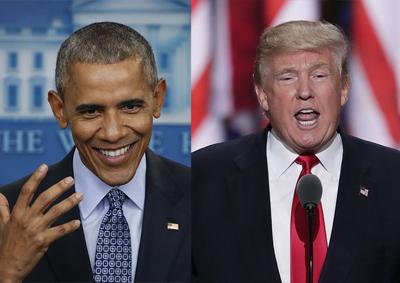

After Donald Trump’s victory in the November presidential election, Abbey Rutherford had a wake-up call. The OU political science and environmental sustainability sophomore decided she needed to make action part of her daily life — including this weekend when she goes to Washington D.C. for Trump’s inauguration.
Rutherford and other members of the OU community said they will be in the District of Columbia this weekend to protest at the inauguration or to march in solidarity for women’s rights in the Women’s March on Washington. Trump will be inaugurated on Jan. 20 in a ceremony that starts at 9:30 a.m. ET, and the march will take place the next day.
Trump has a track record for his comments marginalizing women: During the election, audio from a 2005 recording emerged where he talked about "(grabbing women) by the p***y,” and insiders on his show, “The Apprentice,” said he repeatedly demeaned women.
Rutherford said she will be participating in a protest called ‘Not My President’ on Jan. 20 and in the march Saturday.
“Especially with MLK Day behind us, I think that (the protest is) going to be historic, and I think that it really is going to make me personally feel better about the changes happening in our country,” Rutherford said.
Rilla Askew, English professor at OU, will also attend the Women’s March on Washington to show support for issues involving human rights and the environment.
The march aims to empower and uplift all people from all areas on a variety of issues. Unifying in light of many issues is important, Askew said.
“The unity of Black Lives Matter, the unity of Reproductive Justice, the unity of LGBTQ issues, especially health care, which affects every American, the environment," Askew said. "And I care about all of those issues, so that is why I am going."
Askew said she has been active in protests and demonstrations for four or five decades. She said she has seen activism make a difference, but there is still much more to do.
“The fundamental threat of racism, the fundamental threat of anti-LGBTQ, the fundamental threat of misogyny, which we greatly saw in this last election — all of those things are still here. So we are calling it out,” Askew said.
Corey Abernathy, political science junior who will participate in the march, said he has always been an outspoken critic of Trump on Facebook, but he feels being vocal on social media has had little effect other than creating a rift between him and friends who are Trump supporters.
Abernathy, who ran for OU Student Government Association president during the fall semester, wants to participate in the march to show support for women, following Trump’s legacy of targeting them, he said.
“I just think it’s really important to get behind that movement and show my commitment to women and their rights," Abernathy said. "And I think men joining in that movement is super important. Since I’ve been critical of Trump, it’s really important to take action in that and not just continue posting. Posting is easy, it just takes a couple minutes.”
Abbey Taylor, women’s and gender studies and public affairs administration senior, is also attending the march. However, she said her attendance is not in protest of the inauguration. The trip to the District is a birthday gift from her dad. She said she initially planned to see Hillary Clinton's inauguration and visit a few law schools during the trip.
After Donald Trump was elected president, Taylor decided that being in the District on inauguration weekend was still important to her.
“I don’t want to miss this. I think I would really regret it if I wasn’t there,” Taylor said.
The organizers of the Women’s March on Washington have made it clear that the demonstration is not a protest. This is one of the reasons Taylor said she is making the choice to attend the event instead of a protest of Trump’s inauguration.
“I like that (the Women’s March on Washinton) is happening the day after the inauguration. I think that is really meaningful because we get to say, 'We’re here. We are women, we are minorities, we are underprivileged,'" Taylor said.
Similar to Rutherford, Trump's election made Taylor think hard about things, but she said that now she knows that advocacy is where her passion lies.
“It took me a while (after the election) to find my place again, because I do want to go to law school and I would love to be active in government in some way, shape or form," Taylor said. "With an administration and a government that doesn’t value me as a college kid, as a woman, as opposition, I was scared about where I would be.”
A quote from "Hamilton: An American Musical" helped remind Taylor who she is and what she stands for: "This is not a moment, it’s the movement."
Supriya Sridhar, Chloe Moores and Kayla Branch contributed to this report.


