




Editor's note: this story was updated at 9:14 a.m. May 15 to include a statement from OU Marketing Communications
OU Faculty Senate authored a resolution this week addressing Senate Bill 244, a failed bill that would have required the university to develop an American Civic Thought and Leadership program.
The bill, authored by Sen. Adam Pugh (R-Edmond), Sen. Julie Daniels (R-Bartlesville) and Rep. Mark Lepak (R-Claremore), missed the April deadline for consideration in both the House of Representatives and Senate. It could still be considered again during the next legislative session beginning early February 2026.
SB 244 was first filed in February alongside Senate Bill 267 authored by Daniels. Similarly to SB 244, SB 267 proposes the establishment of a school of American Civic Thought and Leadership as an academic unit on OU’s Norman campus. The two bills have since been merged into the current SB 244.
In an email shared with the Daily sent to all Gaylord College faculty and Dean Andrea Miller on Monday, John Schmeltzer, a journalism professor and Faculty Senate member, wrote that though SB 244 missed the deadline for consideration in this legislative session, the Faculty Senate addressed the bill in a resolution regarding political neutrality on campus.
Schmeltzer wrote that the resolution was created to combat the bill before it might return to the legislature in February 2026.
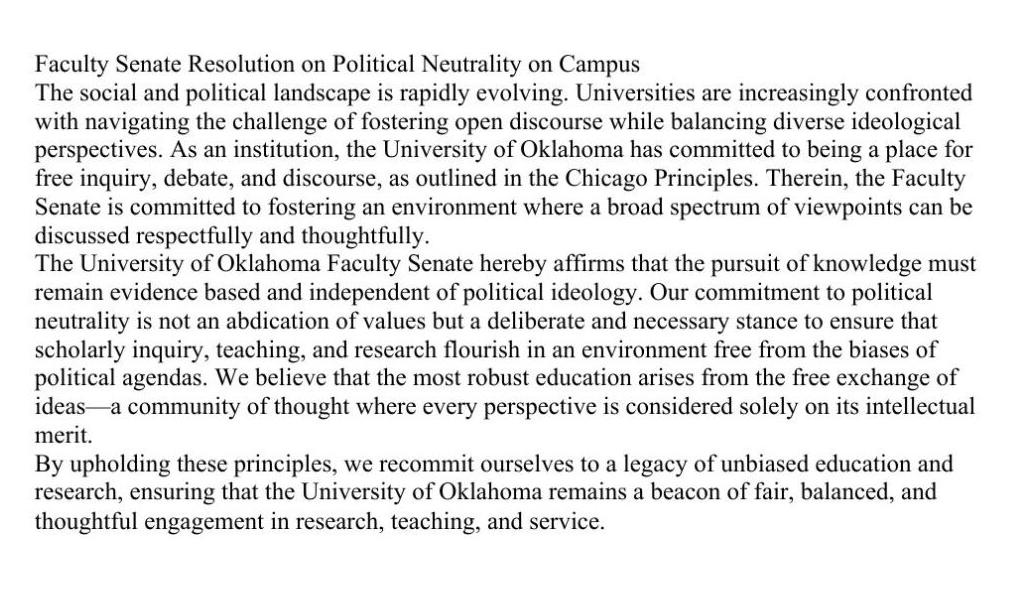
“The social and political landscape is rapidly evolving,” the resolution reads. “Universities are increasingly confronted with navigating the challenge of fostering open discourse while balancing diverse ideological perspectives. As an institution, the University of Oklahoma has committed to being a place for free inquiry, debate, and discourse, as outlined in the Chicago Principles. Therein, the Faculty Senate is committed to fostering an environment where a broad spectrum of viewpoints can be discussed respectfully and thoughtfully.”
In 2022, the Faculty Senate passed a resolution adopting the Chicago Principles, a set of guiding principles developed by the University of Chicago in 2014 protecting free speech and academic freedom on college campuses. The Chicago Principles have since been adopted by numerous other universities across the nation.
The resolution authored this week continues by affirming, “that the pursuit of knowledge must remain evidence based and independent of political ideology. Our commitment to political neutrality is not an abdication of values but a deliberate and necessary stance to ensure that scholarly inquiry, teaching and research flourish in an environment free from the biases of political agendas. We believe that the most robust education arises from the free exchange of ideas — a community of thought where every perspective is considered solely on its intellectual merit.
“By upholding these principles, we recommit ourselves to a legacy of unbiased education and research,” the resolution concludes. “Ensuring that the University of Oklahoma remains a beacon of fair, balanced, and thoughtful engagement in research, teaching, and service.”
According to Schmeltzer, the Chicago Principles have been cited in preventing similar legislation from affecting OU and he hopes it will assist leaders like Chancellor of the Oklahoma State System of Higher Education Sean Burrage, OU President Joseph Harroz Jr. and Vice President of Executive Affairs Hollye Hunt avoid future interference.
Schmeltzer mentioned the bill’s similarities with Texas’ Senate Bill 37, a proposal left pending in committee in Austin that would have allowed the state to evaluate the accuracy, relevancy and necessity of university curriculum and significantly limit how Texas public universities teach students about history, race and inequality.
Schmeltzer said bills like SB 244 will have similar effects.
“The resolution is in response to attempts spanning several years by Oklahoma State Sen. Julie Daniels to force OU to adopt hiring practices that would compel the university to hire people of certain political ideology,” Schmeltzer wrote in the email. “This is similar to current efforts by legislators in Texas (SB-37) to influence course content and curriculum … The administration anticipates she will try again, especially if Texas legislatures are successful this year with their proposal.”
When OU Daily asked OU President Joseph Harroz Jr. about the bill in April, Harroz said he was aware of the bill but was focusing on other issues.
“I know it’s there, I just haven’t had the chance to focus on it,” Harroz said in April.
OU Marketing and Communications told OU Daily in an email Wednesday the university is monitoring developing legislation.
"We continue to monitor legislation and regularly engage with policymakers on matters impacting the University," OU Marketing and Communications wrote.
OU Daily reached out to Daniels for comment on the bill and pushback from the university but did not receive a response by the time of publication.
What is the American Civic Thought and Leadership program?
The goal of the proposed program is to educate students in “principles, ideals and institutions of the American political order” and help ensure OU serves as “a robust marketplace of ideas” for students and faculty, according to SB 244.
SB 244 is specific to OU and does not apply to other public institutions in Oklahoma.
The purpose of the program, under SB 244, would have been to:
• Educate students in the principles, ideals and institutions of the American political order including the character traits and durable habits necessary to sustain that order.
• Educate students in the philosophical foundations of responsible leadership and informed citizenship.
• Promote and provide programming related to civic education, engagement and discourse.
• Enhance education in the fields of political thought and science, American history and government, free market economics, and other related fields as appropriate, with a focus on the foundations of Western and American civilization including its books, the rights and responsibilities of American citizenship, fundamental democratic principles and mores, and the ways in which those principles and mores are expressed in and through mediating institutions at the federal, state, and local levels.
• Provide viewpoint and ideologically diverse resources to students, faculty, state government agencies and actors, educators, and the general public regarding civic affairs.
• Assist in ensuring that OU serves as a robust marketplace of ideas for all students and faculty.
The bill would have instructed the program to develop an undergraduate American institutions and civic knowledge course in anticipation of a future mandate requiring all OU students to complete such a course. The program would have offered general education and honors courses and concurrent enrollment.
A similar bill was filed last legislative session by Pugh and former Rep. Jon Echols (R-Oklahoma City). That bill was amended to move the school to the University of Central Oklahoma campus, but later died in committee.
This story was edited by Ana Barboza. Sophie Hemker copy edited this story.


