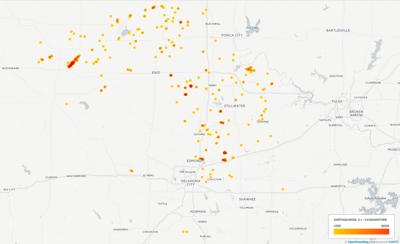

Oklahoma’s earthquake activity in 2016 is slowing down from the year prior and will likely continue to slow down next year, Oklahoma Geological Survey director Jeremy Boak said.
At the beginning of 2016, Boak predicted a 5.0 magnitude quake would occur within the year. However, he did not expect three of them, he said.
This year, there was a 5.1 magnitude quake Feb. 13 in Major County, a 5.8 magnitude quake Sept. 3 in Pawnee County and a 5.0 magnitude quake Nov. 6 in Payne County, for which Oklahoma Gov. Mary Fallin issued a State of Emergency.
Last year, there were 29 quakes with magnitudes of 4.0 or greater, but there was not a single magnitude 5.0 quake, according to data from the OGS.
Boak said he still expects occasional 4.0 magnitude quakes in 2017, but is anticipating fewer than 20 of them.
Actions have been taken by the Oklahoma Corporation Commission throughout the year to shut down disposal wells, where wastewater is injected into the earth, causing pressure on fault lines and inducing earthquakes, Boak said.
“If you say that the injection of wastewater caused the rise in earthquakes … you have to accept that a major drop in injection would be expected to cause a drop in seismicity, and that’s exactly what we see,” he said.
For every one barrel of oil produced, around ten to 15 barrels of wastewater are produced, and each barrel is 42 gallons, Boak said.
The Oklahoma Corporation Commission seemed to be scrambling when the seismicity became more frequent, he said.
“They didn’t have the information they needed to precisely say, ‘This is how we can manage this.’ And they also weren’t certain they had the authority to regulate on the basis of earthquakes — the fundamental purpose of the program was to protect groundwater,” Boak said.
Around 80 disposal wells have been shut-in this year alone, disallowing companies from injecting wastewater into the wells, OCC Public Information Office spokesperson Matt Skinner said.
“Most of those shut-ins occurred this year, but some date back to 2013,” he said.
Skinner said the OCC relies on the OGS and United States Geological Survey for data and feedback to gauge the effectiveness of their actions and sees the OCC continuing on this path.
“There’s almost no doubt you’re going to see more shut-ins, you are definitely going to see more well volume cutbacks,” Skinner said.
The Arbuckle formation is the one that has been linked to the earthquakes, where the OCC has currently reduced its disposals by 800,000 barrels per day, Skinner said.
In 2014, there were 585 earthquakes at a 3.0 or larger, and 907 in 2015. There have been 591 in 2016, according to the OGS website.
“We might be over 650, but not much over 650 by the end of the year, unless something changes,” he said.
Out of the 591 quakes at magnitudes 3.0 or larger this year, 165 have been a 3.5 or larger, according to OGS data.
It is not the cumulative amount of injection, but the rate of injection which needs to slow down to make a difference, Boak said.
“It’s not easy to prove these things, but there’s a huge amount of science behind it — it’s just going to require really careful preparation and a lot of knowledge to see what’s right and what’s wrong,” he said.
Skinner said the Pawnee-Cushing area is on OCC's top-priority list.
“We have a 15,000 square mile area of interest, which encompasses the strong earthquake activity — we have taken action everywhere within that area of interest,” he said.
The OCC is working on a new approach to the area, Skinner said.
“As we look to next year, what you’re going to be seeing are more focused actions on a given area within that 15,000 square mile area,” he said.
Skinner said out of the hundreds of companies who have had to comply with the disposal well regulations, only two have been a challenge in the past. As of recent, all companies have complied with the regulations and have been cooperative in moving forward, he said.


