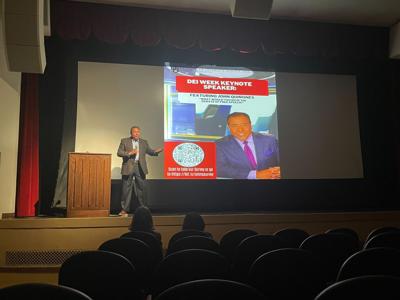

OU’s Office of Diversity, Equity and Inclusion hosted keynote speaker and star of “What Would You Do” John Quiñones Monday in the Meacham Auditorium as part of their third annual “DEI Week” to discuss “The Debate of Free Speech.”
During his talk, Quiñones said he uses his TV show that uses hidden cameras to observe people and the problems they need to solve in their daily lives and shares them with the world.
“‘What Would You Do’ is all about that,” Quiñones said. “It's all about confronting racism and discrimination, bullying. As a journalist and correspondent at ABC all these years, I've been blessed with the opportunity to shine a light on a lot of things that some people don't want to talk about and don't want to see on television. That's the beauty of journalism, if you're talking about free speech.”
Quiñones said the inspiration for his show came from people like himself who experience “What Would You Do moments” in their everyday life.
“After all these years of doing the show, I have found that, time and again, the people who step up and come to the rescue are people who themselves are the targets of racism, bullying, gay-bashing, spousal abuse,” Quiñones said. “They sound the alarm because they know what it's like. They know how painful it can be (because) they've been there. That's why I think, in many ways, I feel like I was destined to do this kind of show. I was destined to come up with the idea for the show, because of where I come from and the world that I grew up in, and the hurdles that I had to cross to get to ABC News.”
In his speech, Quiñones said he grew up in San Antonio in a poor family. He worked as a migrant farmer and didn't learn English until he attended school at 6 years old. During his school days, instead of encouraging him to pursue higher education, Quiñones said teachers would direct him towards manual labor jobs. Even so, Quiñones kept pursuing education and his dream of being a broadcast journalist.
“My message to students is ‘never give up,’” Quiñones said. “Don't ever think that it’s not going to happen because there's always a way. There's always a way.”
At his first job out of college as a Chicago television reporter, Quiñones did a story where he went undercover as a Mexican immigrant crossing the border to America to reveal why they crossed the border and the difficulties they faced. To localize the story, Quiñones said he also went into a Chicago restaurant where the owner had not paid seven undocumented Mexican individuals working for him for 17 weeks and threatened to have them deported if they raised the issue.
When the story aired, Quiñones said the U.S. government shut down the restaurant, arrested the owner, paid the individuals and provided them with temporary U.S. visas.
“Those are the kinds of stories that, as a Latino reporter, I can tell better than anyone,” Quiñones said. “We've talked about the importance of diversity, inclusion. … I call journalism the candle in the darkness. … The journalist, he or she, is the person with a little candle, a little flashlight. They can shine it on the darkest corners of the room to illuminate injustice, to illuminate corruption, to illuminate human rights violations, civil rights violations. When journalism is done right, and we're not doing it right all the time these days, but when it's done right, those are the kinds of stories that we should be telling.”
To end his speech, Quiñones told a story that happened while filming “What Would You Do” where an actor dressed as a drunken homeless man collapsed in front of a busy sidewalk. No one stopped to help, except another homeless woman, Linda Hamilton.
“Who better to teach that lesson than someone who has walked in the shoes of a homeless (person),” Quiñones said. “Tonight, I leave you with that message. The next time you witness injustice, you witness something wrong, or the little voice in the back of your head says ‘do something,’ remember the words and the actions of Linda Hamilton. This woman who was homeless, she had suffered a stroke, and she stopped to help a man who was down, a stranger. ... She did it, because as my dear mother, Maria, would say, her corazón, her heart, told her it was the right thing to do.”


