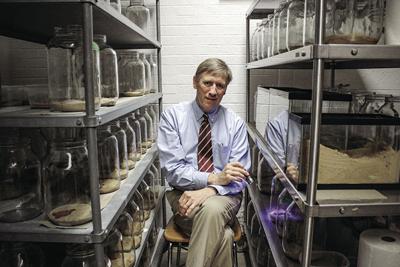

Doug Gaffin adeptly holds a squirming scorpion by its stinger as it glows fluorescent in his darkened office. He’s been stung eight or nine times in his life, but he’s still in search of what makes these creatures tick.
Gaffin, the newly named interim Honors College dean and a staple of OU biology for over 20,000 students, is continually driven to learn by something beyond himself.
“I’d like to say it’s just for the love of the students...but it’s more the love of the question, the chase — the pursuit of the unknown,” Gaffin said.
At OU, Gaffin has found a haven for his scorpion research. But the academic has also found a home, a place to grow and lead, which he will continue to do when he replaces Honors College Dean David Ray in December.
When Gaffin arrived at OU in 1995 from Oregon, he had no connection to the state or the university. His future wife followed him a year and a half later, and the two were married in OU’s Jacobson Hall and lived in Couch Center as faculty-in-residence for three years afterward.
“President Boren always used to say it was on our honeymoon we moved into the dorms,” Gaffin said. “That’s not actually accurate. There were several months in between, but the way he tells it is better, so I’ve come to believe that as well.”
Today, Gaffin and his wife, Mariëlle Hoefnagels, an associate professor of biology and microbiology, live just two blocks north of campus. The two have watched the university transform under Boren’s administration, and have seen their lives grow more and more entwined in every part of the community.
“Everything we do is somehow related to the university,” Hoefnagels said.
'Cheerleader and a champion'
Gaffin, an athlete since his younger days, rides his bike each morning to his office in Richards Hall. One building away in George Lynn Cross Hall is Hoefnagels, who said the two have everything they need in walking or biking distance — they fill their shared car with gas once every month and a half.
Sometimes, when the two do leave Norman, they’ll leave their home in a student’s care. Gaffin said it’s the university’s “continual influx of new and great students” that makes OU home to him in the first place.
“If students can engage in this passion together, it’s all science and it’s all biology and there’s no right answer — the answer’s out there, but we have to find it,” Gaffin said. “And if I can train them a little bit into that world, into the culture of science and how we go about doing this...once they get a few successes, then it’s really quite exhilarating.”
Kendall Hughes, a neuromedicine senior and member of Gaffin’s scorpion lab for the past three years, said the professor is consistently invested in student success.
“I think he’s a really good cheerleader and a champion for his students and making sure that they’re successful in all their pursuits,” Hughes said. “I also think that his passion for his research is infectious. If you talk to him about your research, you can just feel how excited and enthralled he is about scorpions and scorpion navigation and everything. It’s incredible.”
The scorpion lab is where Gaffin gets to focus on his main passion. He leads a team of seven students in their own research pursuits, but is also able to focus on his research in insect and animal navigation.
For years he also taught students zoology basics, leading lecture classes with upward of 500 students, a daunting figure when those class sizes were larger than the populations of some students’ hometowns, Gaffin said. The challenge never extinguished his love for his work.
“I do love teaching, and I do love trying to communicate it in a way where light bulbs go off...if I can help students get there, it’s just really exciting for me...but, it’s hard — you have to want to do that,” Gaffin said. “You’ve got to like to do that. I mean, I figure out better ways to teach all the time so that it doesn’t become stale or you’re not just getting into a rut.”
Gaffin chooses his best students to participate in his lab. There aren’t many other labs worldwide that focus on scorpion research (Gaffin pointed to one in Germany), and in his, students are able to collaborate and receive unique hands-on experience, Hughes said.
“He pushes his students to learn,” Hughes said. “He expects a lot out of them, of course, but he really cultivates learning, and I think that’s his legacy at OU.”
'Nobody’s not important enough'
Hoefnagels, more naturally reserved than Gaffin, said her husband’s teaching style and interactions with students have helped her grow as a professor and member of the community.
“For many students, there’s a real sense of trust there that we’re approachable, we’re available and that we’ll do what they need, whether it’s inside the classroom or outside the classroom,” Hoefnagels said. “I learned that from Doug.”
Large class sizes are no longer a barrier for Gaffin, who now teaches much smaller groups in the Honors College.
Gaffin admits that at first, he was “really bad” at managing those more focused class environments after routinely teaching up to 1,000 students a day. Talking with Ray gave him the strategy he needed to move forward effectively, he said.
“I asked (Ray) what his secret was, and he said, ‘All you’ve got to do is give them something interesting to think about and get out of their way,’” Gaffin said. “And that’s what I’ve been trying to do is trying to simulate with something engaging that really captures their attention, and then try to get away from them and let them go.”
As Ray retires and Gaffin steps into his role in December, Gaffin said he finds himself in tough shoes to fill.
“He’s upped the intellectual vitality of the Honors College in a really major way, and I think that’s exactly what President Boren envisioned with the Honors College,” Gaffin said. “So it scares the pants off of me to have to follow Dean Ray because he’s so beloved by students, faculty and staff.”
Gaffin said he will take advantage of all the time he has left with Ray, taking notes and seeking advice from his predecessor. He has a list of about 40 questions to ask Ray; he’s trying to soak it all in so he can lead students and maintain the national reputation of the college.
This isn’t the first time Gaffin will lead an OU college. From 2002 to 2012, he served as dean of the University College, a position that challenged him but ultimately gave him the tools he needed to prepare for this job, he said.
“I started as University College dean without any experience at all, administratively,” Gaffin said. “I really learned from scratch — I started asking people questions and reading books. I made lots of mistakes…you just learn.”
No matter what environment he’s in, Hoefnagels said it’s his attention to students that makes him a teacher and leader worth emulating.
“He’s just really good with people. Everybody gets a fair shake, everybody gets the attention that they deserve. Nobody’s not important enough — everybody’s important,” Hoefnagels said. “He’s just really good at that, at making everybody feel important.”
Any success the couple has found at the university is based on the support of their respective departments, said Hoefnagels, who works as a textbook author as well as a professor.
“You can work hard at stuff and if the administration doesn’t support you in that, then you’re not going to be able to continue to do it,” Hoefnagels said. “And that we’ve been allowed to develop according to our talents and not according to some pre-defined notion of what faculty are supposed to do and how they’re supposed to do it — that’s incredible.”
'It’s just a passion'
Gaffin’s talent for teaching and engaging with students extends beyond the classroom — sometimes, it reaches the volleyball court. Once a college club volleyball player at Oregon State University, Gaffin said he’s still able to beat most students on the court, and he mentors students in the game to create competitive players.
“I just love to dominate them — I still can too. There’s a few that can beat me, but most can’t,” Gaffin said. “I was always an athlete, so it’s not really work for me.”
Gaffin and Hoefnagels also attend OU sporting events and students’ fine arts recitals or performances. In 2014, both were namesakes at OU’s Camp Crimson.
They’ve accompanied students on various study abroad trips. Hughes said she met Gaffin and learned about his research during a trip to Arezzo, Italy.
The university feels like a home, Gaffin said — not just because of the students, but because of the spirit of stewardship and care the community has for OU.
When Gaffin was University College dean, David Boren and Molly Shi Boren walked through the new Wagner Hall and pointed out changes they wanted made — down to the artwork that would decorate the building.
“No place has a president and first lady that (are) hands-on like this,” Gaffin said. ”It’s unbelievable their attention to detail, all the way down to where a vase should be put on the bookshelf in Wagner Hall...it’s just that sort of spirit that they have. They don’t do it as just a rubber stamp. They put themselves into this.”
After over two decades of receiving countless awards and honors like the David Ross Boyd Professorship, of pouring himself into research, of teaching and exploration, Gaffin shows no signs of slowing down — there’s still so much for him to know.
As he teaches, he learns. He’s kept up with evolving technologies, teaching himself to code during a sabbatical after realizing it could be helpful in his scorpion research.
While he won’t continue teaching during the spring 2018 semester so he can focus on his duties as dean, Gaffin said he won’t necessarily step back from his research.
“I’ve got some things near and dear to my heart...you just don’t turn that off,” Gaffin said. “I think that’s part of modeling scholarship, to keep yourself in that...I’ll certainly be intellectually engaged.”
Gaffin never truly plans to let go of his scholarly pursuits, even post-retirement.
“Even after I retire, I don’t think you really ever retire as an academic because we’re kind of so locked into our pursuits,” Gaffin said. ”We’ve been thinking about them and writing about this for so long that it’s hard to walk away from it...to me, it’s not really work.
“It’s just a passion.”


