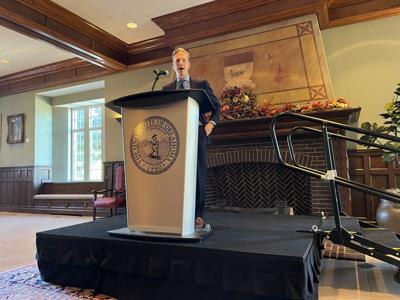

OU hosted a constitutional scholar to discuss free speech in the age of digital media as part of OU’s Free Speech Week celebration on Tuesday.
Noah Feldman, a Harvard law professor, author and constitutional scholar, spoke in the Oklahoma Memorial Union's Beaird Lounge Tuesday afternoon. He talked about social media’s role in social and political debates and if this changes the definition of free speech.
The discussion opened with remarks from OU President Joseph Harroz Jr., who talked about the purpose and importance of Free Speech Week, emphasizing the necessity of considering various perspectives when addressing issues like diversity, equity and inclusion.
“We have to realize and recognize that they’re not just separate,” Harroz said. “They coexist in ways that are critical and essential.”
Feldman began his speech by contextualizing the significance of social media and how it plays into the greater conversation of free speech.
He said the majority of the audience has never lived in a time without social media, and thus they have no experience living in a time where the average person would never encounter anyone actively trying to limit free speech.
Once social media came into effect, Feldman said, society existed in a world where platforms mediate what people say when others view their content.
He said the fundamental problem between social media and free speech is recognizing who has free speech and who is a threat to free speech.
Feldman said social media platforms have the ability to choose which voices to amplify.
He used the example of rapper Kanye West, who was locked out of his social media last week for breaking the terms and services of Instagram and Twitter with an antisemitic post. To some, banning users from social media may seem like a violation of free speech, Feldman said, but platforms have the ability to enforce their rules.
“That’s what a social media platform is. It’s a platform that intermediates speakers by choosing who … gets to hear what speech was said by which person,” Feldman said.
Feldman spoke about the tension between social media and free speech being addressed in the legal system.
“The Supreme Court is going to have to decide … who's talking? And it's going to have to decide that in the light of the question, ‘Who is blocking the speech?’” Feldman said.
Feldman said there is a clash between two different conceptions of free speech where users either feel their free speech is limited by companies or that companies are trying to enforce terms of services for the protection of their users.
Feldman encouraged students to share their thoughts as they are the only generation to grow up in an age of digital media.
“You guys are the only ones in the room, in the country, in the world, who really know what it’s like to treat social media as your primary space for self-expression … so, you need to think about this hard … because it’s going to affect your lives much more powerfully and significantly than it affects (older generations),” Feldman said.
A student in the audience asked Feldman a question concerning Section 230 of the Communication Decency Act, which functions as a special protection for internet service providers. The student asked whether the law should be changed so social media companies who violate free speech principles can be held liable for content on their platforms.
Feldman said it is something the U.S. Supreme Court is reexamining.
He said the act raises the question of whether society wants platforms to be in the business of picking and choosing between different forms of speech.
Another audience member asked if media companies possess a different obligation to free speech than other private companies.
Feldman said he believes it is reasonable to assume social media platforms have special responsibilities to free speech because they benefit from government legislation like Section 230, but also because the digital space has become a primary place of conversation for humanity.
“It is reasonable to say (platforms) have special responsibilities to free speech …by virtue of the fact that they have become the space where speech happens,” Feldman said. “What happens on their platform can affect the world.”
Feldman said he believes it’s critical to have free speech, discern who is speaking, and understand free speech in an age of evolving media. He also emphasized the importance of productive and open communication.
“In a world that’s too polarized, we need to be able to disagree in substance but agree on a method for talking things over, deliberating, voting about the outcomes, counting the votes and believing whatever happened in reality is actually what happened in reality.”


