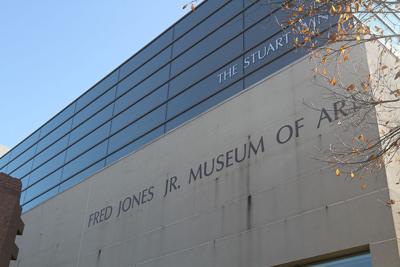
The Fred Jones Jr. Museum of Art is currently undergoing a complete reinstallation of its permanent collection.
According to an Instagram post from the museum, the Adkins and Sandor galleries both closed July 8, and will reopen Oct. 8. Kaylee Kain, director of communications at the museum, said all galleries on the first floor except the Weitzenhoffer French Impressionism Collection will close Aug 1.
By the beginning of August, Kain said, the only exhibits still available for public viewing will be The Weitzenhoffer French Impressionism Collection, the Sandy Bell gallery and the rotating exhibition, "Between the Isms”.
“The museum hasn’t undergone a reinstallation in over ten years, so this is a major undertaking,” Kain said. “We are not necessarily just rotating art and exchanging them for things that are on display, we’re also looking into in-gallery cosmetic updates, such as wayfinding and updating some of the color schemes. I don’t want to give too much away because I think it will be a really great opening for everyone to see in October.”
Kain said they are reinstalling their entire permanent collection, which consists of about 20,000 objects. Items in the permanent collection are what make up most of the galleries and exhibitions visitors see, said Kain, adding the works that are rotating belong to the museum and the university, and will remain at the museum.
The new reinstallation will feature a “chronology-type layout” according to Kain. There will be geographical emphasis on where the artifacts came from, what they were used for, when throughout history they were used and by which culture they were used.
Kain said this type of layout will highlight the diversity of the artworks in the museum, which is the main drive and motivation behind the reinstallation.
“I think people tend to forget or aren’t aware of just how extensive and diverse our permanent collection is,” Kain said. “It started back in the 30’s and 40’s with the addition of the Asian and Oceanic Art Collection. So we really want to bring that to the forefront of just how diverse the permanent collection is.”


