
Before walking into each Rock Properties test, Blake Saylor made sure to know the one vital piece of information that was on every exam: the price of oil.
For the petroleum engineering senior and his classmates, though, the price means more than points on a test. Ultimately, it determines their ability to gain employment post-graduation in an industry driven by the fluctuating value of this commodity.
“You don’t think you’re going to be sitting there looking at the price of oil every day and that it’s going to be what you’re excited about or bummed out about, but it does become a huge part of your life,” Saylor said.
When he switched his major to petroleum engineering in August 2015, Saylor had no way of knowing that the crude price of oil per barrel, then relatively stable around $50 USD/bbl, would drop below $30 USD/bbl just six months later.
This decrease is part of a larger cyclic trend in the industry of oil and gas, which goes through ups and downs as the commodity value changes. The industry is now beginning to rebound after nearly three years of falling oil prices.
After the price of crude oil ranged between roughly $80 USD/bbl and $100 USD/bbl from 2012 to 2014, the price plummeted in May 2014 to around $50 USD/bbl. It bottomed out in January 2016 at just below $30 USD/bbl, but it has since seen a slow climb to where it currently stands near $50 USD/bbl.
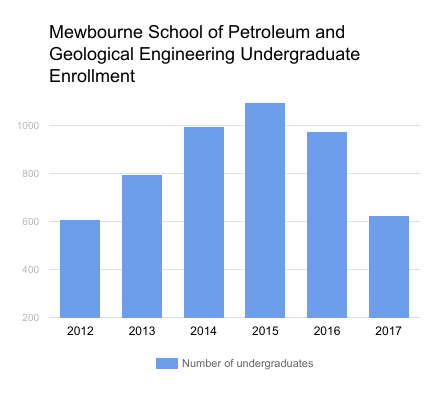
Trends in the industry are reflected by lower enrollment numbers in the Mewbourne School of Petroleum and Geological Engineering, said Chandra Rai, the school’s director.
“When people were hearing that industry is booming, lot of jobs, very highly paid jobs, people were just driven,” Rai said. “And now when they’re hearing that the industry is suffering because of the low commodity price, people are choosing other fields.”
Source: OU Factbook
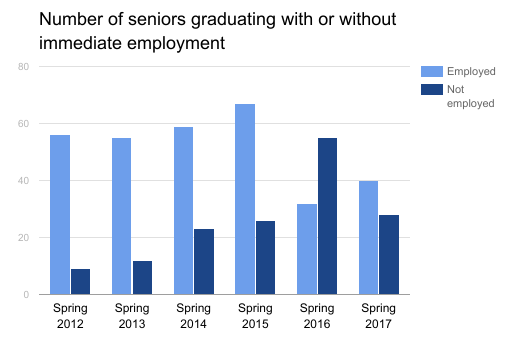
During times of hardship in the industry, graduating seniors also face unfavorable job placement rates.
With a rapidly approaching May graduation date, Saylor has yet to land the petroleum engineering job he expected to when he chose the major.
“If you’re doing oil and gas, it’s kind of like, OK, do you get lucky and get out at the height of things when everyone has a job?” Saylor said. “Or do you get out whenever things are kind of down in the dumps and it’s just kind of weathering the cycle?”
The school surveyed 90 of its graduating seniors in a recent poll, and 44.44 percent of those seniors reported having a job lined up post-graduation. In spring 2016, 29 percent of graduating seniors polled reported that they found immediate employment post-graduation, a significant drop from the 65 percent who reported graduating with a job lined up in spring 2015.
Source: The Mewbourne College of Earth and Energy
After a fruitless job search in the field of petroleum engineering, Saylor has begun applying for data science and analytics jobs, which would allow him to use the same quantitative skills he learned as an engineering student.
“It’s kind of a bummer graduating and not having a job, but at the same time, it’s kind of encouraging to see there are other opportunities outside of just doing oil and gas,” Saylor said.
This slump in the industry is nothing new. Rai said he has experienced the industry endure at least five ups and downs since 1980.
“This is not something which has come for the first time,” Rai said. “And it’s not going to be for the last time. That’s the nature of business when your students work in an industry which is commodity, price-driven.”
Despite low job placement rates and enrollment numbers, the school continues to teach and advise students on how best to handle the circumstances, Rai said.
“The only thing we can do is advise the student (the) best possible way we know how to find a job — in terms of interview skills, in terms of how to look for jobs, where to look for jobs,” Rai said.
While many struggle to find jobs in the difficult market, there are still those who have been able to find employment. Christopher Shea, petroleum engineering senior, accepted a full-time job with drilling company Helmerich & Payne Inc. post-graduation, but he said the process was not as easy as it had been in years past.
“It used to be that you show up to the career fair with your resume and you hand it to a couple people and you get an interview and you get a job,” Shea said. “And it is not that way anymore. I’ve probably put in as much time in the job search and in the internship search as I have for any of the hardest classes I’ve had any semester.”
Shea said the price of oil collapsed shortly after he started his freshman year as a petroleum engineering student, but he decided to stick with it because he knew it would eventually bounce back.
“As long as you weather through it, there’s always an upturn somewhere,” Shea said. “Nobody’s really hanging onto a sinking ship or anything; it comes back every time.”
Shea said there are signs that the industry is rebounding now, such as increased drilling, land acquisition for oil sites and higher drilling rig counts.
“We hit the lowest of the low last year, so there’s been a slow but steady climb up from there,” Shea said.
Rai also said he thinks the industry is making a comeback, which will benefit younger and incoming students.
“For anyone who is still junior, I think the prospect of jobs and everything getting out will be far better than what it is today,” Rai said. “For freshmen, I think it will be very, very good, because I think industry will come back — it is already showing signs of coming back.”
And despite his own lack of employment, Saylor said he and others in his position remain optimistic about the future and other opportunities outside of the industry.
“You kind of sign up for it whenever you get into the major,” Saylor said. “You know it’s ultimately going to be an industry that you’re not in control of ... so it’s kind of like a roller coaster ride. You just sign up for it, and you’re in it through the ups and downs and just get to hold on through the entire thing and see how it goes."


