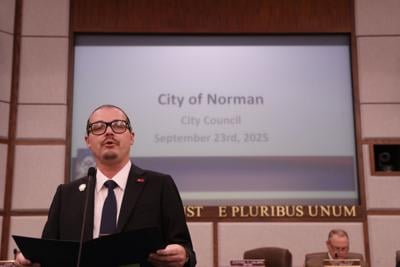


Norman City Council approved the proposed 2026-27 fiscal year budget Tuesday as the city experiences stagnant sales tax revenue.
Council approved the budget 8-1, with Ward 5 Councilmember Trey Kirby voting against. According to Clint Mercer, city of Norman finance director, the budget totals $271,830,663, a decrease of about $2.8 million from the 2025-26 budget and $1.2 million from the 2024-25 budget. The budget will be in place from July 1 to June 30, 2027. According to the city’s preliminary budget book, the decrease in funds is attributed to flat revenue growth in sales taxes, the city's largest revenue source. During the last five fiscal years, sales tax revenue has been stagnant or negative.
Mayor Stephen Tyler Holman stressed that the city’s budget relies almost entirely on sales tax, a structure he said is unique to Oklahoma.
“We are still the only state in the country … where state law mandates that cities operate on sales tax revenue for police and fire and all of these essential services that we provide. We do not get property tax for operations,” Holman said. “It really does matter where you spend your dollars.”
Holman said cities like Moore can collect sales tax from Norman residents without providing them police or fire protection.
City Manager Darrel Pyle noted that online shopping also affects revenue.
“Every time you buy something online and it gets delivered to your home, your home is considered the point of sale,” Pyle said. “If you like Costco in Moore, just shop online, have them deliver to your house in Norman. Norman wins.”
In January 2025, Anthony Francisco, former city finance director, said Norman’s expenditures were growing faster than its revenue, and the city would experience a negative fund balance if the trend persisted, which is illegal according to Oklahoma state law.
In April, Mercer told OU Daily if revenue continues to trend downwards, the city will have to make changes.
“We (will) have to tighten our belt and take steps to curve back because we're not going to get the sales taxes that we budgeted,” Mercer said. “We have to take care of the revenues that aren't going to come in.”
Projected revenue and expenditures
The increasing costs of employee healthcare and city projects have added to the city’s expenditures, according to the city manager’s letter in the budget book.
In June, Mercer told the Daily the city took measures to avoid a negative fund balance.
“We did not include any cost of living raises or merit raises, which was a big, big one,” Mercer said. “We held the line on, kind of, the expanding new functions or anything new like that.”
Numbers according to the budget book are listed below.
Revenue: $301,846,410, with general sales tax and user fees and charges providing the two largest shares at a combined 56.7% of all revenue.
Expenditures: $302,902,890, with the largest expenditure being public safety — which includes police and fire departments — accounting for 22.7% of the total. This number is a 0.9% decrease from the 2025-26 budget and a 1.1% increase from the 2024-25 budget.
Expenditures are $1,056,480 over revenue in the budget.
Police department: The largest expenditure in the city's general fund, which is the general operating fund used to account for all of the city’s financial resources, is the police department, totaling $30,725,088, or 27.4% of the budget. This percentage is a 0.6% decrease from the 2025-26 budget and a 1.6% decrease from the 2024-25 budget.
Expenditures in the police department go toward salaries and benefits, supplies and materials, services and maintenance, internal services and capital development. Salaries and benefits make up most of the expenditures.
Public works: Public works costs are the second largest expenditure in the general fund at $22,727,651, accounting for 20.3% of the fund’s expenditures, a 1% increase from 2025-26 and a 0.3% increase from 2024-25. The public works department manages transit, stormwater, street maintenance and the city’s equipment fleet. In June, Mercer told OU Daily the city creates a budget reserve so departments in the general fund don’t have to make significant changes as expenditures fluctuate by year.
“We count on those reserves, and then we also just use management policies. Like if there's attrition, we might leave a position open for some time,” Mercer said.
Sales tax revenue amid SEC move, graduation season
SEC vs. Big 12: In March, public sales tax receipts showed an increase in sales tax revenue following OU’s move to the Southeastern Conference. Norman brought in between roughly $7.8 to $9 million each month during OU’s first two years in the SEC compared to roughly $7 to $8.2 million each month during 2023, the school’s last season in the Big 12.
Playoff game: OU’s December football playoff game was the main contributor in the 13.61% increase in sales tax revenue compared to December 2024.
May graduation season: OU’s second-to-last Big 12 graduation season in May 2023 generated $8,418,787 in sales tax revenue, while the university’s last Big 12 graduation season in May 2024 generated $8,189,601. The two graduations outweigh OU’s first SEC graduation season, generating $7,799,835, by a combined $1,008,718.
This story was edited by Reagan Rozzi and Audrey McClour. Tori Pham copy edited this story.


